

Every year, I labor over a homemade cake for my son's birthday. Last year, he asked for a donut cake. So I made one — four layers, from-scratch butter cake, homemade frosting, the works. Then I drove to Krispy Kreme, bought a box of glazed donuts, and arranged them on top and around the sides, skewered into place so they wouldn't slide.
At the party, the kids went straight for the donuts. Not one of them touched the cake the donuts were sitting on. (The adults, who had some idea what goes into four layers from scratch, were a bit more discerning.)
I've been thinking about that cake while working on this 3-part series, because it's kind of where retail media sits inside the modern retailer. The flashy, fun part — the donuts — is what everyone reaches for. But it's propped up on a foundation that took all the actual work, and most people at the party don't appreciate it. This week's demon is about what happens when the donuts start carrying the cake.
This is the second in my three-part series with Anne Hallock, VP of Americas at Mirakl Ads, on the demons inside retail media — the internal, structural threats she argues are more dangerous in 2026 than anything happening in the market outside. Last week was the growth demon: the top-line scorecard that's started to mislead the industry. This week, the silo.
This series is sponsored by Mirakl Ads.
The bolt-on has better infrastructure than the building
Retail media was built as an ad-sales function. Separate team, separate P&L, often walled off from merchandising, marketing, and finance.
As a bolt-on, that made sense — you stand up a new revenue line, you give it room to grow, you don't entangle it with everything else on day one.
But there's been somewhat of a pivot recently. The retail media arm is now frequently the most modern, most tech-forward part of the whole company. Anne traces it to a simple funding asymmetry. Retail media is a profit center, so it can afford to keep a current tech stack. Marketing, classically, can't. She spent almost 20 years in marketing before moving into tech and sales, and she likes to joke that marketers are "really good at spending money but not very good at making money."
Marketing is a cost center, which means the technology underneath it tends to be the legacy piece holding the organization back.
So the media business ends up doing something it was never scoped to do. As Anne puts it, the retail media arm has created a second flywheel — putting customer data to work across all the retailer's touchpoints, not just on behalf of its suppliers, but on behalf of the retailer's own business. That's a much bigger job than selling ads. And it's why the newest part of the company keeps getting asked to serve everyone else.
"Mad tech"
This was the throughline at The Drum's Commerce Media Forum in Miami, where Anne hosted a couple of round tables. The room of around 60 people — leadership at the brand level, the technology level, and retail media leaders, many of them being competitors.
A term surfaced in those sessions that she's been turning over since. Someone started describing the convergence of marketing technology and advertising technology as "mad tech." The label is cute, but the thing it points at is real: the marketing stack and the ad stack are collapsing into each other, and the ad side is usually the one with the money to fund it.
You could see the same convergence in how some of these leaders are talking about the scope of their businesses. Lisa Valentino shared in a separate session how she's trying to shake off the "retail media" moniker in favor of something more expansive and foundational: "I literally just sent out the memo last week, we're not an RMN," she said on a panel at ADWEEK House at Possible. "We're a commerce platform."
Because the Best Buy ads business has had to keep a very modern tech stack, and because it's a profit center, it's been able to fund the next-generation, bleeding-edge technology. The profit center funds the future while the cost center waits its turn.
You can't just "go do that thing"
This started to sound like a decision somebody made, that retial media would become somewhat of an innovation center inside a retailer.
I asked Anne whether RMNs are actually being asked to unify all of this — or whether someone walks in tasked with "go make money from this," surveys the disheveled state of play, and realizes there's no one else to do it. Siloed customer data, legacy tech, businesses stitched together through acquisition. Is the scale of that challenge understood internally, or is the prevailing attitude "come on, it's just an ad, plop it on a website"?
Anne's answer started, of all places, at Clorox. Early in her career on the client side, the marcom team sat on a different floor than the brand team — physically separated — and the media team sat apart from the digital team. "That makes me old," she said. But the point isn't nostalgia. People inside tech companies, especially high-growth ones smaller than a Macy's, tend to have a fantasy of "well, why don't you just go do that thing?" — and you have to explain that the person who'd do it doesn't even sit in the same building as the other person.
A lot of it comes down to the specialization of talent: you end up sitting somewhere very specific and getting very good at something very specific. Then a leader arrives who wants to be transitional, who wants those capabilities brought together — and it isn't simple, because you have to cultivate the talent alongside the systems you're being asked to merge. The leaders who pull it off, in her read, tend to be utility players — option-quarterback types who can come in and understand how to both run the ball and pass it. So when she says the shift is technology-led, she means it's led by the specific people whose skill set lets them straddle the silos in the first place.
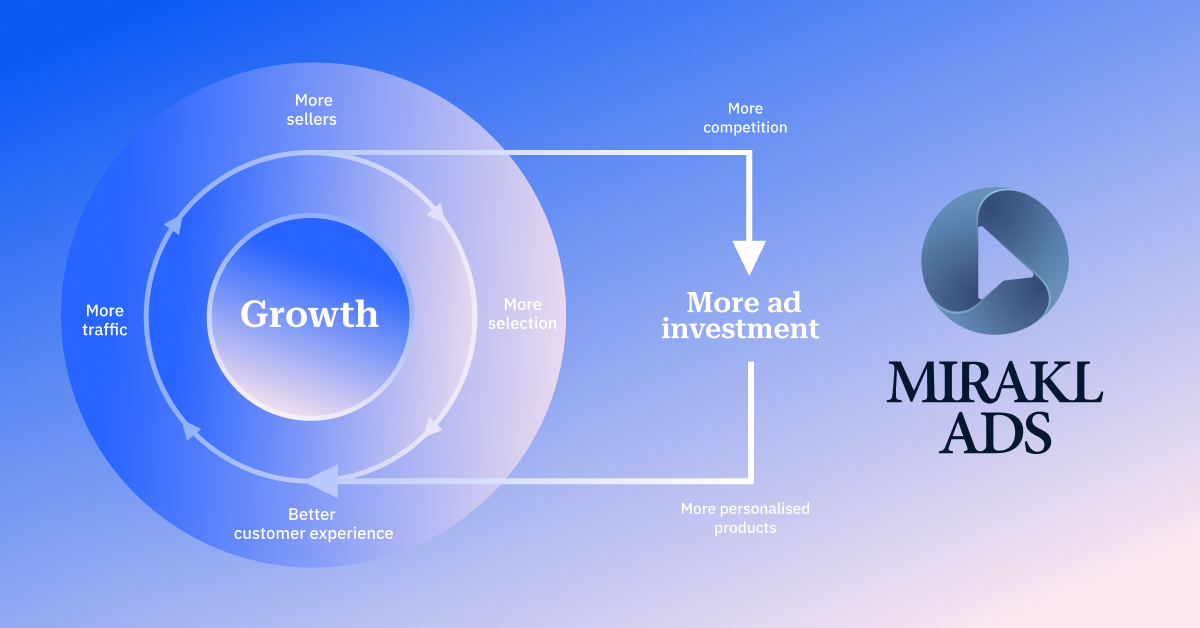
Retailers know that a marketplace model can dramatically boost product assortment, shopper engagement, and total revenue. But, to get the most out of your marketplace, you need an ad tech solution that can really engage sellers. Mirakl Ads is powering the future of retail media for leading retailers — to activate both 3P sellers and 1P brands.
The first move out of the silo
I put Anne back in a retail media leader's hat: you're trying to break out of the ad-sales silo. What's the first move?
She reached for a framing from her former colleague Drew Cashmore. The first wave of RMNs put their hand out, got a bunch of money, and then plateaued — and the question becomes how you jumpstart out of that plateau into meaningful growth again. (Regular readers will recognize this as a close cousin of the retail media doom loop I've written about before.)
What's changed, she argues, is interoperability. The technology partners have decided to be more interoperable in a way they hadn't even a year ago; Andrew Lipsman flagged this last summer around the Uber–Instacart announcement, where competitors partnered to get something right. So she'd look for the most interoperable partners — the ones who won't throttle her demand when she's the one generating it.
Then there's the shape of the revenue itself. Most of a retailer's revenue is recognized in the second half of the year — it's why we see those offset fiscal years. The trap is lumpiness: still doing joint business planning with insertion-order-shaped deals for your tier-one suppliers. The move she's describing is lowering that volatility — getting funded through the year from the torso and tail, because you've built a tech stack that can activate those advertisers without a high cost to serve. Which is, not coincidentally, the Mirakl pitch. But it's also just the logic of the silo problem turned into a revenue strategy: the infrastructure that serves the whole business is the same infrastructure that smooths the revenue line.
Now What
The silo demon is sneaky because the original structure was correct. Standing retail media up as its own ad-sales function is exactly how you get one of these businesses off the ground. The trouble is the structure outlived its usefulness and nobody noticed, because the walls that once protected a fragile new business are now keeping the most capable infrastructure in the company from serving the rest of it.
Anne framed this as a "second flywheel" — the media arm as a way to put customer data to work for the whole retailer, not just its suppliers. That's a far bigger mandate than selling ads, and it explains why the people who break out of the silo tend to be the generalists rather than the specialists the org spent years cultivating.
But it's not all sunshine and rainbows for RMN leaders. When the media business becomes the reason the company finally fixes its infrastructure, it often generates value it doesn't get to keep — the profit flows back to the broader business, even though the RMN did the work. I suspect it's where a lot of the internal friction is going to surface over the next year or two.
It also sets up the third and final demon. Everyone wants the AI upside — agentic commerce, LLM-driven discovery, the whole pitch. That upside sits on top of foundational, unglamorous data work that nobody wants to fund. Next week: the shortcut.
If you enjoyed this no-holds-barred conversation, join me, Anne and RMN leaders from Costco, Halford's, and CVS at our IRL Breakfast Club at Cannes! June 25, from 9AM. Apply to attend here
This 3-part series is sponsored by Mirakl Ads.