"The trade dollar, shopper marketing dollars — they're tapped out. If you go any deeper, the retailer itself could start losing leverage on cost of goods."
That's Katherine Mazza, the recently appointed Chief Growth Officer at Barrows Connected Store, on a recent episode of the OmniTalk podcast with Chris Walton. She's run retail media at DICK'S Sporting Goods and Hy-Vee, and now sits on the tech side. So she's seen this from both the buy side and the build side.
On this episode, Chris asked Katherine to comment on some recent announcements from Dollar General Media Network. And Katherine made a couple of particularly compelling points about where retail media’s next phase of growth is likely to come from.
The Case For A Unified Buying Surface
A few weeks ago, Dollar General rolled out an expansion of its AI-powered in-store audio network with QSIC, then a first-of-its-kind unified on-site and off-site offering with Kevel and The Trade Desk.
Mazza says of DGMN’s hot streak of announcements in recent months that all the upgrades are in likely pursuit of the new holy grail for RMNs: the brand marketing budget.
“The trade dollar, shopper marketing dollars, they're tapped out,” she said on the podcast. “If you go any deeper, the retailer itself could start losing leverage of cost of goods.”

Did you know leading retailer media networks drive 85% of their ads revenue through mid- and long-tail advertisers?
Mirakl Ads provides full funnel ad formats tailored to both 1P and 3P advertisers, leveraging unique AI-capabilities that provide unprecedented levels of relevance and engagement.
Retailers who want to capture ad spend from the long tail of 3P marketplace sellers use Mirakl Ads in their tech stack.
What she means is that if RMN leaders pull harder on the lever of existing trade and shopper dollars, they won’t be winning any incremental revenue, and in fact might be picking a fight with their own merchant team over those funds.
She also says its smart for DG to tie in the off-site, on-site and in-store media buying opportunities and connect them.
“What that's gonna do is it's going to make it a lot easier now for media buyers and for holdco [agencies] to go in and run campaigns. The fact that it's all going to be unified through the media buying, through trafficking, and through the reporting is great.”
Mazza says that the effort involved behind the scenes to get the Trade Desk piped in with Kevel, and then the brand's first-party data to build the audiences, and then in-store in the QSIC platform, would have been substantial.
The Ideal Sequence
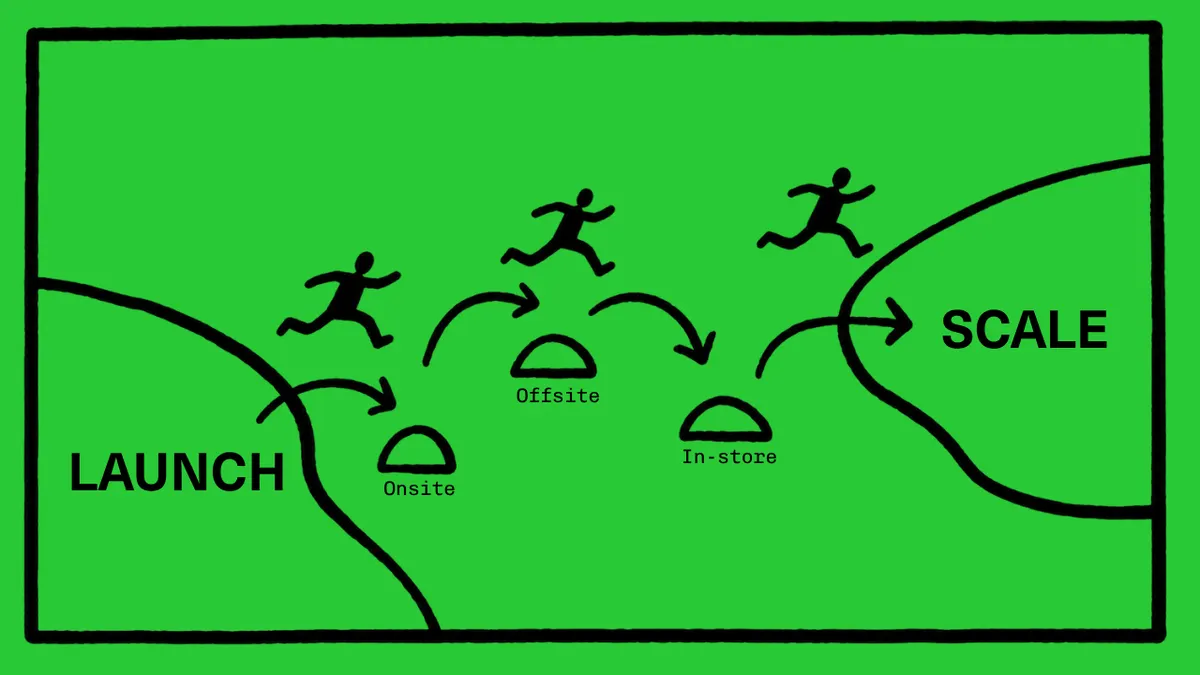
Mazza's view: build out the high-margin ad products on your owned and operated platforms before you go off-site. In her book, Dollar General did this in the right order. A solid on-site platform with sponsored product ads. In-store coming online now. Off-site added last, once the rest is working and there's a national-scale audience to sell.
Off-site might look like the prize from the outside — it's where bigger brand budgets live, it's how you compete with the open web. But off-site is also where you share economics with the DSP, the agency, and the measurement partners. The margins are far thinner.
Owned and operated surfaces is the opposite. Sponsored products on your own site? You keep significantly more of the dollar. In-store screens and audio? You control the environment, inventory, and measurement approach.
So the right sequence according to Mazza is to get onsite tight first, then in-store, where you control everything. Only then does off-site make economic sense — because by that point, you have a full-funnel story to sell agencies, and the off-site dollars don't have to carry the whole P&L.
Now What
The subtext here from Mazza (or at least my interpretation) is that many retailers have tried to jump ahead in the sequence, launching off-site before sponsored products were really working.
It’s also true that retailers should lean into their strengths. The revenue mix of onsite to offsite to in-store will likely look differently by retailer. And while there might be an ‘ideal’ order, often RMNs are hamstrung by the underlying data foundations that the core retail business is built on.
Some are leaning into off-site now because it's where brand dollars are most visibly flowing — without the on-site and in-store layers that would make the off-site pitch credible. The result is a lot of networks competing for brand budgets with half a stack.
The trap is to keep pulling harder on a trade budget that, as Mazza put it, is already tapped out.
You can listen to the full OmniTalk podcast episode with Chris Walton and Katherine Mazza.
Where to find me next!
Xnurta Signal To Scale - Chicago, May 19
I’m keynoting Xnurta’s summit next week in Chicago. Register here
P2PI Retail Media Summit - Chicago, June 2-4
I’m leading a closed workshop for P2PI’s retail media Guild members. More info here
Mirakl OutPace Summit - New York, June 10
I’ll be on the ground doing panels, round-tables, and more. Register here
Cannes
Lots of stuff coming up at Cannes! For now here’s a few highlights:
- Women In Commerce Collective Morning Hike
- Retail Media Couple’s Therapy — my brainchild I’m so happy is finally coming to life! Request a spot here
- Retail media celebrity deathmatch — I debate fellow industry analysts Colin Lewis & Andrew Lipsman, and I don’t fight fair. Request a spot