
RETAIL MEDIA BREAKFAST CLUB
Today I’m re-hashing an article posted to my column at The Drum last week, about how the most mature retail media ad networks are staying ahead of the pack.
Amazon’s philosophy to ad coverage seems to echo the words of Miss Piggy: “too much is never enough,” and while some customers complain about the velocity of ads, the ecommerce giant continues to grow its ad revenue.
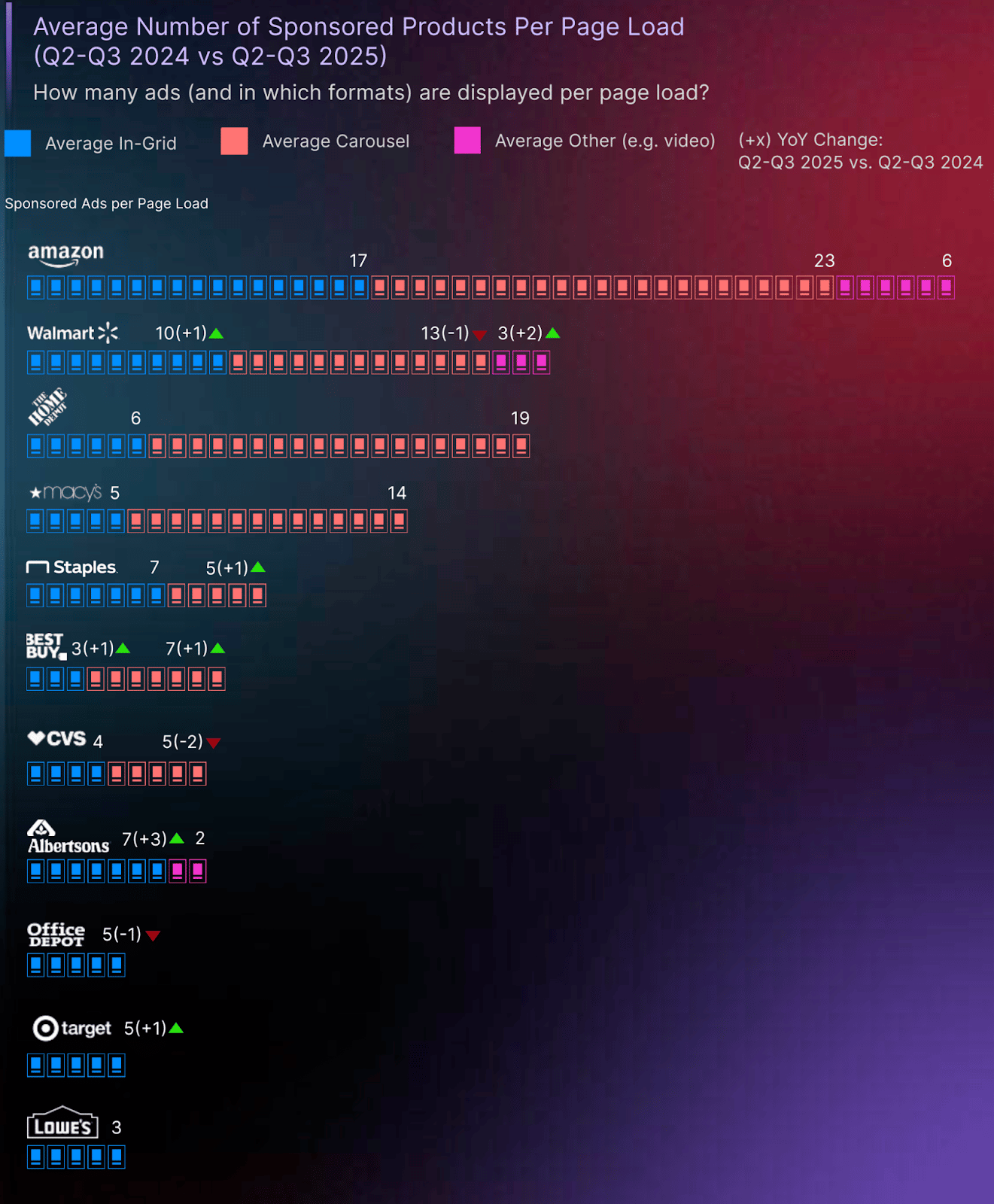
If you've searched for anything on Amazon lately, you've probably noticed: ads are everywhere. Logic would suggest that ad saturation destroys the shopping experience and causes shoppers to abandon it. But new research from retail media tech provider Pentaleap shows Amazon now serves an average of 25+ sponsored products per page load.
For context, Walmart sits at roughly 15-16 sponsored products per page, while Home Depot manages around 13.
Most mid-tier retailers have ads that fire on 40-70% of searches. Amazon has near-universal coverage, with 99% of searches prompting sponsored placements. This is a retail media surface operating at maximum capacity.
If Amazon can show this many ads without killing the golden goose of consumer demand, why can't everyone else? And what does this tell us about where retail media is headed?
SPONSOR: MIRAKL ADS
Did you know leading retailer media networks drive 85% of their ads revenue through mid- and long-tail advertisers?
Mirakl Ads provides full funnel ad formats tailored to both 1P and 3P advertisers, leveraging unique AI-capabilities that provide unprecedented levels of relevance and engagement.
Retailers who want to capture ad spend from the long tail of 3P marketplace sellers use Mirakl Ads in their tech stack.
The Density Plateau
Amazon's ad load has remained remarkably stable year-over-year, shifting only in decimal points. According to Pentaleap's benchmarking data, this indicates we're witnessing what a fully monetized retail media surface actually looks like. There's simply nowhere left to add more traditional sponsored product placements.
Andreas Reiffen, chief executive of Pentaleap, told me in an earlier interview that this density only works when sponsored products maintain relevance parity with organic listings. "If you go from zero ads to 10 sponsored products on a page and you track both the margin from your retail business and the margin from your ad sales—and in the scenario with 10 ads you make more money—that indicates you're doing the right thing," he explained. (Disclaimer, Pentaleap is a client of mine.)
It isn’t enough to just measure ad volume. Click-through rate counts too. When sponsored products achieve CTR comparable to organic results, high density becomes sustainable. When they don't, the entire model collapses.
The Long-Tail Test
Amazon doesn’t just show more ads per page than competitors— it also maintains coverage across complex searches. Pentaleap's research reveals that Amazon and Walmart are the only two retailers maintaining high sponsored product coverage on three- and four-word queries, where most networks see coverage collapse.
This technical sophistication matters. Long-tail searches typically indicate higher purchase intent. A shopper searching for "wireless noise cancelling headphones under $200" is closer to conversion than someone typing "headphones." If your ad tech can't match relevant products to complex queries, you're missing the highest-value advertising opportunities.
The difference comes down to targeting methodology. Retailers offering both keyword-based bidding (where advertisers choose specific terms) and product-based bidding (where the retailer determines placement based on campaign objectives) can maintain coverage across simple and complex searches alike. Those with less sophisticated systems see sponsored product coverage drop off dramatically as query complexity increases.
This technical gap creates what I have called a doom loop for mid-tier networks: without sophisticated matching, ads become less relevant, CTR drops, and retailers face pressure to either reduce ad load (sacrificing revenue) or maintain density despite poor performance (degrading user experience). Amazon avoided this trap by investing early and heavily in ad tech infrastructure.
Format Diversity Over Brute Force
Amazon's path to 25 ads per page didn't come from simply stuffing more tiles above the fold. It came from adding new surfaces for advertisers, like product carousels, brand carousels, and video placements throughout the shopping journey. This format diversity allows Amazon to introduce incremental inventory without overwhelming the shopper.
But more formats also create a harder problem: keeping relevance high when ads can come from anywhere.
That’s the real point of Amazon’s unified campaign manager which the company revealed at Unboxed a few weeks ago. By collapsing Sponsored Ads and DSP into one system with shared signals, Amazon can make smarter decisions about which format to serve and where to place it. The experience on the page stays coherent to the customer, even when there’s extremely high ad density.
The simplicity of Amazon’s new media buying system is an important factor. At Unboxed, multiple agency executives told me that Amazon's advertising console remains markedly more accessible than competing DSPs like Google DV360 or The Trade Desk. This simplicity allows Amazon to tap budgets from advertisers of all sophistication levels, from enterprise brands with dedicated teams to small businesses running their first digital campaigns.
Ash McMullen, head of ecommerce at skincare brand Advantice Health, told me: "Meta has grown significantly and gotten more complicated. Google has grown significantly and gotten more complicated. Amazon has grown—and they're simplifying it."
The Economics of Abundant Inventory
Amazon's high ad density creates a counterintuitive economic effect: more supply moderates CPC inflation.
Skai’s Q3 2025 data backs this up: Amazon’s ad spend and clicks each jumped 23% year-over-year, yet CPCs nudged up just 1% over the same period. Sponsored Products rose only 2%, Sponsored Brands stayed flat, and Sponsored Display CPCs actually fell 30%. This isn’t what a constrained auction looks like—it’s the signature of a platform absorbing demand by expanding supply.
This mirrors what other ad platforms like Google have achieved: by consistently expanding available ad space on results pages, Google created surplus inventory that moderated price increases while driving overall revenue growth through volume.
Amazon's CPCs have risen year-over-year, but far less dramatically than they would have if inventory remained constrained. By expanding coverage, placement density, and format diversity, Amazon built a marketplace where ad supply absorbs rising demand.
For other retailers watching Amazon's success, this creates an uncomfortable choice. Most entered retail media with expectations of 70-80% profit margins on sponsored products—margins that require constrained inventory and high CPCs. Amazon proved you can make more total revenue with abundant inventory and moderate pricing, but that requires technical sophistication most retailers lack.
This dynamic explains why Amazon continues dominating retail media despite hundreds of competitors. The company commands 75% of US retail media spend not just through marketplace scale, but through advertising infrastructure that enables monetization other retailers can't match.
What This Means for Everyone Else
For retailers still scaling sponsored product coverage—Best Buy at 68%, Staples at 49%, Macy's at 73%—Amazon's saturation offers both blueprint and warning. The blueprint: high density works if relevance holds. The warning: you need sophisticated ad tech to maintain relevance at scale.
Kroger made notable progress in Pentaleap's latest benchmark, jumping from 41% to 55% coverage—signaling focused investment in retail media capabilities within grocery. CVS and Lowe's each reached 50% thresholds. But all remain far from Amazon's full saturation.
For brands and agencies navigating this landscape, it’s long been obvious that Amazon isn't going to reduce ad inventory. If anything, we can expect more formats and ad types as the company pursues new surfaces and placements.
Is the Amazon playbook within reach to other retailers? Amazon's combination of marketplace scale, technical investment, and first-mover advantage creates a competitive fortress. The most legible takeaway might be that there’s no hard upper limit on ad load.
Twenty-five ads per page would have broken most retail experiences. On Amazon, it's just a regular Tuesday.