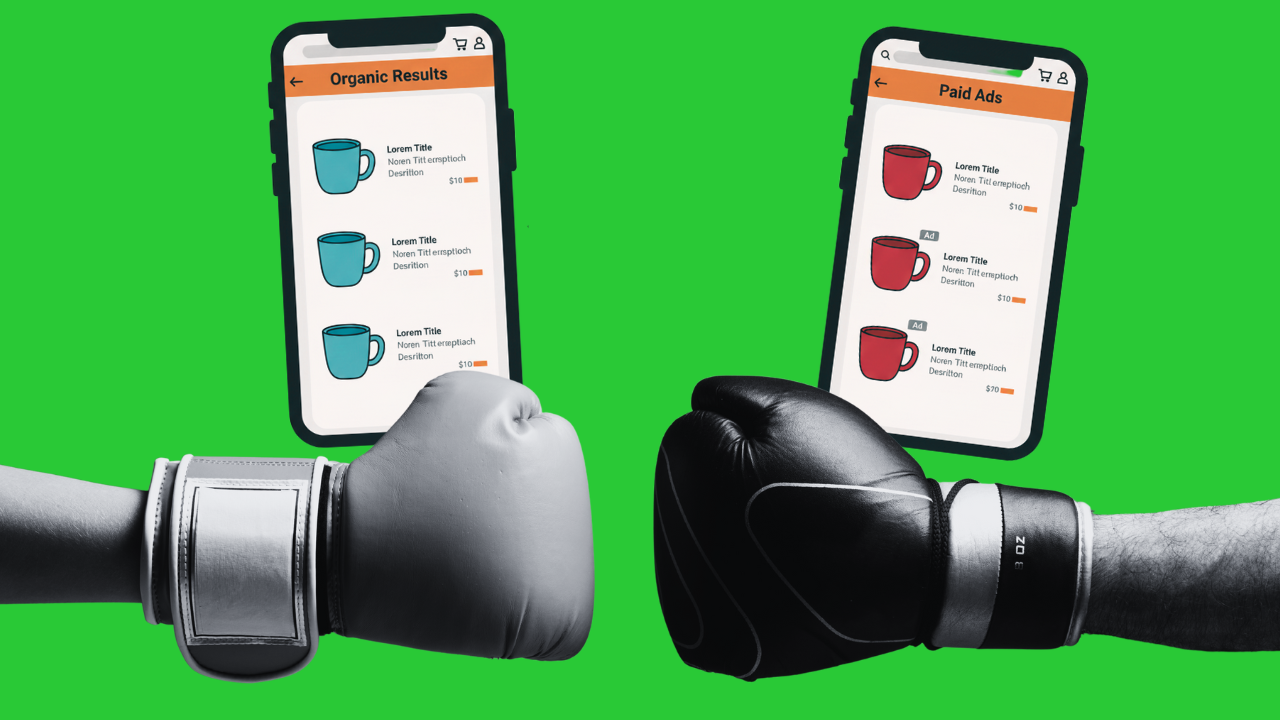
Retail media teams want to fill every ad slot. Merchant teams want to sell products. At most retailers, these goals are at war with each other—and shoppers are caught in the crossfire.
"Show me the incentive and I'll show you the outcome," Charlie Munger once said. When one team gets paid to fill slots and another gets paid to sell products, you get exactly what you'd expect: mediocre sponsored products clogging search results while relevant products get buried.
Amazon runs 25+ sponsored products per page with 99% search coverage, yet engagement holds steady and conversion rates stay strong. They've merged sponsored and organic ranking into a single relevance engine that optimizes for total margin—retail revenue plus ad revenue combined—rather than forcing teams to compete.
Most retail media networks haven't made that shift. They're still building ad servers that operate in total isolation from the search technology that's been perfecting product discovery for years. But Pentaleap's H225 Sponsored Products Benchmark, released last month, shows cracks in the old model. Retailers are starting to adopt "fluid" ad formats that integrate sponsored products dynamically rather than treating organic and paid as church and state.
SPONSOR: MIRAKL ADS

Mirakl Ads is the only retail media solution designed for both 1P & 3P marketplace brands. Why does that matter?
Marketplace sellers demand a seamless advertiser experience that still offers full-funnel ad formats. And retailers need a flexible solution that allows you to scale your media business.
Onsite Search Already Solved This
Here's what Andreas Reiffen, CEO of Pentaleap, told me during our livestream last week: "We think of retail media ad serving versus onsite search as two totally different things. They are not. They're both about understanding queries and relevant products and sorting things in a way that brings money in."
Andreas pointed out that Companies like Algolia, Coveo, and Bloomreach have spent 10+ years building sophisticated algorithms that figure out which products are relevant for which query. That's their entire job: matching shopper intent to product catalog at scale.
Then retail media arrived. Instead of building on this foundation, most networks created separate systems with their own relevance scoring, their own keyword matching, their own bidding logic—operating in complete isolation from the organic search technology already running on the site.
That resulted in a disconnect between organic relevance (powered by high-end AI and years of refinement) and paid relevance (powered by basic algorithms that retail media vendors claim are high-end AI, but testing proves otherwise).
The Fifth Avenue Problem
This legacy approach treats sponsored products like a separate inventory pool. Retailers reserve specific carousel positions and grid tiles exclusively for ads, then fill them with whatever demand exists. If you have 10 reserved slots but only one truly relevant sponsored product, you're stuck choosing between showing nine mediocre ads or leaving big bucks on the table.
Andreas said it's like running a store on Fifth Avenue and putting your slow sellers into the store window.

Pentaleap's research shows retailers still using fixed placement strategies are leaving massive performance gaps. Office Depot shows low overall coverage (24%) with sporadic placement patterns. CVS sits at 48% coverage despite being a major retailer. These networks have demand—they just can't match it to shoppers as effectively.
Fluid vs Fixed Placements
The better approach treats all products—sponsored and organic—as a unified inventory pool. Instead of reserving tiles, the system calculates expected margin per impression for every product and ranks accordingly.
Here's how it works: A product's ranking score combines retail margin (what you make selling it) with ad revenue (what you earn if it has a bid). Products that generate more total margin rank higher, regardless of whether that margin comes from retail or advertising. If a sponsored product isn't relevant enough to justify its position based on this combined margin calculation, it gets dropped. No fixed slots, no mandatory ad placements—just products that belong in front of this particular shopper.
Macy's provides a clear before/after. Pentaleap's data shows that over the past year, Macy's moved from heavily front-loading ads in positions 1-3 to spreading sponsored products fluidly across the entire grid (positions 5-8 now carry substantial ad coverage). This isn't about adding more ads—it's about showing them where they actually belong based on relevance and revenue potential.

Home Depot shows similar evolution. Their grid position distribution has shifted from concentrated top-of-page placements to dynamic positioning across positions 4 and 8, suggesting their algorithm is making real-time decisions about where sponsored products deliver the most value.
This Also Solves the Merchant vs. Media Problem
What strikes me about this solution is that it addresses a core friction point within retailers between their retail media team (whose incentivized to build ad revenue) and the merchant team (who’s incentivized to build product sales). In a fixed placement system, one team wins at the other's expense. The retail media team celebrates filling all 10 slots. The merchant team watches their carefully curated category pages get hijacked by irrelevant ads that tank conversion rates.
Fluid integration solves this by changing the equation. When sponsored products only appear if they're relevant enough to justify their position based on combined margin (retail + ad revenue), both teams win. The merchant team gets better overall merchandising. The retail media team captures more revenue because relevant ads convert better. The conflict disappears when the system optimizes for total margin instead of forcing a choice between product sales and ad revenue.
Now What
The good news: retailers don't need to rip out existing infrastructure. The better approach creates a unified analytical layer that connects to existing systems—onsite search on one side, retail media ad serving on the other.
But this might require retailers to admit that their retail media "AI" isn't actually AI, just basic algorithms that are cosplaying as something sophisticated. It requires giving up the illusion that ad serving is a separate business that can operate independently from how products get discovered on the site.
The retailers winning this shift are the ones who figured out that when you optimize for total margin—retail revenue plus ad revenue combined—both teams win. The merchant team gets better merchandising. The retail media team gets better performance. The shopper gets relevant results.
For brands evaluating where to spend, ask your retail partners one question: Does your sponsored product algorithm talk to your organic search algorithm, or are they running in parallel?
Amazon's 99% coverage with 25+ sponsored products per page works because relevance parity between sponsored and organic listings stays high. The moment shoppers start seeing the Fifth Avenue problem—slow sellers in the window—frustration ensues.
Most retail media networks are still running two separate businesses on the same website. The ones pulling ahead stopped treating ads as separate inventory and started treating them as products that need to earn their placement just like everything else on the shelf.
You can watch the full replay of my LinkedIn livestream with Andreas here, and you can download the H2 2025 Pentaleap Sponsored Products Benchmark report here. Pentaleap has been a client of mine in 2025.