
Benedict Evans, one of the clearest strategic thinkers in tech, doesn’t compare AI to the invention of electricity or the industrial revolution. He has a more grounded comparison: the invention of the iPhone.
Which is still a massive deal when you think about the second-order effects of that technology, the assumptions people made at the time, and what actually happened.
The lesson from that time is that you can be totally right that a technology is transformative, and still be completely wrong about who wins and where the value goes.
This same thinking matters enormously for retail media.
SPONSOR: MIRAKL ADS
Did you know leading retailer media networks drive 85% of their ads revenue through mid- and long-tail advertisers?
Mirakl Ads provides full funnel ad formats tailored to both 1P and 3P advertisers, leveraging unique AI-capabilities that provide unprecedented levels of relevance and engagement.
Retailers who want to capture ad spend from the long tail of 3P marketplace sellers use Mirakl Ads in their tech stack.
Value Capture
In a recent podcast interview on The Knowledge Project, Evans breaks down the iPhone’s real impact.
"People thought of a 'mobile use case,' assuming PCs stayed the main device. The iPhone was really a small PC (small Mac), not just a nicer phone UI. Telcos, Nokia, Microsoft all failed to capture the value; mobile replaced the PC as the center.
You can be very, very clear that this is the thing and then still be completely unclear how it's gonna work. The same thing with mobile internet... it was very clear mobile internet was going to be a thing. It was not clear that there would be basically small PCs.
That was the fundamental shift of the iPhone—it's a small Mac, it's not a phone with better UI, it's a small Mac.
And it wasn't clear that the telcos would get no value. It wasn't clear Microsoft and Nokia would get no value. It wasn't clear it would take 10 years before it took off. And it wasn't clear it would replace the PC as the center of the tech industry. I mean, everyone was talking about, well, what's a mobile use case? What would you do? You'll do some things on your mobile phone, but obviously your PC will be how you use the internet. And of course that's not how it worked."
This makes me think about how the incentives and levers that retailers, brands, consumers, and platforms have right now are at risk with a major technology shift. As usual, it is the incumbents who have the most to lose.
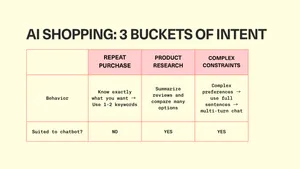
Let’s talk about retailers first. They are adding AI features to their websites—Rufus at Amazon, Sparky at Walmart—treating AI as a better interface for the same shopping journey. Meanwhile, AI platforms are working toward something different: a new starting point for commerce that could possibly replace retailer websites — at the very least, as the center of shopping discovery behaviors.
A Behavior Reset
What makes platform transitions dangerous for incumbents is when consumers reset their default behaviors, as Evans explains:
"You have this moment of discontinuity in which everybody resets their priors and reconsiders their defaults... There's a reset both of what the product is and how you sell it and your org structure around selling it.
And do you have the right politics and the right org structure to build that and the right incentives and internal conflicts. And then the consumer behavior kind of gets reset as well."
When the iPhone arrived, people didn't just get a better phone—they stopped turning on their desktop computers as often. The PC was still perfectly functional. Microsoft wasn't suddenly making worse software. But the default behavior shifted. Instead of sitting down at a desk to check email, browse the web, or look something up, people pulled out their phones.
The same dynamic threatens retail media right now. RMN revenue—particularly the onsite search and display inventory that generates the bulk of current retail media spend—depends entirely on traffic to a retailer.com. If LLMs intercept shopping queries before consumers reach Amazon, Walmart, or Target, that onsite ad inventory (and advertiser demand for it) shrinks.
Retailers will survive, of course. AI platform companies have no intention of becoming retailers themselves. But it calls into question if retail media as we currently know it, will survive.
Incumbents Default To Making New Technology A Feature
Evans has a general rule about platform shifts, which we can apply to the retail industry:
"With any of these fundamental technology changes, the incumbents always try and make it a feature and they try and absorb it.
And the same thing outside of technology. Existing companies try and absorb it and they use it to automate the stuff they're already doing. And then over time you get new stuff, you unbundle the incumbents because of something that's possible because of this new technology.
So you can always kind of jump into the new thing. And sometimes the new thing kind of really is just a feature and sometimes it's a fundamental change in how everything works."
Retailers are treating AI as a feature. They're adding chatbots to their existing websites, improving search interfaces, making recommendations smarter. But all of this assumes that the current behavior will persist: that consumers will still come to our site, and we'll just help them find things better.
But AI platforms aren't constrained by that assumption. Entirely new shopping experiences are emerging where discovery, comparison, and purchase happen without ever visiting a retailer's website.
AI shopping agents and LLM-powered product search represent genuine unbundling of the traditional retail journey, and as a result, the onsite media which comprises most of retail media spend today.
The offsite retail media business faces even greater risk, though that deserves its own analysis. When your core value proposition is "exclusive access to closed-loop purchase data," and LLMs start observing both intent and conversion across multiple retailers, that exclusivity dissolves fast. (More to come on this topic very soon.)
The Window Is Closing
Such shifts create a brief window of opportunity. Retailers have limited time to better engage consumers on-site (such as with truly smart and differentiated on-site AI assistants and experiences that are personalized and genuinely helpful) before external agents capture habit share.
If Amazon's Rufus becomes the default way consumers shop on Amazon, Amazon’s onsite and offsite revenue streams stay relatively safe. But ChatGPT becomes the default way consumers start shopping journeys, both of those revenue streams face existential pressure.
Many retailers are slapping on features to their existing business. AI platforms are building an entirely new commerce infrastructure.
We’re all watching to see just how much consumers are willing to trust fully agentic shopping, but that’s perhaps just the tip of the spear. What percentage of RMN revenue depends on behaviors that could move to LLM environments? That's the question every network should be modeling out right now.
Until tomorrow,
Kiri