
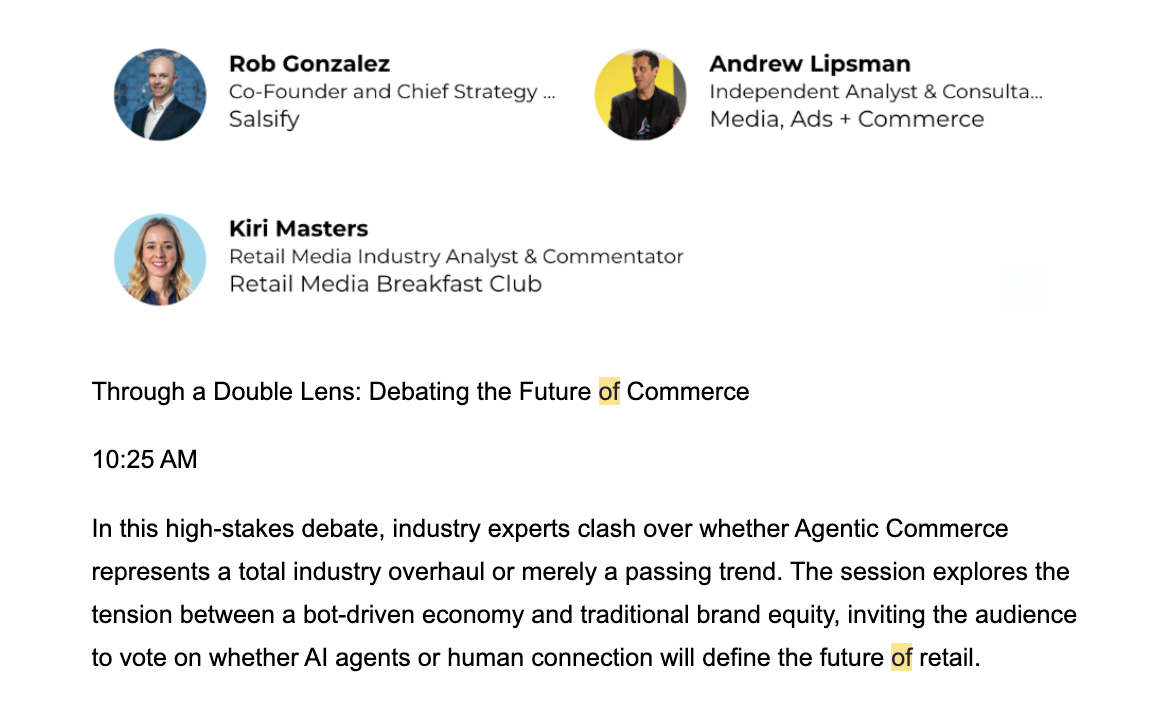
Last week I shared a stage with Andrew Lipsman and Rob Gonzalez at the Digital Shelf Summit in Atlanta. it was a debate, with the motion: Agentic commerce will be an existential crisis for ecommerce traffic. I argued the affirmative. Andrew and Rob argued the negative.
A lot of ground that Andrew covered in his talking points were covered in his guest post in Debra Aho Williamson's AI Ad Economy newsletter a couple of weeks back. I asked Debbie if I could write a response. That piece runs in her newsletter next week (and you should definitely subscribe as it’s wonderful companion reading to this one).
Today, I share the version for you.
“Agentic commerce is a collective hallucination”
For those who haven't read his piece, here's the short version. Andrew calls agentic commerce a "collective hallucination" — a story the industry has told itself into believing, fueled by conference echo chambers, consulting firm prognostications, and headline-grabbing statistics that don't survive scrutiny.
He puts three of those headlines to the test:
- Adobe's 693% YoY growth in Gen AI referral traffic during the 2025 holiday season. He compares it to Sensor Tower data and shows the growth came off a tiny base — from 0.1% to 0.6% of ecommerce traffic.
- The viral chart claiming ChatGPT is the #2 ecommerce site behind Amazon. He shows the math cherry-picked which sites to include (no Google) and that ChatGPT's actual product-oriented traffic is dwarfed by every major retailer.
- The "agentic commerce is an existential threat to RMNs" thesis (this is me he's talking about, among others). He pulls eMarketer forecasts showing commerce media ad spend will grow $48B through 2029, versus $28B in agentic ecommerce sales, and concludes that retailers should keep building RMNs and stop worrying.
His warning: don't be surprised when you get burned by belief.
I want to give Andrew his due on points 1 and 2. He's right. The Adobe number was over-indexed on. The ChatGPT chart was bad math. The industry should read more carefully.
But on point 3, he's measuring the wrong thing.
Mirakl Ads is the ad-tech solution trusted by Rakuten and 50+ global enterprise retailers.
That’s because Mirakl Ads was built with both 3P marketplace sellers and 1P suppliers in mind. Both advertiser audiences demand a seamless advertising journey from onboarding to reporting.
You can offer everything from Sponsored Products to video all in one solution.
The category error
Andrew's argument is a forecast about transaction share in 2029. The argument I've been making (in my two-part series earlier this year, in follow-up pieces, in my Drum column on OpenAI killing Instant Checkout) is about where consumers do their narrowing in 2026.
A forecast can tell you how much money will move through agentic ecommerce in three years. It can't tell you where the buying decision is being made today. And that's the part retail media's business model actually rides on.
Retail media doesn't make money from transactions. It makes money from impressions on the surfaces consumers visit on the way to a transaction.
And as it stands today, most of the ad revenue from retail media is from onsite placements: Search results pages, category browse, homepage banners. Those surfaces depend on consumers showing up to do the work of discovery, comparison, and decision-making on the retailer's site. If that work moves upstream into an AI assistant, the transactions can still close on retailer.com — and the retail media impressions still go missing.
That's the dynamic I've been writing about for a year. Andrew's argument doesn't address it because he takes umbrage at the conflation of AI-assisted shopping and full-fledged agentic commerce. I'd call that a distraction from how emerging consumer behavior could vastly reshape the economics of retail media.
The new, direct-to-PDP shopping journey
Criteo recently published their 2026 Commerce & AI Trend Report. Their top-line view — that AI is additive, that buying stays centralized at trusted retailers, that the hype overstates what's happening — reads almost like an endorsement of Andrew's piece.
But their own network data tells a sharper story.
Across roughly 500 US Criteo merchants in January and February 2026, more than 70% of LLM-referred users now land directly on product pages. In mid-2025, that figure was 50%. In roughly six months, the share of AI-referred shoppers who skip everything else on the retailer's site and go straight to the PDP went from half to more than seven in ten.
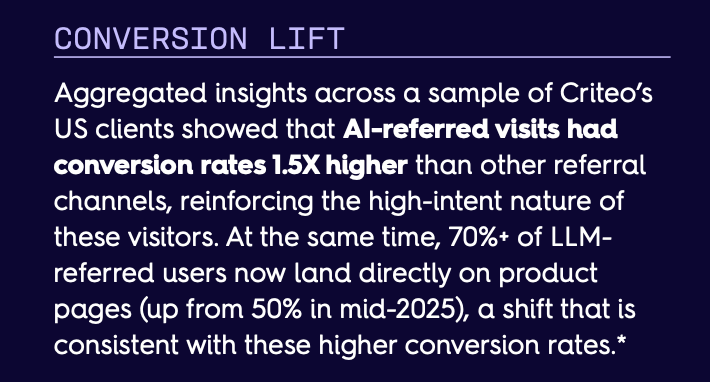
Criteo frames this as good news. Higher conversion, less friction, shoppers arriving with intent. From a pure ecommerce P&L view, that's fair.
But for retail media specifically, that pattern is the problem.
Adobe's latest Quarterly AI Traffic Report (April 2026) makes the same point from a different angle. AI-referred visitors spend 48% more time on retail sites, view 13% more pages, and convert 42% higher than non-AI traffic. At first glance, that sounds like onsite retail media is fine. Adobe — the same source Andrew leaned on for the 693% number — calls this "a structural shift in how consumers discover retail products," and notes that the post-holiday momentum confirms it isn't a seasonal blip.
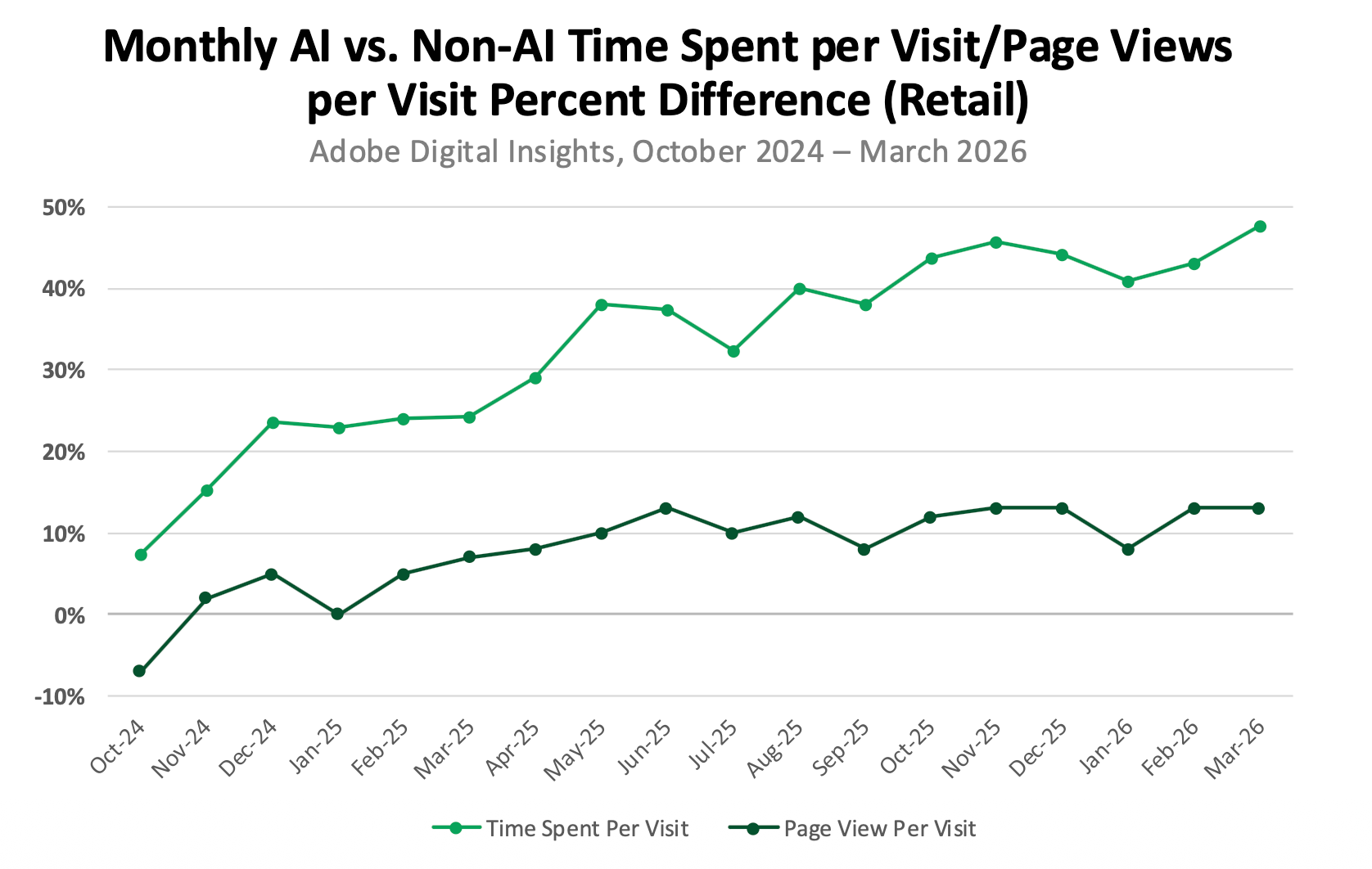
But Adobe doesn't tell you which pages.
An AI-referred shopper arrives with a shortlist. They open three PDPs to compare reviews, specs, and price. They pick one. They check out. That's 12 pages viewed, 15 minutes on site.
What they don't do is browse the category page, scroll the homepage, or click into the deals section. Those are the surfaces where onsite retail media's premium inventory lives.
This is the version of the future I've been describing:
Engagement ⬆️
But.... Onsite ad inventory & impressions ↘️
(And for the record, I don't believe that retail media is dead, but that retailers need to start developing more durable surfaces and collaborations rather than relying on the current playbook. More on that here, here and here.)
"But upstream influence isn't new"
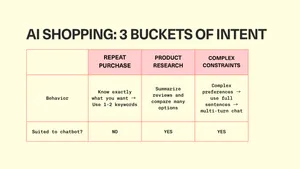
The objection I hear most when I make this argument, and one that Andrew raised on stage, goes like this: consumers have always done research before they hit a retailer site. TV, radio, social, influencers, reviews on third-party blogs. Upstream influence is as old as retail itself.
It's a fair point. But this time is different for a few reasons:
The Criteo data is what this looks like in the wild. The direct-to-PDP behavior doesn't show up for TV-influenced shoppers, or social-influenced shoppers. It's specific to AI referrals, and it's growing.
The OpenClaw signal
One more thing Andrew dismisses too quickly: the early behavior at the edges.
Andrea Leigh, an ex-Amazonian and industry advisor with three teenagers, automated her Fred Meyer shopping run with ChatGPT and a browser extension. These are hacks that early users are cobbling together, because off-the-shelf options don't really exist yet.
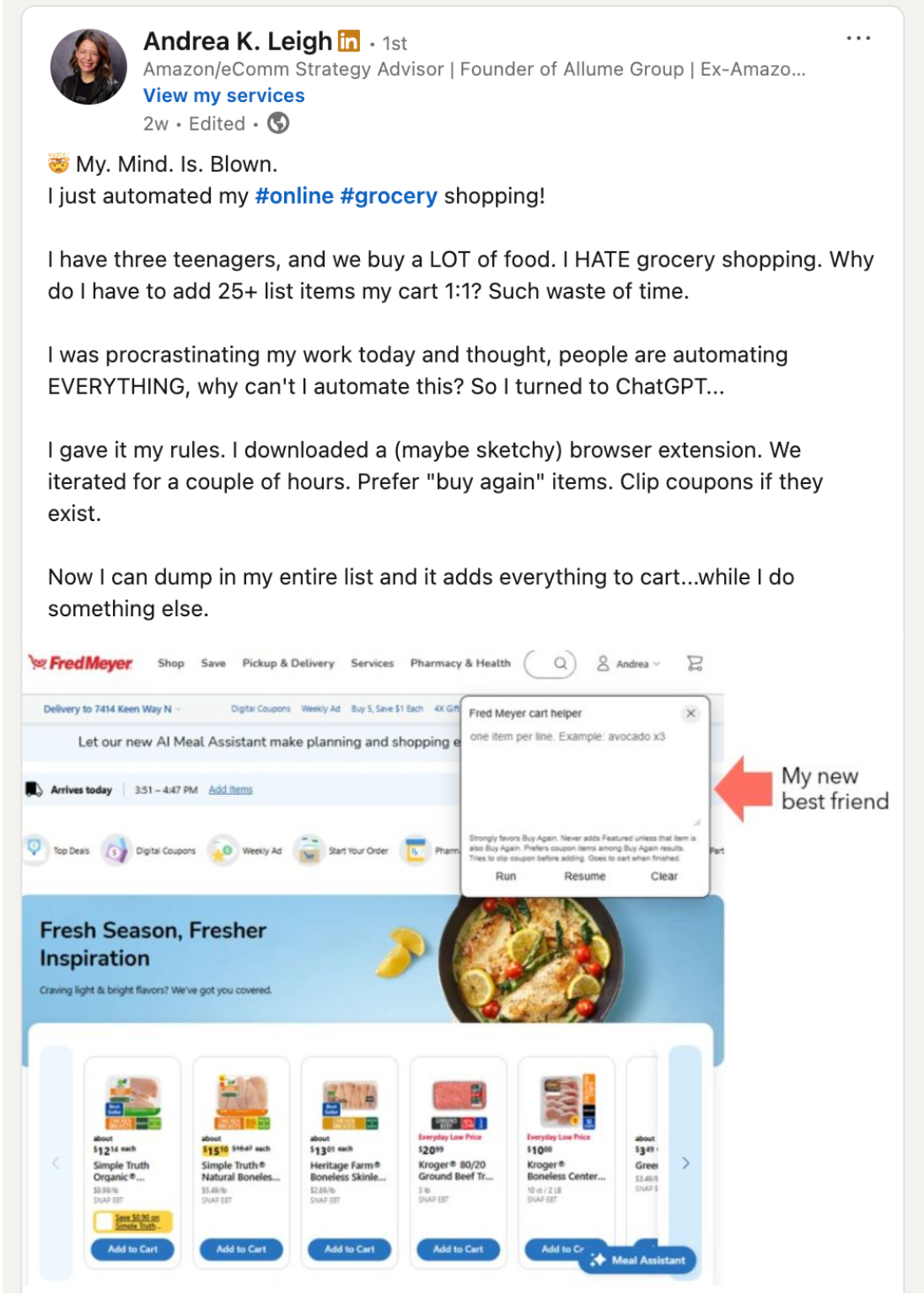
We've seen this movie. Napster wasn't a viable business model either. But it was proof that consumers want a thing that the industry hasn't figured out how to deliver. It just primed consumers for the future, resilient business model: iTunes. Behavior often precedes the business model.
People adopt new behaviors when there's pain in the current way of doing things, and new technology emerges that makes a better experience easy to adopt. We haven't yet seen the technology that meets these requirements. OpenAI's Instant Checkout wasn't it, but that doesn't mean the whole concept is dead.
Amazon, for what it's worth, seems to think this is real, too. In late April, Amazon joined the Universal Commerce Protocol Tech Council alongside Meta, Microsoft, Salesforce, and Stripe — joining founding members Google, Shopify, Etsy, Target, and Wayfair. UCP is the body writing the open rules for agentic commerce. The biggest walled garden in ecommerce and retail media just took a seat at the table writing the open rules. Read that signal however you want.
The real hallucination
Andrew closed his piece with a warning: "Don't be surprised when you get burned."
I'd hand that back to him.
The hallucination he's worried about — the one where the industry talks itself into agentic commerce as imminent disruption — is real. He's right about that.
But the bigger hallucination is the belief that nothing about the current system needs to change. That the surfaces retail media is built on will keep generating the same impressions, at the same volumes and prices, for a journey that looks like it did in 2023.
Andrew is right that the headlines are oversold. But he's wrong that retailers should blindly continue with the same playbook they've been running for the past five years.
The hallucination isn't that agentic commerce is coming. It's the belief that nothing about the current system is immune from change.
Andrew's full guest post ran in Debra Aho Williamson's AI Ad Economy newsletter. My response to it publishes there next Wednesday. You can also subscribe to Andrew's Substack, Media, Ads & Commerce, where he publishes much of this work.