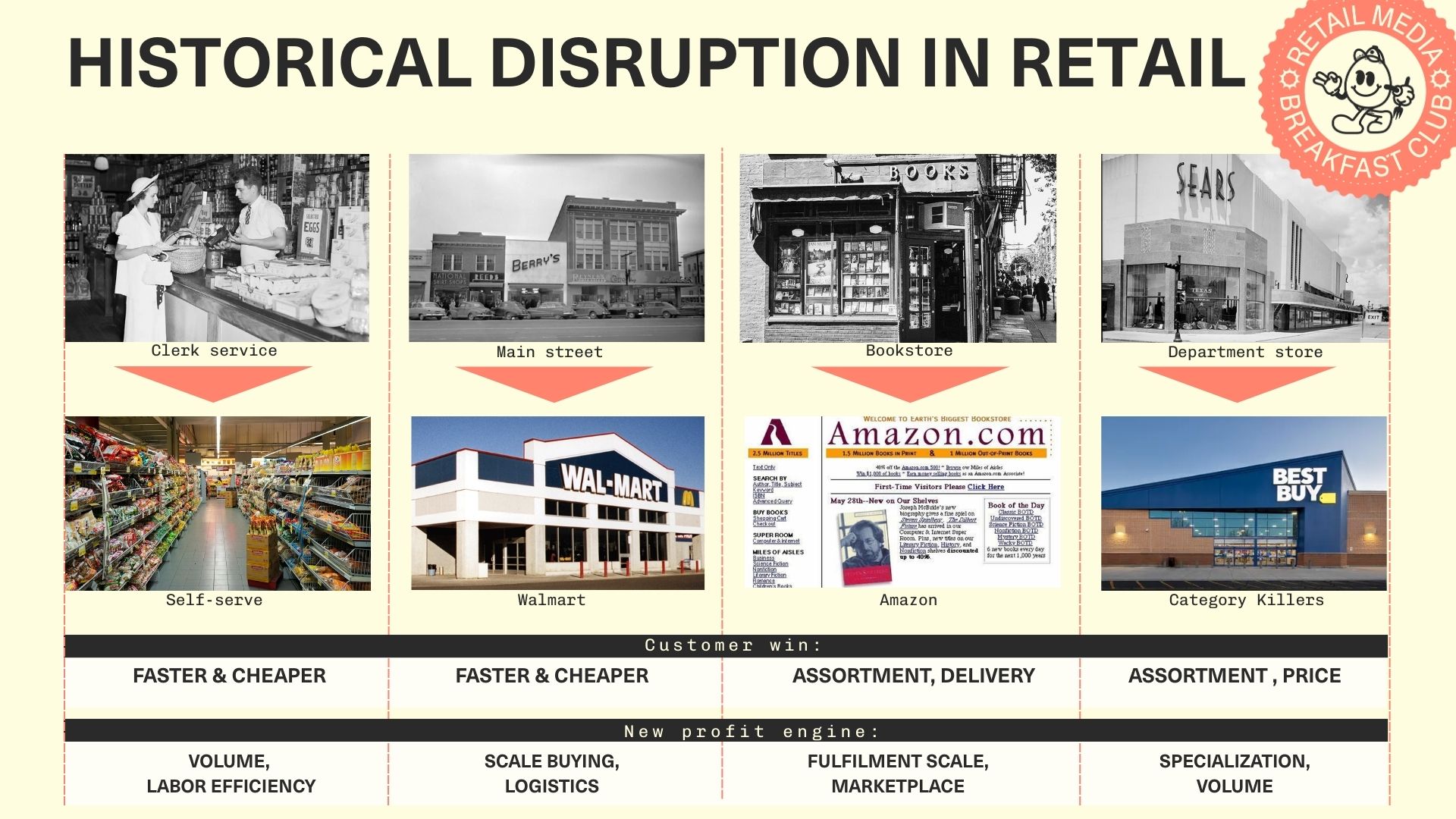
Every major retail disruption follows the same pattern. A constraint in the old model gets removed. The customer wins. And the profit engine that powered the incumbent breaks.
Clerk-service grocery stores couldn't scale past the labor at the counter — self-service supermarkets fixed that. Main Street shops couldn't match Walmart's buying power. Bookstores couldn't compete with Amazon's infinite shelf space. Department stores couldn't go deep enough to beat category killers like Home Depot and Best Buy.
Each time, the disruption created a unique win for the customer. Better pricing, more convenience, better selection. The source of profits in the new model probably looked tenuous — it certainly wasn’t coming from where it had before. Each time, there was a migration to a new profit engine, one that the incumbents had previously been unable to access due to some constraint (geography, buying power, etc).

I think we're watching this pattern repeat right now — and the profit engine at risk is some forms of retail media.
SPONSOR: MIRAKL ADS

Did you know leading retailer media networks drive 85% of their ads revenue through mid- and long-tail advertisers?
Mirakl Ads provides full funnel ad formats tailored to both 1P and 3P advertisers, leveraging unique AI-capabilities that provide unprecedented levels of relevance and engagement.
Retailers who want to capture ad spend from the long tail of 3P marketplace sellers use Mirakl Ads in their tech stack.
The browsing layer is leaving the building
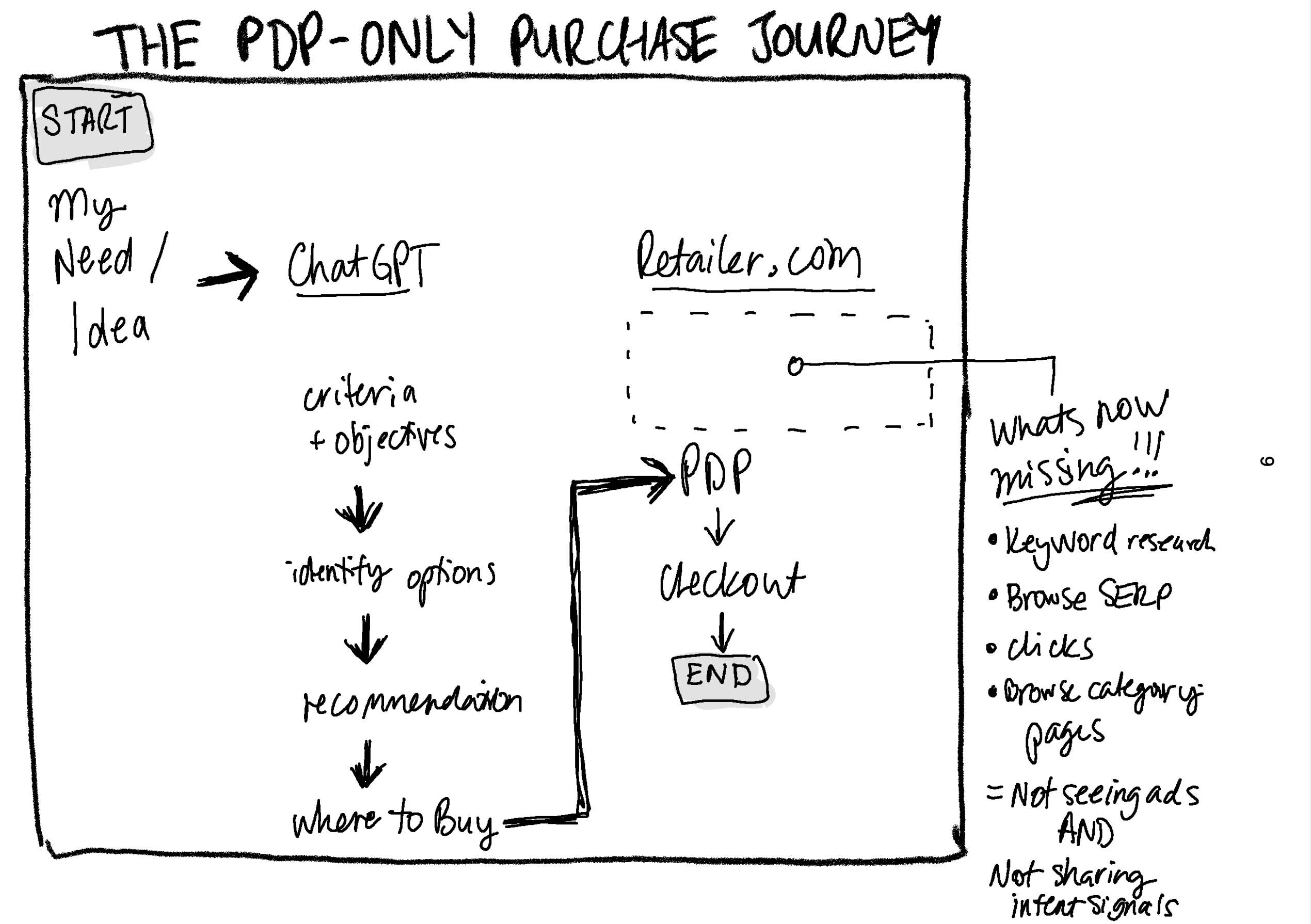
I've spent the past year writing about how AI-enabled shopping poses an existential threat to the three economic pillars of retail media. The short version: when shoppers use ChatGPT or Gemini to research and narrow their options before visiting a retailer's site, the retailer loses the browsing behavior that makes their ad business work. Fewer signals. Fewer ad surfaces. A fuzzier measurement story.
As I wrote in my recent column at The Drum: I got the urge to buy a Shark Glossi hair tool, hashed out my options with ChatGPT, picked a retailer based on price and delivery, and arrived on their site having already decided on the exact SKU. The retailer got the sale. But they lost everything that happened before the sale — and that's the part their media business is built on.
This is called "dark search" — the growing share of shopping research that happens inside LLMs, invisible to retailers. And it's catching on.
Nikki Baird, VP of strategy and product at Aptos (who writes a great newsletter that leans more skeptical on AI-enabled commerce), picked up the concept this week and shared her own experience. She'd been shopping for specialty dog food — large breed, older dog, diet formula. Her usual brand was getting pricier and harder to find. So she asked ChatGPT to recommend alternatives with similar recipes that she could get quickly.
ChatGPT gave her five options. She didn't follow its retailer links — she went to the retailers where she gets free shipping and searched for the brands by name. She ended up buying her original brand at PetSmart after spotting it in-store, but her intent was to switch to Purina.
As Nikki put it: "Who knows what my intent was? Only ChatGPT." Amazon didn't know. PetSmart didn't know. Nutro certainly didn't know. That's dark intent — and as she wrote, "any retailer saying that it doesn't matter if all that activity happens on a platform LLM and not on their site because they get the sale in the end is deluding themselves."
So what should retailers and media buyers actually do?
I covered seven ways to break the retail media doom loop earlier this year, and I’m revisiting some of those items, informed by some recent industry conversations.
- Go where the inspiration starts. The "inkling to buy" still happens outside the LLM — on social, CTV, or other discovery platforms. Retailers still own the transaction data that proves whether those upper-funnel impressions actually worked. Travis Clinger, Chief Connectivity & Ecosystem Officer and GM, International at LiveRamp predicts this means that retail media shifts to more offsite, more CTV, more social. The play is using commerce audiences to fuel brand building and then closing the loop with real purchase data. Travis expects this to grow: "In the past, people would be like, oh, you use audiences for performance marketing. I think now you use audiences for all marketing."
- Collaborate on data or accept being blind. If shoppers stop leaving clues on retailer sites, commerce media networks need to bring in context from elsewhere — other retailers, payment networks, travel platforms. Clean rooms make this possible without sharing raw data. Even the biggest grocer in a category would benefit from combining their replenishment signals with a specialty retailer's high-intent category data.
- Optimize for the new shopper journey. When a shopper lands directly on a product page with their mind already made up, the PDP becomes a mini homepage. Amelia Van Camp, Head of Agentic Commerce at Mirakl. frames it well: "Retailers really have to think about… what is your ideal shopper journey coming from an LLM? If the user is landing on a PDP page, what ultimately are you trying to drive beyond the baseline conversion?" (Mirakl sponsors this newsletter.)
That means rethinking what happens on and around that page — cross-sells, sampling, loyalty enrollment, replenishment nudges — without cluttering it with more pop-up ads nobody asked for. Amelia points to Sephora's trial program and loyalty integration as a model. She also notes that loyalty programs are "having a resurgence," in part because some LLMs encourage users to log into retailer apps to complete checkout — which hands back some of the signal that dark search takes away. - Double down on physical stores. No LLM can replicate physical presence. In-store remains the most defensible part of the retail media stack — I've written about this multiple times, and I keep coming back to it. Sam's Club is scaling in-store media with serious investment. Best Buy Ads president Lisa Valentino says the future of retail media lives in the store. For retailers with strong physical footprints, this is a natural hedge against digital disruption.
The only real risk is dismissal
Things are moving fast. Behaviors and technologies that were nascent 12 months ago are becoming more common. A year ago, roughly 7% of website referrals to US retailer sites came from ChatGPT; by October 2025, that was 16%.
I'm not saying onsite retail media is dead. I am saying the ground is shifting, and the retailers who treat this as someone else's problem are the ones most likely to get caught out. Educate yourself. Watch your own shopping behavior. And don't throw the baby out with the bathwater — but also don't pretend the bathwater isn't getting cold.
Read more from me on this topic: