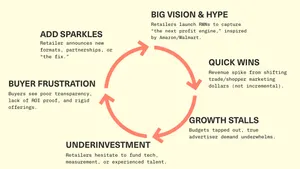

Last year I wrote about the retail media doom loop—the vicious cycle where retailers launch with sky-high profit expectations, grab quick wins by repackaging trade dollars, then stall out when that easy money runs dry. Without revenue growth, they can't justify investing in better tech and talent. Without better tech and talent, they can't attract new budgets. The loop tightens.
I've also spent the past few months writing about how agentic commerce throws out existential questions for this industry. When AI agents build shopping baskets without ever visiting retailer websites, what happens to all that valuable on-site advertising inventory?
But here's what I've come to believe: disruption also means a reset. A chance to build the kind of retail media ecosystem that should have existed from the start—one built on genuine value creation rather than margin extraction.
Call it a cosmic do-over.
The retailers who treat this moment as an opportunity rather than a threat have a chance to break out of the doom loop entirely. What does that virtuous cycle actually look like? Here are several areas where I see real potential. This isn't an exhaustive list—and I'm hoping for feedback from the industry on what I've missed.
SPONSOR: MIRAKL ADS

Did you know leading retailer media networks drive 85% of their ads revenue through mid- and long-tail advertisers?
Mirakl Ads provides full funnel ad formats tailored to both 1P and 3P advertisers, leveraging unique AI-capabilities that provide unprecedented levels of relevance and engagement.
Retailers who want to capture ad spend from the long tail of 3P marketplace sellers use Mirakl Ads in their tech stack.
1. Double down on in-store and experiential media
Here's the irony: while digital retail media faces existential questions from AI agents, physical stores remain largely untouchable. People will still visit stores, still see endcaps and shelf displays, still respond to the theatre of in-store retail.
Sam's Club has been pushing experiential boundaries, turning membership into something that goes beyond transactions. Retailers with strong physical footprints have assets that digital-first competitors simply can't replicate—and that AI agents can't bypass.
The retailers most at risk from agentic commerce are those heavily dependent on e-commerce. Those with strong physical presence have a natural hedge, if they invest in making those in-store moments matter.
2. Activate the long tail through marketplace sellers
The average retail media network gets 28% of revenue from mid- to long-tail advertisers, according to Forrester research. But most RMN tech stacks were built to manage 50-100 relationships with major suppliers, not 5,000 marketplace sellers.
Anne Hallock, VP of Mirakl Ads Americas, cites the 80/20 rule being in play whereby most media revenue comes from top-tier advertisers.
“The challenge that revenue leaders have faced in the past 2 years is: some executive says, 'Okay, now go capture the long tail.'“ Hallock said at the EMARKETER Commerce Summit in December. “And you're like, 'With what staff? The technology isn't set up for that.'"
The retailers cracking this with self-serve technology for the long-tail of marketplace sellers are seeing results. Lowe's expanded its total long-tail advertiser count by 23% year-over-year after launching its 3P marketplace. When big brands won't expand beyond 5-6 RMN relationships, growth has to come from somewhere else.
Read more: Long-Tail Advertisers Are a Quiet Growth Engine for Top Performing RMNs.
3. Stop trying to out-Amazon Amazon
Jordan Witmer, Managing Director of Unified Commerce at the agency Salt, distinguishes between "minor league" and "major league" retail media approaches. At the advanced stage, he told me, "differentiation comes not from controlling how investment flows in, but from unique strengths: better audience building capabilities, distinctive ad units, and innovative ways to deliver spend."
Most retailers will never match Amazon on sponsored search capabilities. But they can create unique, high-value moments that make the most of their specific customer relationships and transaction data.
More here: Retailers Are Becoming Retailers Again.
4. Make it easier for buyers: transparency and access
Two related moves that signal maturity: revealing your tech stack, and being where media buyers already want to buy.
Costco revealed their entire tech stack at NRF this year—partnerships with LiveRamp, Google Cloud, and Habu laid bare. (I wrote about it for The Drum here.)
When I polled 67 verified brand-side buyers last year on whether knowing a retailer's tech stack would influence spending decisions, 88% said yes. The sophisticated agencies have already figured out how to reverse-engineer these partnerships through reporting patterns anyway. The secrecy is ultimately futile—it just creates friction.
On access, Koddi's research found that 96% of buyers will certainly or will consider buying on-site media via a DSP. And 93% would shift non-retail budgets into retail media if they could do so programmatically. Retailers worry DSP integrations will commoditise their offerings, but the right supply-side tech lets them protect their network while tapping into demand that currently takes the long way around.
More here: Why RMNs Keep Their Tech Stacks Secret and DSPs Wanted
5. Create ad formats that sell more stuff
While most retailers fixate on replicating Amazon's playbook with sponsored product listings, a handful of companies have identified white space in moments that feel less like advertising and more like value creation.
Rokt monetises the post-purchase moment when shoppers are most receptive. Swish treats the product itself as media—adding full-size samples to online grocery orders, funded by CPG brands. Nift turns "thank you" moments into brand discovery opportunities.
These approaches work because they create genuine win-wins for brands and retailers.
I covered these approaches in "Beyond Banner Ads" for The Drum.
6. Loyalty Programs are a bastion
When AI agents comparison-shop across retailers, price competition becomes a race to the bottom. But loyalty benefits—early access, exclusive products, tier multipliers—create genuine preference that persists even when agents optimise for price.
As I explored with loyalty expert Stephanie Meltzer-Paul, the infrastructure gap is real: loyalty benefits aren't currently visible in product search, let alone readable by AI agents. But retailers who solve this first gain an edge that pure price comparison can't breach.
More in How Loyalty Programs Give Retailers the Edge in an AI Shopping Future.
7. Consider cross-retailer collaboration
The irony of retail media is that fragmentation hurts everyone. Brands struggle to manage dozens of separate platforms. Retailers struggle to compete individually with Amazon's scale. What if the answer is collaboration?
Macy's partnership with Amazon Retail Ad Service raised eyebrows—partnering with your fiercest competitor feels risky. But Michael Krans, head of Macy's RMN, is bullish on the results: more than 175 new brands activated sponsored product campaigns in the first six months. His reasoning is practical: buyers can use the same Amazon Ads tools and UI they already know, agencies can plug their existing Amazon Ads API-based tech, and Macy's can activate "tail" and "torso" advertisers without growing internal headcount.
"Two retailers can actually collaborate in one space in digital media advertising and then also compete in another space," Krans said at NRF. "Two things can be true."
Consortiums and federations that pool data and audiences while preserving individual retailer advantages could offer brands the scale they need without forcing retailers to build capabilities they'll never match.
The virtuous cycle
The doom loop is a choice. Retailers can continue playing hide-and-seek with their infrastructure while wondering why growth has stalled. Or they can embrace a different model: one built on transparency, genuine value creation, and collaboration where it makes sense.
Agentic commerce may well disrupt the current retail media model. But the retailers who use this moment to build something better—rather than clinging to what worked before—have a shot at breaking out of the loop entirely.
What did I miss? I'm genuinely curious what opportunities the industry sees that I haven't covered here.
Until tomorrow,
Kiri