
A few months ago, the mood around agentic commerce in retail media circles was closer to dread. The EMARKETER/Bain survey from late 2025 captured it: when RMN leaders were asked about future disruptive forces, "zero-click/genAI search disrupting discovery" ranked first at 36%, with "agentic AI changing ad buyer decision-making" second at 28%. I've spent the past year building the case that this threat is real, and I stand by that.
But something has shifted. In my private conversations with RMN leaders recently, and in what I heard at Shoptalk, the panic has cooled off. Retailers are asking sharper questions — what does this actually mean for my category, my customer? Less existential dread, more practical sequencing.
That seems like progress. It also exposes a problem: most retailers aren't ready to respond to this shift even if they wanted to. The plumbing isn’t yet ready.
SPONSOR: MIRAKL ADS
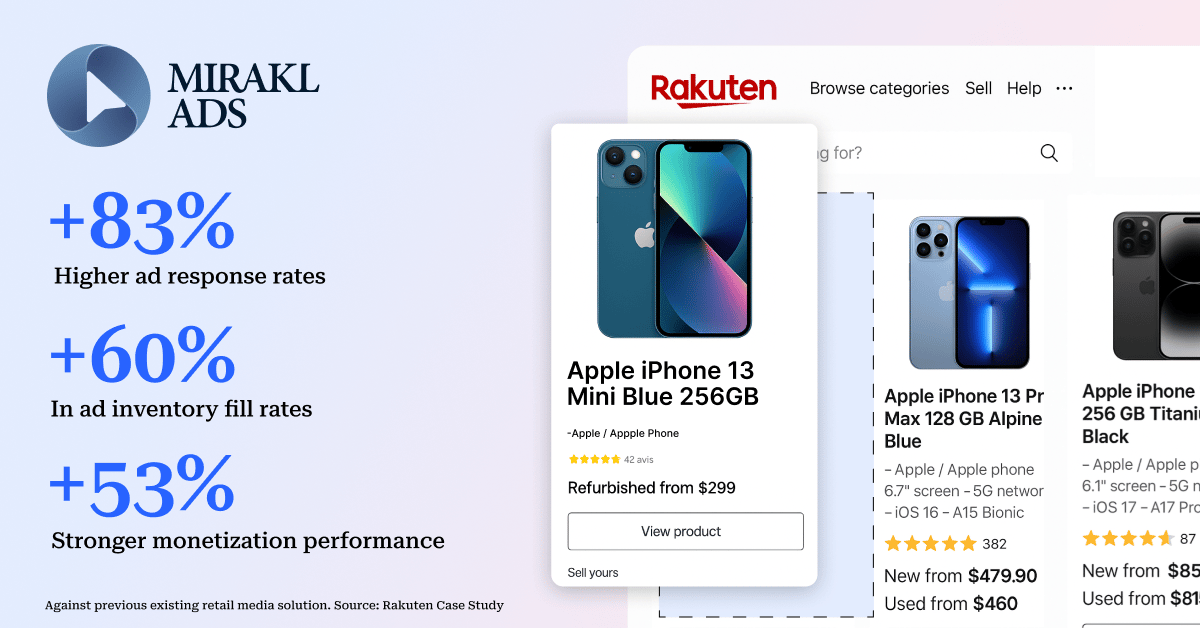
Retailers know that a marketplace model can dramatically boost product assortment, shopper engagement, and total revenue.
But, to get the most out of your marketplace, you need an ad tech solution that can really engage sellers.
Mirakl Ads is powering the future of retail media for leading retailers — to activate both 3P sellers and 1P brands.
The sequencing required
On a recent livestream I hosted with Costco's Mark Williamson (AVP of Retail Media), he framed agentic commerce as "an order of operations thing." Not a question of if, but a sequencing problem.
"The instinct is to just jump in," Williamson said. "This is a shooting star. We gotta go grab it. We gotta get in on this." But integrating with an LLM or an AI shopping assistant doesn't just happen. There are legal requirements, policy frameworks, product feed quality, data infrastructure. None of it is optional.
His expectation of his team: "Are the decisions we're making today in our owned and operated ecosystem going to make it possible for us to integrate with an LLM when the company decides that's something we're gonna do?"
That's a very different question from "should we build a ChatGPT app?"
Costco is keeping its options open. Their recent deal with Symbiosys to run measurable Google Shopping ads is step one of a broader upstream-search strategy. As Williamson put it: "Google today, ChatGPT tomorrow, perhaps." The modular tech stack they've been building — and publicly sharing — is designed so they don't paint themselves into a corner.
What makes that modularity possible is MetaRouter, Costco's data and identity layer — it's the plumbing that routes member-level data to whatever new partner or activation tool Costco plugs in next. (Disclosure: MetaRouter sponsored the livestream where this conversation took place.)
Retailers are shunning hype
At Shoptalk, Home Depot's EVP of Customer Experience Jordan Broggi described AI shopping features on third-party platforms as "someone else's side quest," adding that the company doesn't want to "pivot resources to try to be the first at something very nascent, at the expense of scaled activities." Lowe's SVP of Digital Joe Cano was equally blunt: "Not one customer have I seen in our voice-of-customer data say, I really want to check out on ChatGPT."
These aren't retailers dismissing the shift. They're being honest that there are more pressing things to address.
Meanwhile, Target's CIO Prat Vemana offered a glimpse of what this work actually looks like when you commit to it. In an interview with The Aisle, Vemana said that Target has rewritten 60% of its app code to be, in his words, "AI-ready" — rebuilding their search engine and recommendation systems from scratch. That's the unsexy, expensive stuff that makes AI-assisted commerce possible down the line.
Of particular interest to me, Vemana also said in that same interview that Target's ChatGPT app integration now passes conversational queries back to Target, giving them signal they never had before. Where Target used to only know what people bought on Target, they can now combine that with LLM-derived data on what people are buying and researching elsewhere.
That's the kind of payoff that retailers only get after they've done the unglamorous sequencing work.
On-site preparation
Anne Hallock of Mirakl Ads, who I spoke with at Shoptalk, described what she's seeing as "a little bit of capitulation" among retail media leaders who'd been anxious about agentic commerce. The shift: rather than panicking about external AI threats, they're focusing on getting the on-site experience right first — building contextual shopping assistants, improving product recommendations, creating the kind of intelligent on-site experiences that would need to exist whether or not an external AI agent ever sends traffic their way. [Disclosure: Mirakl Ads sponsors this newsletter]
But this isn’t a switch that one can simply flip on when the time comes. Williamson has been at Costco for two and a half years. It’s only recently that the fun exciting tech stack announcements have started rolling in. The data and identity layer needed to get sorted well ahead of that — stitching together what members experience as one store but what Costco internally managed as roughly ten different businesses with disconnected systems. If your tech stack still can't connect ad exposure to in-store sales, "getting it right on-site" is itself a multi-year project — and the clock on external disruption doesn't pause while you catch up.
The clock doesn't stop
None of this means retailers should ignore agentic commerce — the opposite. Williamson himself said that if AI-assisted shopping becomes material, "we have no choice. We're obligated to be there. Take retail media out of it — as taking care of our members, we have to have a point of view on that."
Every quarter that a retailer spends without member-level identity or closed-loop measurement, the gap gets wider. And it's already pretty wide.
Worrying about agentic commerce isn't a strategy. Neither is ignoring it. The unsexy middle ground — fixing your data, sorting your identity layer, building for flexibility — is where the actual work is.
COMING UP!
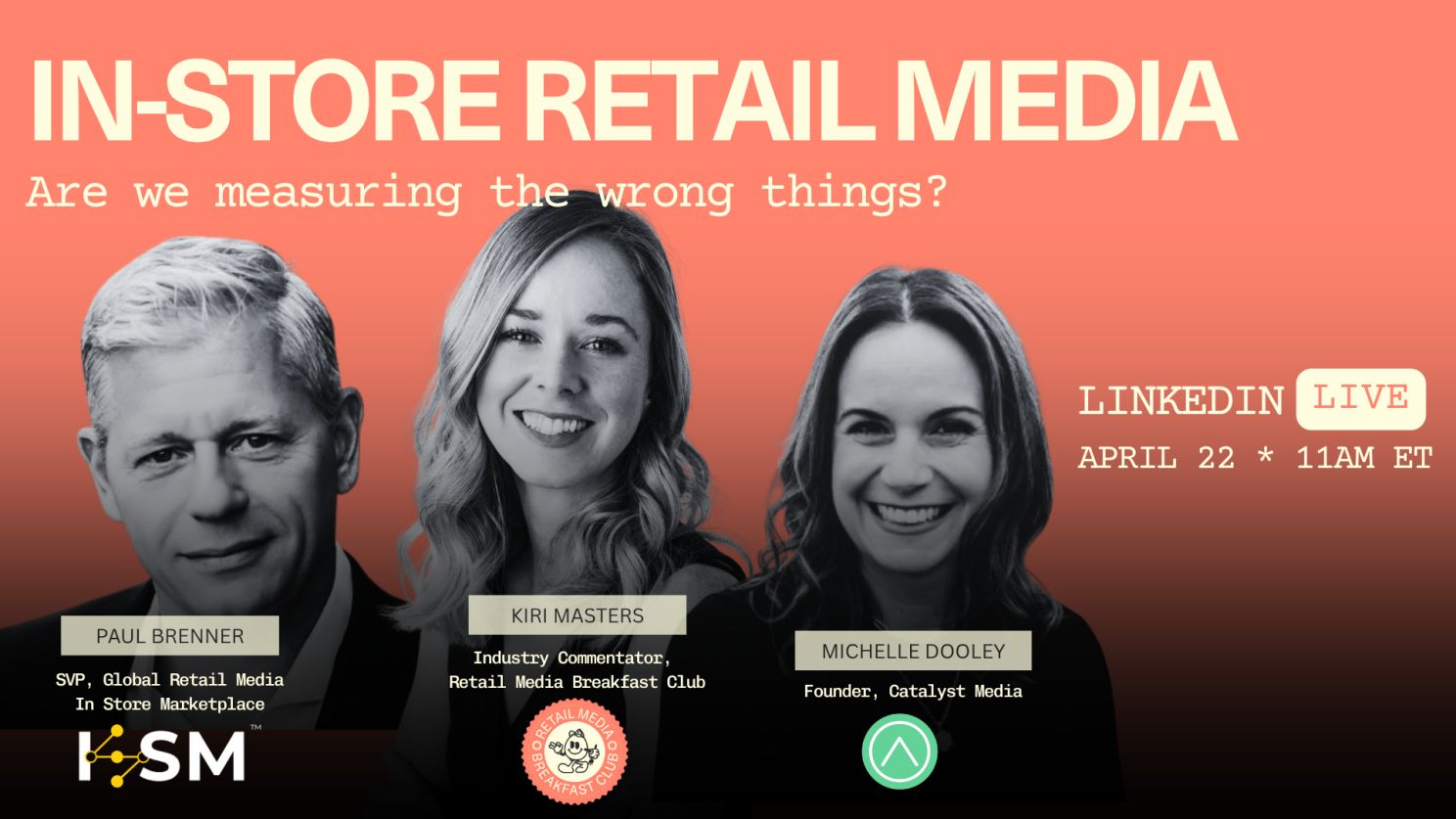
I'm hosting a LIVE event with In-Store Marketplace and Catalyst Media Consulting on April 22 about In-Store Retail Media: are we measuring the wrong things?
Has the retail media industry skipped basic math and gone straight to advanced calculus?
We’ve rushed into complex attribution models and digital-style measurement for in-store media before anyone agreed on the fundamentals. The result? Brands, retailers and agencies are all working from different scorecards — and that is making it harder to grow in-store investment, not easier.
Join Kiri Masters (Retail Media Breakfast Club) live with Paul Brenner (In-Store Marketplace) and Michelle Dooley (Catalyst Media Consulting) to unpack new research on the state of in-store retail media measurement — and why the path forward may actually be simpler than the industry is making it.
We'll dig into:
- Why brands, retailers and agencies keep talking past each other on measurement
- Whether in-store media is being forced into a digital measurement framework that doesn't fit
- What brands actually want — and why "did more product sell?" is still the question most are trying to answer
- How the UK and US markets are approaching this differently
- What a more practical measurement foundation could look like
- We'll also discuss the early market reaction to this research and where the conversation is heading next.
If you work in retail media, shopper marketing, or commerce media — bring your questions and join us live! REGISTER HERE