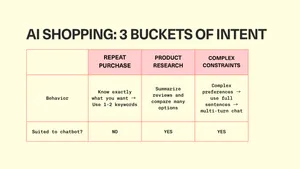

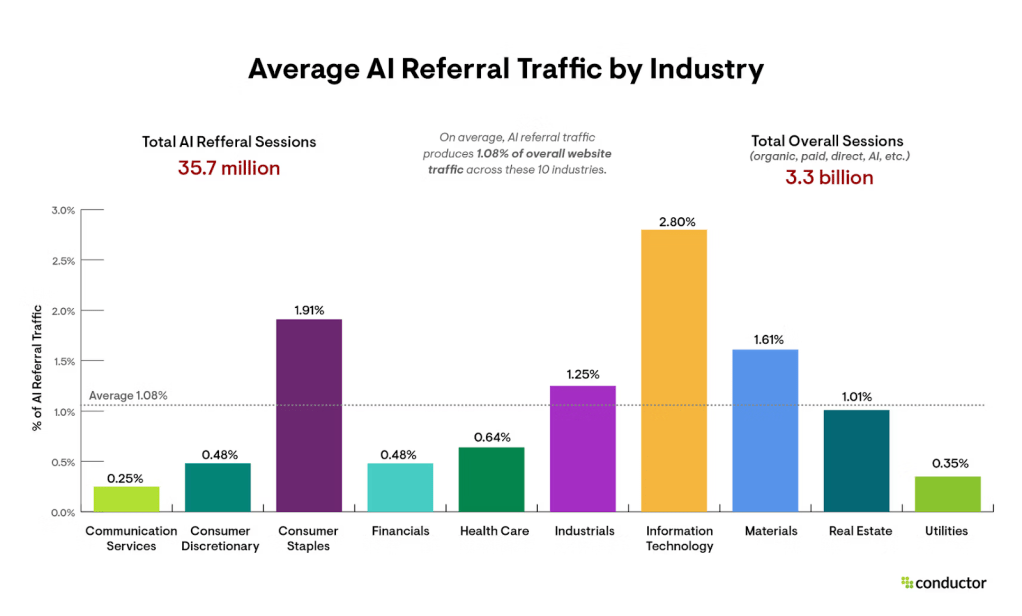
Here’s a number that gets thrown around a lot: less than 1% of website traffic comes from AI referrals. It's technically accurate, but it's almost completely useless as a metric. Retailers and brands who anchor to that figure are measuring the wrong thing. There’s a silent metric that this figure misses: dark search.
I recently joined Destaney Wishon on the Better Advertising podcast. Destaney described a recent purchase that she made for her podcast studio. She didn't search "mid-century modern podcast chair" on Amazon or Google, or any other retailer’s site. She took a photo of the space and sent it to ChatGPT in order to hash out some ideas. She didn’t make an agentic purchase using ChatGPT ‘Instant Checkout’, she even click through to a retailer’s site directly from that session. But that collaboration with ChatGPT would later inform a purchase she’d make on a retailer site on her iPhone using Apple Pay.
That retailer would see no browsing. No comparison shopping. No intent signals generated for that retailer until the moment she landed to purchase.
That's the story the 1% traffic figure misses entirely.
SPONSOR: MIRAKL ADS
Did you know leading retailer media networks drive 85% of their ads revenue through mid- and long-tail advertisers?
Mirakl Ads provides full funnel ad formats tailored to both 1P and 3P advertisers, leveraging unique AI-capabilities that provide unprecedented levels of relevance and engagement.
Retailers who want to capture ad spend from the long tail of 3P marketplace sellers use Mirakl Ads in their tech stack.
Buying Decisions Are Being Made Well Before the Click
Juozas Kaziukenas, founder of Marketplace Pulse, says that we are seeing a decoupling of influence from attribution. ChatGPT as a source of traffic is a lagging indicator. People are asking it to recommend products. They're walking the aisles at Walmart, photographing a shelf, and asking AI which brand to pick.
Recent data from Acosta Group shows that more than half of shoppers used AI while shopping in-store over Thanksgiving last year. 18% of those used AI assistants like ChatGPT and Gemini.

None of that generates a referral click to a retailer. But it absolutely influences the purchase.
Malte Landwehr, CPO and CMO of Peec AI, calls this phenomenon "Dark Search"—the LLM equivalent of dark social. When an AI recommends your brand, the user might search your brand name on Google, type your domain directly, or come back later. All of that looks like direct traffic or branded search in your analytics. The actual source—the AI conversation—gets zero credit.
He's documented a case where 1% of a company's clicks came from ChatGPT, but 20% of new leads self-reported they discovered the brand via ChatGPT. The click-based dashboard made AI look irrelevant. Self-reported attribution told a completely different story.
This is the ghost in the retail machine. The influence is real, substantial, and growing. The measurement infrastructure just can't see it yet.
That upper-funnel activity is where the intent signals live, where the onsite ad inventory lives, and where the measurement narrative starts. When it migrates to an LLM, those assets start to thin out for retailers who rely on them for their media businesses.
When Intent Shifts, Monetization Shifts
Destaney said something that cuts to the heart of what's at stake: "Everyone's leaning too heavily on agentic. It isn't a great experience, but I don't think that's the disruptive part right now."
She's right. The industry conversation about AI and retail has been fixated on whether people will check out inside ChatGPT. That's a real question, but we have a more immediate one to ask. The disruptive part is happening upstream—in the discovery and consideration phases that retailers currently own.
I've had the same experience. I recently decided I wanted a new hair styling tool. I talked it through with ChatGPT, narrowed it down to a specific SKU, selected a retailer based on price and delivery time, and landed on their website with my decision already made. The retailer made the sale. But I never generated a single upper-funnel signal on their platform. I didn't browse their sponsored content. I didn't engage with their onsite ads. That activity—and the data it creates—went somewhere else.
What's Really At Risk
Retail media isn’t just built on the transaction. It was built on the whole journey. The browse data, the search behavior, the research patterns—that's where the intent signals live that make offsite retail media valuable. Brands pay for Walmart's audiences on CTV because Walmart knows you searched for high-protein snacks last week. That's the data that powers the whole ecosystem.
If that upper-funnel activity migrates to LLMs, the data erodes before any transaction moves. Landwehr believes that about 10% of discovery is happening via LLMs today.
Some emerging partnerships between OpenAI and retailers are worth watching closely in this context. If AI starts routing discovery and then funneling purchase intent toward specific retailer partners, that's not necessarily a threat to retail media—it could be the next form of it. Target Roundel has shared that it is conducting what sounds a lot like a collaborative bidding model: “Roundel is testing how Target-owned ads perform in ChatGPT with select brand partners.”
This is an ad capability I’ve been anticipating: a CPG brand and a retailer co-bidding within an LLM, capturing a sale that ultimately processes on the retailer's site. That's genuinely new and a win-win for retailers and brands.
(I have shared more ideas of some models for the future of retail media here and here)
Navigating the shift while it’s incomplete
Juozas quoted Alfred Lin of Sequoia on paradigm shifts: the hardest part isn't predicting the end state, it's navigating the shift while it's incomplete. Move too early and you burn capital on infrastructure that isn't ready. Move too late and you defend yesterday's margins.
That framing applies directly here. Retailers who are waiting for AI-driven traffic to show up clearly in their referral dashboards before they act are already behind. The influence is indirect, it's accumulating, and it's fundamentally not designed to generate clicks in the way that current search attribution expects.
Dark Search doesn't announce itself. But it is quietly moving upper-funnel discovery somewhere you can't measure.
Coming Up: When RMNs Come Calling for Your Brand Marketing Budget

Retail media networks have exhausted the "easy money" of trade and shopper marketing budgets. Now they're knocking on the door of brand marketing—but the playbook that got them here won't get them there.
In session # 3 of this livestream series with Jordan Witmer of Salt XC we're going to breaking down what brands need to be asking about when retailers come calling on that alluring brand marketing budget.
If you haven't joined one of our live sessions yet, its kind of like a live podcast where we take audience comments and questions in stride. Join us live as we hash this topic out.
Jordan brings an especially informative POV to this topic since prior to leading retail media at Salt, he was brand-side at Kenvue, Hershey and Stanley Black & Decker.
Sign up to join live or be notified of the replay! Register here