
It's a perilous exercise to take your own buying habits and extrapolate from them. A lot of our actions as consumers are unconscious, uninformed, and the very act of observing them changes the behavior. (That’s the Hawthorne effect, for the research nerds.)
But one of my favorite parts of working in this industry is that we're all consumers. We each get this little slice of behavioral research from an N of 1. And while its dangerous to over-index on that, observing your own buying behavior is an excellent place to start asking questions.
I've been doing that this past year. Regular readers have heard my Shark Glossi anecdote before — how I talked through a hair styling tool purchase with ChatGPT, landed on a product I'd never heard of, visited a retailer only to check out. The retailer made the sale but never had a shot at influencing my decision.
I wrote about this emerging "dark search" behavior some weeks ago — the idea that AI-influenced discovery is growing but largely invisible to retailers' analytics. There were head-nods from smart people like Nikki Baird of Aptos, but not much hard data yet to confirm it as widespread.
So I was pleased to find two pieces of research the past couple of weeks that addressed this directly — from different angles, and drawing different conclusions.
Retailers know that a marketplace model can dramatically boost product assortment, shopper engagement, and total revenue.
But, to get the most out of your marketplace, you need an ad tech solution that can really engage sellers.
Mirakl Ads is powering the future of retail media for leading retailers — to activate both 3P sellers and 1P brands.
Criteo says AI is expanding the pie
Criteo released its 2026 Commerce & AI Trend Report a couple of weeks back, and the framing is upbeat:
“Aggregated insights across a sample of Criteo’s US clients showed that AI-referred visits had conversion rates 1.5X higher than other referral channels, reinforcing the high-intent nature of these visitors. At the same time, 70%+ of LLM-referred users now land directly on product pages (up from 50% in mid-2025), a shift that is consistent with these higher conversion rate.”
Criteo 2026 Commerce & AI Trend Report
Criteo’s conclusion: AI expands the ecommerce pie.
But Retailgentic says we're flying blind
Also this week, Scot Wingo's team at ReFiBuy published a detailed analysis of what they're calling "Dark Agentic Commerce Traffic" — DACT. (Disclosure: I'm an advisor to ReFiBuy.)
They confirmed something I had suspected ever since writing the piece about Dark Search: that when shoppers click through from AI apps like ChatGPT and Gemini, the referral headers get stripped. Google Analytics categorizes this traffic as "Direct." (As opposed to ChatGPT which adds an explicit referral tag to the outbound link.)
Based on three independent data sets, roughly 70% of AI-influenced traffic carries no referrer at all. What GA4 identifies as AI referral traffic may understate the real number by as much as 100x.
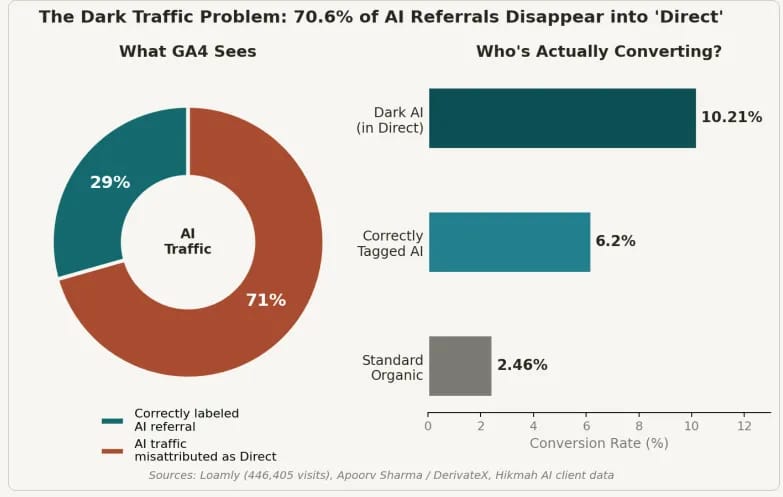
This analysis from Loamly found that invisible traffic converts at an eye-popping 10.21% — compared to 2.46% for average ecommerce traffic. Shoppers hit product pages, add to cart, and check out in under 20 seconds. Quite possibly the highest-quality traffic source most retailers have — credited to nobody.
I'm planning a deeper dive on DACT soon. But for now, the headline finding reinforces something I've been writing about since February: the referral data we're all looking at dramatically understates AI's role in commerce.
The tension between these two readings
Criteo's data and ReFiBuy's data aren't contradictory — they're measuring different slices of the same evolution. Criteo tracks what it can see through its merchant network: AI referrals are growing, converting well, and bringing in new shoppers. All true, as far as it goes.
ReFiBuy's point is that what Criteo can see is a fraction of what's actually happening. App-based AI traffic — which is growing faster than browser-based — is almost entirely invisible to analytics. The shopper who researches on ChatGPT and then Googles the brand name? GA4 credits that to branded organic search. The consumer who talks through a purchase with Gemini and then types the URL directly? "Direct."
I recently wrote a long feature for Arthur D. Little's PRISM publication [LINK] exploring this shadow shopping economy in depth. The through-line across all three pieces of work is the same: a growing share of purchase decisions are being made inside AI conversations that retailers can't see and can't measure.
And… a growing share of decision-making moments where a retailer can’t expose an ad impression.
Why this matters for retail media
Criteo's "expanding the pie" framing is comforting if you're a retailer. More shoppers! Higher conversion! What's not to like?
What it misses is the retail media implication. Every one of those high-converting, pre-decided shoppers arrived without generating the browse data, search queries, and category page visits that retail media businesses monetize. They didn't see sponsored products. They didn't produce the intent signals that make offsite retail media audiences valuable.
The retailer made the sale. But the media business lost the impression, the signal, and the data.
Criteo's report actually reinforces this concern, even if that wasn't their intention — their own data shows that 70%+ of LLM-referred users now land directly on product pages, up from 50% in mid-2025. These shoppers aren't browsing. They've already decided.
And that is why I argue that this consumer behavior shift is a structural threat to retail media economics. Read more in my piece for PRISM that came out last week.