I've been in a hair rut. Years of doing the same thing, going through the motions. And then my hairdryer exploded, which I took as a sign from the universe to shake things up and invest in a proper styling tool.
So I went straight to ChatGPT. Gave it my criteria — under $200, low heat, easy to learn — and let it do the work. We narrowed it down from three options to two to one: the Shark Glossi. (It worked, by the way. The rut is over.)
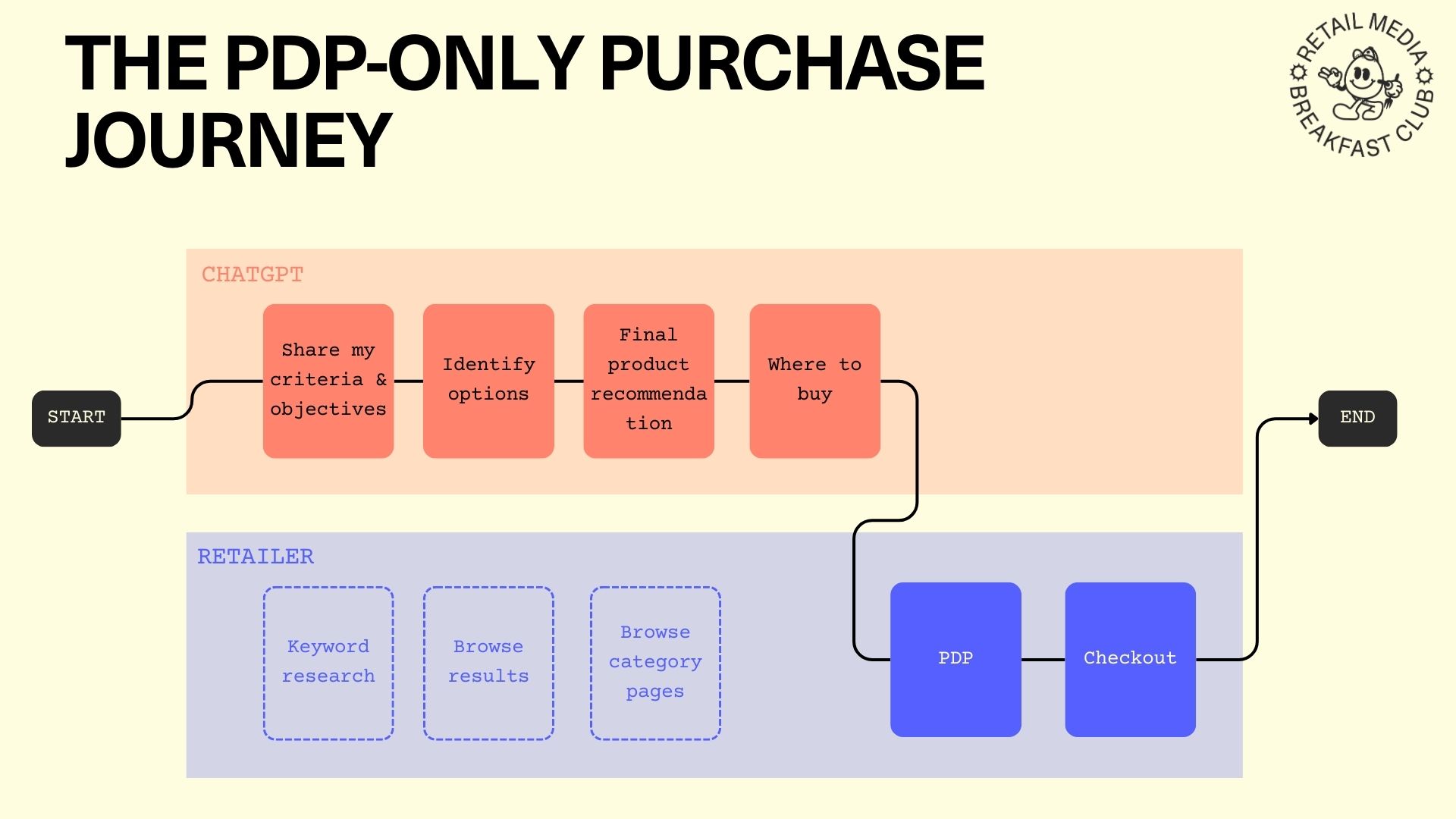
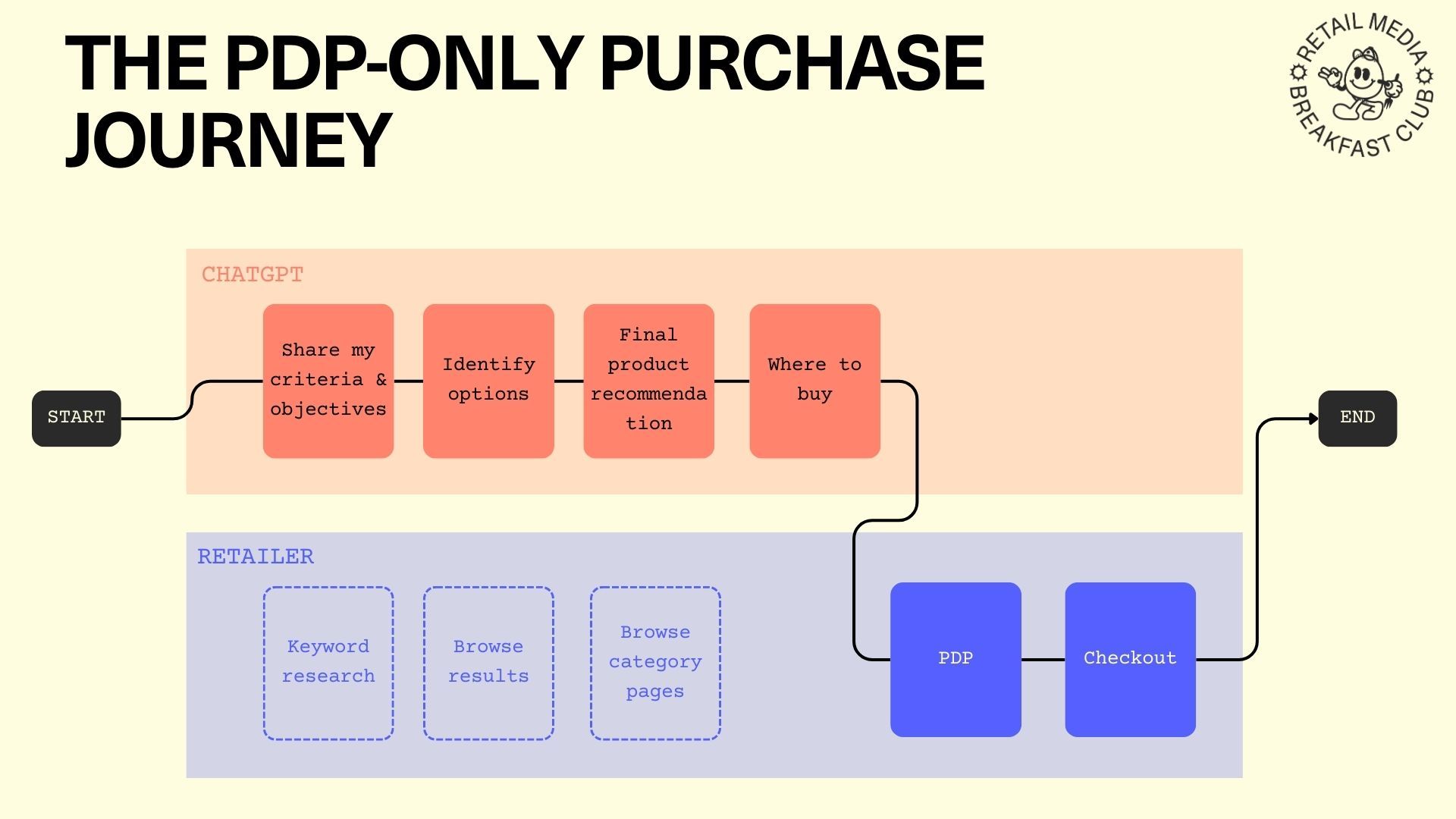
But here's what's interesting about that story from a retail media perspective. I bought the Glossi at Best Buy. And my entire journey on bestbuy.com was: land on the product page, add to cart, check out. Maybe 90 seconds, start to finish. I didn't browse. I didn't search for anything. I didn't see a single sponsored product ad. Their analytics team probably flagged me as a bot.
All of the discovery — the research, the comparison, the decision — happened in ChatGPT. Best Buy got the transaction, but they had zero influence over which product I chose or why.
This is what's happening right now, at scale. 53% of U.S. consumers have made a purchase based on AI recommendations, according to Capgemini research. Consumers aren't just using LLMs for online shopping either — they're pulling up ChatGPT and Gemini while standing in a physical store aisle. Acosta Group found that during the 2025 Thanksgiving weekend, 52% of consumers used an AI assistant while shopping in physical stores.
Discovery is moving upstream. The retailer site isn't dying — but its role is changing. And that shift has real implications for how retailers think about their digital surfaces, their product data, and ultimately their advertising businesses.
To dig into what this actually means — and what retailers should do about it — I sat down with Amelia Van Camp, Head of Agentic Commerce at Mirakl. It's a job title you don't hear much yet, but I suspect that'll change fast. Mirakl is best known as a marketplace platform, and if you’ve been following this newsletter you’ll know they have a sophisticated ad product for retailers, too. But they've also been building AI-first products around multi-merchant order orchestration — and Amelia's role is to figure out how to bring agentic commerce capabilities to market.
Here's our conversation, edited for clarity.
SPONSOR: MIRAKL ADS
Retailers know that a marketplace model can dramatically boost product assortment, shopper engagement, and total revenue.
But, to get the most out of your marketplace, you need an ad tech solution that can really engage sellers.
Mirakl Ads is powering the future of retail media for leading retailers — to activate both 3P sellers and 1P brands.
Kiri: When you're in front of a live audience, you ask people to raise their hands if they've used an LLM to start a shopping journey. What do you see?
Amelia: Usually about 80% of the room raises their hand. Then I ask how many have actually purchased through an LLM, and that number is smaller. But here's what I’ve noticed — in a four-month span, both numbers keep climbing. And the domain keeps expanding. It's not just LLMs like ChatGPT. It's also the shopping agents that retailers are building themselves, like Rufus or Sparky. Consumers are just trying to find the best way to get from a problem to a product.
Kiri: We've always had ways to discover products outside of a retailer's site — TV ads, social media, word of mouth. What makes LLMs different as a discovery channel?
Amelia: I think what consumers are really looking for is ease. Where can you get the most access to information in the easiest way possible? LLMs create this unique environment for that. But here's where it gets tricky for brands and retailers: these LLMs aren't just pulling from your website. They're pulling from Reddit, YouTube, Wikipedia — it's an explosion of data sources feeding a single recommendation. So now the question for brands and retailers becomes: how do I influence that? And where do I even start?
Kiri: So when an LLM lands on a retailer's site and scrapes a product page, what is it actually looking for?
Amelia: Mirakl’s Chief Data and AI Officer, Anne-Claire Baschet, explains this really well. She says that when engineers built these AI agents, they basically taught them to think about trust the way children do. The agent lands on a product page, but it's evaluating the whole context of the user's query — are they price-sensitive? Do they care about delivery speed? Style? Then it looks at the product itself and asks: can I trust you? Is the pricing accurate? Are the ratings and reviews strong? Are shipping details present? All of these signals that have existed in e-commerce for years suddenly become even more important, because they're the gatekeeping factors that determine whether your product gets recommended.
Kiri: You make a distinction between baseline product data and what you call "intent-based attributes." Can you break that down?
Amelia: Sure. Your baseline product data is the foundation — accurate pricing, stock status, descriptions, ratings, shipping info. That's your first building block for establishing trust with AI agents. You've got to get that right before anything else. Then on top of that, there's a layer we call intent-based attributes, which fall under what's known as GEO — generative engine optimization — or AEO, agentic engine optimization.
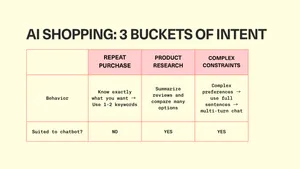
The difference is how consumers use LLMs versus how they used to search. Traditional keyword searches were two or three words. Now people type multiple sentences, full paragraphs. They're bringing much more context into their query. Intent-based attributes are built for that conversational context. They include things like Q&A, situation-setting, use-case descriptions — stuff that doesn't typically live in a standard product catalog today. When you layer those on top of strong baseline data, you're essentially increasing the odds that your product shows up in the conversation the consumer is actually having with the LLM.
Now What
Here's my takeaway from this conversation: retail sites don't die. The LLMs need retailer sites just as much as consumers are coming to rely on the LLMs themselves — the agent has to absorb product data from somewhere. But the discovery and decision-making stages are, at least partially, moving upstream. And if your product data isn't ready for that — if pricing is inaccurate, if reviews are thin, if your catalog lacks the contextual richness that these agents are looking for — you're invisible before the shopper ever arrives on your site.
In Part 2 of this series, we'll talk about what happens when shoppers land directly on a single product page, having already decided what they're going to buy. The PDP becomes the new homepage — and that creates both problems and opportunities for retailers.
Listen to the full conversation on the Retail Media Breakfast Club podcast.