
Retail media networks want brand dollars. That's not new. What's new is the growing realization that the barrier isn't a lack of demand or capability—it's that most brands are structurally incapable of spending those dollars through retail media, even when they want to.
On a recent LinkedIn Live, I sat down with Jordan Witmer, who leads retail media strategy at SALT XC, to talk about what actually happens when RMNs come calling for brand marketing budgets. Jordan spent years on the big CPG side before moving to agency life, so he's seen this from every angle.
The punchline: whoever owns the budget determines what retail media is allowed to be.
SPONSOR: MIRAKL ADS
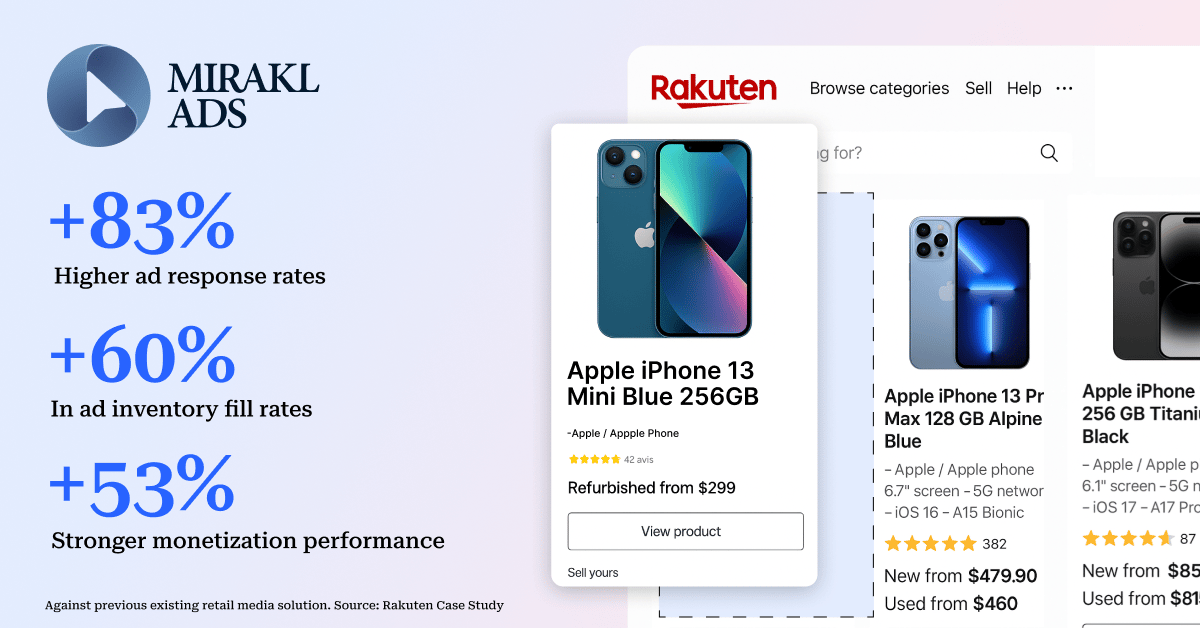
Did you know leading retailer media networks drive 85% of their ads revenue through mid- and long-tail advertisers?
Mirakl Ads provides full funnel ad formats tailored to both 1P and 3P advertisers, leveraging unique AI-capabilities that provide unprecedented levels of relevance and engagement.
Retailers who want to capture ad spend from the long tail of 3P marketplace sellers use Mirakl Ads in their tech stack.
Who Picks Up the Phone Determines the KPI
The conversation really kicked up a gear when we got into the internal dynamics on the brand side. Jordan made the point that you can predict almost everything about how a brand will evaluate retail media based on a single variable: who owns the budget.
Sales or shopper team owns it? You'll get a brief focused on ROAS and incremental lift at that specific retailer.
Brand or media team owns it? They'll plan it the way they plan any media buy — reach, frequency, audience segments — and suddenly you're in weird territory where a streaming buy through a retailer's network is supposed to fit inside a JBP conversation.
As Jordan put it: "Your brief is to build awareness and drive sales — cool. Got it. Sure. I'm pretty sure that's why we all have jobs. But how much? Which one? What are you actually gonna judge this on?"
Ah, the old “Build awareness and drive sales," if only those of us who’ve spent time in agency-land could have a dollar for every time we’ve heard that!
This is exactly the kind of ambiguity that produces what Jordan later called "Franken-campaigns"—stitched-together plans trying to satisfy incompatible goals.
The brand side has to get its own house in order. Even the best RMN proposition falls apart if the internal brief is trying to do two contradictory things at once.
"Credible Reporting" Means Different Things to Different Teams
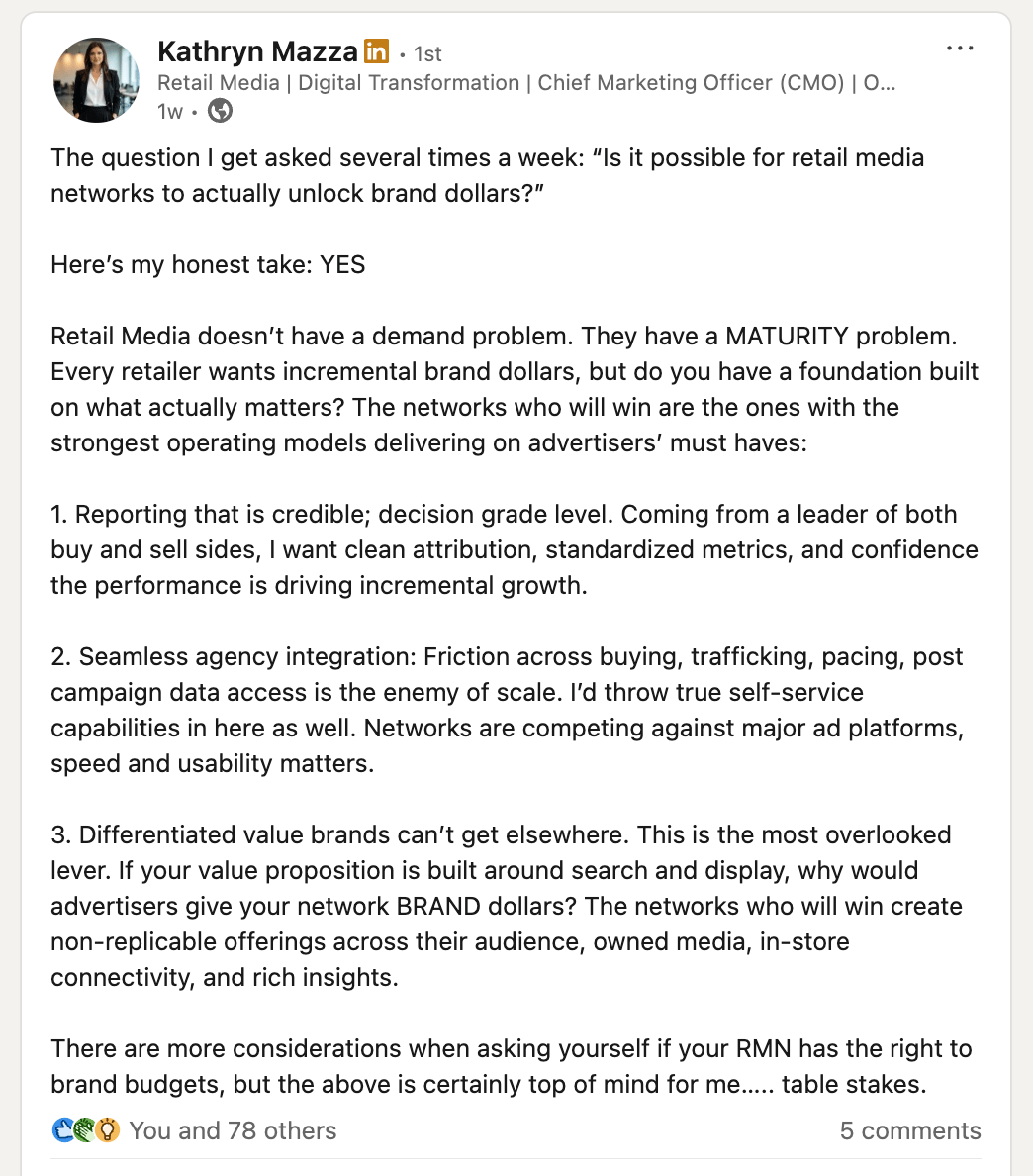
This was sparked by a LinkedIn post from Kathryn Mazza, who formerly headed up the retail media networks at Hy-Vee and Dick’s Sporting Goods. Kathryn laid out the maturity requirements RMNs need to meet before they have any right to ask for brand dollars — credible reporting, seamless agency integration, and differentiated value. Jordan zeroed in on the reporting piece, and what "credible" actually means depending on who's asking.
The core tension: a shopper marketing team wants to know whether the dollars they put into Hy-Vee drove growth at Hy-Vee. A brand marketing team wants to know whether those same dollars drove growth across the country. Those are two completely different asks of a reporting team — and Jordan questioned whether it's even reasonable to expect an RMN to answer the second one.
Let’s compare this to a brand running campaigns at Meta. Nobody expects Meta to show, in its own reporting, that it drove sales at a specific retailer. Instead, Meta made its data accessible enough for third-party measurement partners to pick up the signal. As Jordan pointed out: "What do you look at for Meta if they're not doing the credible reporting that retailers do? They've made a lot of the data easier to access over time, that flows out into brand organisations and third-party measurement partners."
That's the model RMNs need to move toward if they want brand budgets — not better closed-loop attribution, but more open data that plugs into how brand teams already measure.
The Franken-Campaign
I asked Jordan about the most common failure mode when brands try to buy upper-funnel activations through a retailer.
It's what he calls Franken-campaigns — stitched-together plans that emerge when both the sales and brand teams are in the room and neither steps back.
The sales team insists a Vizio streaming buy needs to drive traffic to Walmart.com. The brand team wants to go wide. Nobody resolves the tension, so you get a campaign that tries to do both and achieves neither. Jordan's reframe: the point of buying through Walmart isn't to do a "Walmart thing." It's that Walmart has access to unique inventory that fills a need for the brand. But that only works if someone in the room is willing to say which need they're actually solving for.
He also noted how retailers have evolved their CTV pitch. Two years ago, they were leading with closed-loop ROAS on streaming. The problem? The numbers never backed it up. Jordan didn't entirely credit strategic clarity for the shift: "I think a lot of it has been, it doesn't do that thing. It is a longer-term, leaned-in brand building tool to show up on somebody's TV. And it doesn't kick off ad-attributed exposed return on ad spend because it's not supposed to."
CTV doesn't produce great ROAS numbers because it's not supposed to.
The Real Takeaway
We keep hearing about this as a supply-side problem: RMNs need better brand products, better measurement, better agency relationships. All true. But this conversation makes clear that it's equally a demand-side problem. Brands need to decide what they're buying before they can evaluate whether retail media delivers it.
If the sales team owns the budget, retail media will be evaluated as a sales tool. If the brand team owns it, it'll be measured against awareness benchmarks. And if both teams share the room without resolving whose goals matter more, you get Franken-campaigns that satisfy nobody.
The unlock isn't better technology or more data. It's organizational clarity. And right now, most brands don't have it.
You can watch a replay of the full LinkedIn Live, which is sponsored by Salt XC.
And Join us for our next LIVE discussion in a couple of weeks! We’ll be talking about How Brands Grow for retail media: what does “effectiveness” really mean?