

Ad industry analyst Eric Seufert threw down the gauntlet against agentic shopping a couple of months ago. In his essay "Agentic Commerce is a Mirage," he laid out multiple reasons why AI shopping agents won't reshape retail the way the hype suggests.
Recently, he revisited one of those arguments on LinkedIn: Amazon as gatekeeper. The logic is that Amazon controls ~40% of US ecommerce, already has its own agent in Rufus, and has zero incentive to open its walls to third-party agents. If Amazon won't play ball, agentic commerce can't reach critical mass.
I've learned a tremendous amount from Eric over the years, and I think his broader skepticism about agentic commerce hype is healthy. But this specific argument—Amazon as bellwether—is one I want to push back on.
Not because it's wrong on its own terms. Amazon probably won't open up to independent agents anytime soon. But the assumption that Amazon's participation is necessary is where I think the logic breaks down.
SPONSOR: MIRAKL ADS
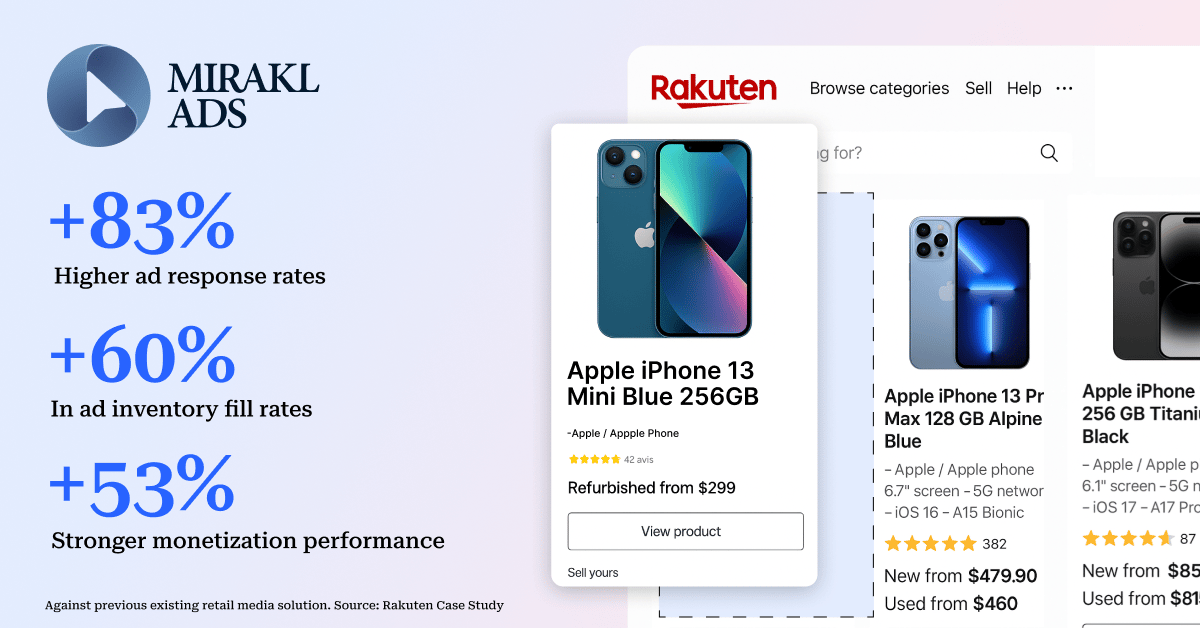
Did you know leading retailer media networks drive 85% of their ads revenue through mid- and long-tail advertisers?
Mirakl Ads provides full funnel ad formats tailored to both 1P and 3P advertisers, leveraging unique AI-capabilities that provide unprecedented levels of relevance and engagement.
Retailers who want to capture ad spend from the long tail of 3P marketplace sellers use Mirakl Ads in their tech stack.
Let’s start with Eric’s argument.
Eric’s argument: why Amazon won’t cave to agentic shopping
Eric shares an argument cemented around a lack of incentive for the incumbent.
First, Amazon controls ~40% of US ecommerce GMV. With that kind of moat, you can afford to wait things out.
Then, Rufus shows Amazon is already an “agentic” winner. It is arguably the most advanced retailer AI assistant by a wide margin, and reportedly responsible for >$10B incremental annualized sales (though there’s fair criticism of this)
And finally, Amazon’s ad/first-party data business gives it a reason to block independent agents. Amazon derives huge value from the user-level data exhaust of transactions to fuel a $60bn ads business and a full-funnel DSP, so ceding discovery and transaction to third-party agents weakens its moat.
Eric goes on to argue that independent agents (such as a ChatGPT Instant Checkout) can’t scale without Amazon. Paraphrasing from his post:
- Independent agents must get meaningful traction without Amazon.
- These agents must divert enough transactions away from Amazon to matter.
- Some other retailer that does integrate with agents must grow ops enough to threaten Amazon.
- That threat must be so acute that Amazon is forced to subordinate its 1P customer relationship and $60B+ ads business to those agents.
This is a strong logic chain but it assumes an either-or outcome: that either Amazon cooperates or agents are irrelevant. It also assumes that all retailers share Amazon’s incentive structure.
Why retailers shouldn’t play agentic commerce ‘chicken’
Eric's logic assumes Amazon is the only car on the road. If Amazon won't swerve, then agents crash and burn.
But that's not how this game works. I have 5 reasons why:
1. Agents as new demand generators, not just channels.
Today AI isn’t massively stealing traffic from search; it’s more like an extra layer. First I ask AI for help with meal planning, gift ideas, etc. But I still go out to websites and apps to make the purchase.
But as agents get better at going from “help me think” to “OK, now place the order for me,” more and more purchase decisions move into that agent layer.
Think of it as ‘old demand’ vs ‘new demand’:
- Old demand: most shopping journeys start in Amazon’s search bar. That’s the world where Amazon owns ~40% of US ecommerce – it’s 40% of legacy ecommerce.
- New demand: when journeys start in an agent instead, the agent decides where to send the order. As more retailers, payment providers, and commerce platforms plug directly into agents, a growing share of future demand will be created and routed outside Amazon’s walls — even if Google search and Amazon search volumes stay high.
2. Amazon lags on grocery
And here's where Amazon's 40% share becomes less relevant than it looks: the company continues to falter in a key category: grocery.
EMARKETER projects Walmart holding about 31.6% of U.S. grocery ecommerce sales in 2025, ahead of Amazon at 22.6% and Kroger at 8.6%
This matters because grocery is a prime candidate for agentic shopping. It’s not typically a fun experience like other categories like beauty or fashion. The popularity of Instacart, BOPIS, and home delivery suggest that many consumers are OK with allowing someone else to pick out their avocados. And a lot of purchases are either replenishment or conceivably integrated into meal planning systems. It is the category of shopping that most consumers say they would like to theoretically offload to an agent.
If Walmart, and other grocers are agent-forward and Amazon is behind, then Amazon’s 40% ecommerce share doesn’t translate into veto power over the most agentic-prone category.
3. Does Amazon see the writing on the wall?
Amazon has an incredible ads business. Even stronger than AWS. Amazon stands to lose its golden goose if they concede their user’s shopping journeys.
But Amazon is already behaving as if on-site lower-funnel sponsored product ad revenue is under threat — with or without agents — and has been rapidly diversifying into off-site, CTV and non-endemic ads.
I analyzed the headline announcements that Amazon made at their Unboxed event this year.
Only 3 of 11 major product announcements were squarely focused on the core onsite/endemic Sponsored Ads ecosystem. The other 8 either lean upper-funnel, serve non-endemic advertisers, or are platform infrastructure plays designed to unify everything.

Let’s also consider that Rufus itself is an “on-platform agent” that, by design, reduces the number of old-school SPA tiles needed per transaction (even if there are some ad units inside it).
From these actions, it looks like Amazon sees the writing on the wall: lower-funnel SPA is already in a squeeze. The idea that Amazon will permanently refuse agentic access just to protect SPA feels like a short-horizon assumption.
4. Interoperability economics: why many retailers want agents to work
Travis Clinger, Chief Connectivity & Ecosystem Officer at Liveramp, gave me an interesting perspective this week: In the long run, interoperability tends to win.
History bears this out. In the early internet, companies like AOL and CompuServe tried to keep users inside closed portals with curated content and shopping. The whole pitch was: "The internet is scary and confusing. Stay here where it's safe and curated."
But the open web, built on shared standards, won. Users preferred a world where any site could link to any other, and no single portal controlled everything.
Amazon/Rufus is the portal model: “we’ll be your internet, just stay here.”
Today, LLMs and open protocols (like ACP) are the open-web model: “we’ll connect you to many merchants and publishers through one interface.” tt LLMs are already wiring directly into a long tail of merchants and platforms, not just one or two mega-retailers.
This is why Retailers should want agentic commerce to work.
Amazon might choose “closed Rufus”; other retailers – who are desperate for incremental budgets and differentiation vs Amazon – have the opposite incentive: to be extremely agent-friendly.
5. Partial adoption is enough
Agentic commerce doesn’t need to absorb all or even most online spending to matter; if 10–20% of spend in a few key categories goes agentic, it’s already a massive shift in:
- media planning (more upper-funnel, more off-site)
- measurement (more importance of transaction-level data across channels)
- retail merchandising and pricing.
We don’t need to wait on a sci-fi future to argue that retailers should be thinking about this now.
Brands are fair-weather friends. Their ad budgets drift to wherever the consumer is hanging out and making purchase decisions. For the past few years, that place has been retail media.
But a shift just in some shopping missions for some groups of customers, and a brand’s wandering eye is awakened.
So who swerves first?
Eric's right that Amazon won't open its gates. They don't have to. Rufus is working, the ads business prints money, and they've got the balance sheet to wait everyone out.
But Amazon isn't the only player in this game. Walmart, Kroger, Instacart—they're desperate to differentiate, desperate for incremental budgets, and increasingly desperate to escape Amazon's gravitational pull. For them, being agent-friendly isn't capitulation. It's the point.
While everyone watches Amazon, a part of them wishing for their moat, the wiring is happening anyway. Nobody's waiting for permission.
Agentic commerce doesn't need to go through Amazon. It just needs to go around them and capture enough new demand to make brands care.