I was in the room at ADWEEK HOUSE during Possible Miami when Anne Hallock made a prediction that, at least by her account, didn't go over well.
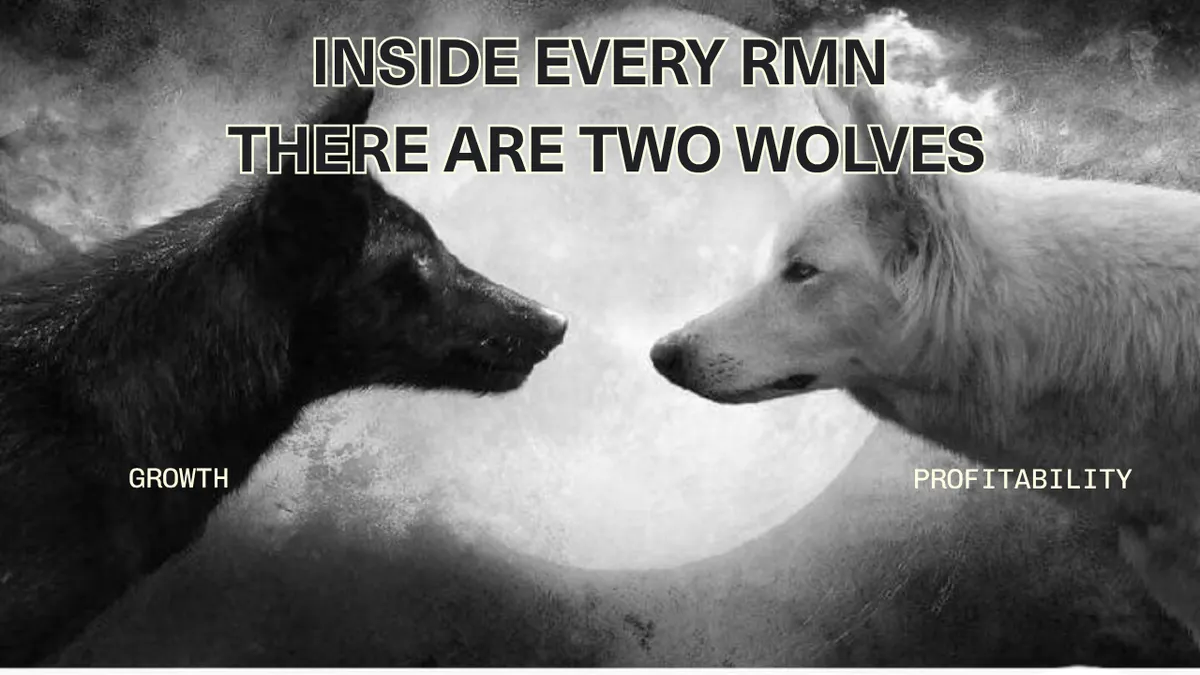
The panel included a star cast of commerce media network leaders and brands. ADWEEK's editor Ryan Joe asked what curveball nobody saw coming, and Anne's answer was: more retail media networks are about to get pushed to operate profitably. That top-line growth has been the scorecard for years, but that's all about to change.
I didn't clock it myself, but Anne said she felt the room turning on her in real-time. After all, this room was full of people whose whole pitch is growth. Maybe I missed it. But either way, that roundtable was one of the more honest exchanges I've listened in to lately. Lisa Valentino, President of Best Buy Ads, pushed back on the premise that fixating on profitability would cramp the industry's ability to build a real media ecosystem; she's noted 40% of Best Buy's ad revenue comes from off-site. A fair point that we'll come back to later.
I think Anne is onto something. And the reason it made people shift in their seats is actually why it has merit: the pressure isn't coming from inside the retail media network. It's coming from the much larger company the RMN lives inside.
This is the first in a three-part series I'm doing with Anne, which we're calling The Demons Inside Retail Media. Her read is that the biggest threats to retail media in 2026 aren't the external ones everyone's bracing for. Not AI, not agentic traffic, not disintermediation. They're internal. There are three structural problems that could eat retail media from the inside out, and over the next three weeks we're walking through each one:
- the growth demon (today)
- the silo demon: how retail media ends up funding tech innovation inside a retailer.
- the shortcut demon: how nobody wants to fund the foundational data work that makes all the exciting new AI stuff possible.
This series is sponsored by Mirakl Ads.
Growing fast covered a lot of sins
A retail media network makes a lot of noise at conferences. But it's still a business unit inside an organization orders of magnitude bigger, and as Anne put it, that asterisk never goes away.
For the first couple of years, nobody looked too closely. The revenue was new and growing fast, and nobody checked whether headcount was growing just as fast. Anne thinks that's the number about to come under the microscope — the ratio of what the media business brings in, versus what it costs to run. "That is going to be a proportion that is much more closely guarded," she said.
I pushed on this. Media, even run inefficiently, is one of the most profitable things a retailer does. Next to running stores or moving pallets, shouldn't it look great by comparison? How would a retailer even know there's more to squeeze?
Usually it doesn't figure that out on its own, Anne said. The number comes from outside, often from the management consulting firms that size the opportunity for the eager boards of retailers. And a lot of that "opportunity," as many in the industry have pointed out, is often dollars shifting from one pocket of the business to another.
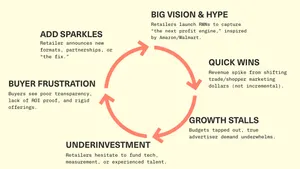
This is the retail media doom loop in action — retailers grab quick wins repackaging trade dollars, then stall when that easy money runs dry.
The merchant is watching the money move
Picture it from the merchant team's seat. The retail media network launches, grows, posts big numbers — and a chunk of those numbers are dollars that used to run through their budget. On paper, it shows up as attrition in their department.
"I am pointing that out, and I'm being very loud about it," Anne said, playing the part. "Because within these organizations, everyone still has to live in the business that they're in. They don't exist as an island, even if they're operating separately."
That's what the growth-at-all-costs story leaves out. An RMN doesn't get to celebrate its revenue in a vacuum. Somebody down the hall is watching the same dollars and asking why they vanished from their P&L.
It also reframes the profitability question. It isn't that an RMN's margins are bad. It's that the broader organization has started asking harder questions about cost to serve, about headcount, about whether the growth is incremental or just reshuffled from somewhere else.

The Agentic AI Revolution is here. The competitive edge belongs to those who move faster than disruption itself.
Join Mirakl Ads in New York City on June 10, 2026 for strategies, insights, and connections built for the era of agentic commerce.
Discovery is shifting. Media economics are following. The brands and retailers who figure out what comes next won't be the ones who wait — they'll be the ones already moving.
"If it isn't driving the business, what is it for?"
The retailer that seems to have understood this earliest is Costco.
Anne brought up Mark Williamson, who leads retail media there. Williamson has been clear that Costco's media has to drive the core flywheel: product sales, membership affinity.
"Mark's point is really: if it isn't driving the business, what is it for?" Anne said. "And everyone is playing that record internally somehow."
She has a way of categorizing RMN leaders I liked. Two types, she says: the technologist and the salesperson. "The technologists built this really robust tech stack, but they might be behind on revenue targets. Or the sales leader is telling this really compelling story, but if you look behind the curtain, there's not a lot of technology supporting it — it's really people-powered." What makes Williamson unusual, in her read, is that he doesn't sit cleanly in either camp. He can answer to the merchant and run the media business — which is what the profitability era will ask of more leaders.
Profitability costs money first
Here's the awkward part: Getting to profitability isn't free. You have to invest before the dollars start flowing.
I pointed to Home Depot's recent announcements — nearly every new format made available self-serve right from the start. That takes real upfront work to build. But self-serve is what lets you activate advertisers at low cost, which is what makes the math work later.
Anne agreed, and it's where her own company's pitch sits: you can't hire your way to profitability by throwing 30 salespeople at an old playbook. It has to be technology that lets you reinvest the ad dollar cheaply.
So the 2026 conversation isn't "cut costs," and it isn't "chase growth." It's spend in a measured way now to build an operation that can survive a profit standard later — and survive the merchant down the hall tracking the dollars.
Which leaves the open question Lisa was getting at. If everyone turns inward on profitability at the same moment, does the industry talk itself out of building something bigger? I don't think Anne would say profitability and ambition are opposed. But it's a real tension for the industry to wrestle with.
This 3-part series is sponsored by Mirakl Ads. Read next:
Part 2: the silo demon, how retail media ends up funding tech innovation inside a retailer.
Part 3: the shortcut demon, how nobody wants to fund the foundational data work that makes all the exciting new AI stuff possible.