
A version of this post was originally published to my column at The Drum as 'Why retail media’s ‘mid’ moment may be its turning point' on May 22, 2026.
I was at a happy hour at Advertising Week New York last year when I was introduced to a well-known thought leader in the lofty brand marketing space. I introduced myself as someone who covers retail media.
"Retail media is the scourge of the advertising world and nothing more than a tax on brands," they quipped, then immediately left the event.
I was dumbstruck. Did they not want to hear my response? Perhaps they just had somewhere better to be?
But that wasn't the first or last time I've heard such things.
Last year, I wrote an impassioned rebuttal to the claim that retail media is basically a nothingburger. The argument goes like this: most retail media is just ad dollars spent on Amazon, and onsite sponsored product ads at that.
 Kiri Masters
 Kiri Masters
In my corner of the internet, retail media is a big deal. I write a newsletter that more than 10,000 retail media professionals read. Are these people simply volunteering their time to a good cause?
A few weeks ago, I was on a call with a tech leader in the ecommerce ecosystem who said: "There's only one company that makes a lot of money on retail media today: Amazon. Walmart has decent revenue from it, but Walmart has around $780bn in top-line revenue and what, $3bn, $4bn, $5bn from retail media? Walmart's retail media business could disappear, and Walmart would be fine. It's a trillion-dollar company."
That's a third of its operating profit.
He wasn't moved. Even if Walmart had to protect those margins — even if AI made retail media irrelevant — he figured Walmart could claw the cost back out of suppliers another way. To him, most of retail media is just charging brands for a search position they'd have gotten anyway. A tax by another name.
This made me realize, again, that even in 2026, retail media still has a huge perception problem. Not just among average consumers who say they hate ads, but among smart professionals in the ecommerce industry.
More troubling than that, if we continue down the path we're on, retail media may in fact become "mid."
Why retail media is perceived as mid
The critique is not entirely irrational. Retail media is often too reliant on sponsored product ads, especially on-site search placements. Amazon still dominates the category. Some retail media networks remain under-resourced, under-differentiated and too dependent on outsourced sales or cheap tech stacks.
Jason Goldberg has made a version of this argument before, and it was a great tit-for-tat that we ran across both our properties. His critique, as I understand it, is that the category's biggest growth engine is also its greatest reputational weakness: retail media often looks less like media innovation and more like retailers monetizing access they already controlled.
The industry weighs in
I called on a cadre of industry friends to weigh in.
Industry analyst Andrew Lipsman pushed back on the idea that retail media's Amazon and sponsored product concentration makes the rest of the market too small to matter.
"Non-search retail media is a $21bn market already, projected to hit $35bn by 2029," he said. "Non-Amazon retail media is a $23bn market already."
In other words, even after you strip out Amazon and sponsored product ads, what remains is still a very large business. Lipsman argued that the remaining slice is enough to support at least four $1bn-plus ad businesses already, including Walmart, Instacart, DoorDash and Uber, with Kroger, eBay and Target expected to hit that mark in the next year or two.
"Most RMNs still have huge upside because they remain under-monetized in onsite search and are still ramping onsite display and video," he said. "In-store retail media drives little revenue today but promises to be a $10bn-$20bn ad market within five to 10 years. Lack of execution is a much bigger inhibitor of growth than lack of opportunity for non-Amazon RMNs."
Lipsman also said critiques of Amazon's ad clutter are fair, but incomplete.
"One reason Amazon gets away with it is because its ad relevance is best-in-class," he said. "Consumers largely don't notice or don't care. Non-Amazon RMNs have a lot more runway to monetize with ads without much risk to customer experience if they get their ad relevance up to par."
My view is that non-Amazon retail media is smaller not because the opportunity isn't there, but because too many retailers are tripping over themselves — fighting merchandising-versus-ads battles and underinvesting in tech and talent.
Neal Sheridan, retail media veteran and now vice-president of sales at Stingray Advertising, argues that Amazon's dominance is built on ecommerce-specific dynamics that don't translate neatly to the broader omnichannel landscape.
"Amazon will remain a major player, but its share will decline as the total market expands beyond ecommerce," he said.
His read on why Amazon scaled the way it did — and why much of that spend is protective rather than growth-driving:
- An authenticated user base that few other retailers can match
- Third-party marketplace competition that forces sellers to pay to defend their own listings
- Conquesting on branded search — brands buying their way back to the top of results they'd otherwise own
Meanwhile, most retail still happens in physical stores, where Amazon has limited reach. Traditional retailers control what may be the most valuable asset in the next era of retail media: high-frequency physical stores tied to loyalty identity. Every aisle, shelf tag and checkout lane is a monetizable media surface, and integrating in-store with digital, CTV and off-site unlocks omnichannel attribution Amazon can't match at the same scale.

The Agentic AI Revolution is here. The competitive edge belongs to those who move faster than disruption itself.
Join Mirakl Ads in New York City on June 10, 2026 for strategies, insights, and connections built for the era of agentic commerce.
Discovery is shifting. Media economics are following. The brands and retailers who figure out what comes next won't be the ones who wait — they'll be the ones already moving.
The next wave, Sheridan argues, comes from non-endemic advertisers — auto, finance, travel, QSR, insurance, telecom — who value deterministic identity and real-world behavioral data and bring far bigger budgets than CPG alone.
"The next era of retail media will not be defined by ecommerce scale," Sheridan said, "but by omnichannel reach, loyalty-driven identity and measurable real-world impact."
Anne Hallock, vice-president of sales, Americas at Mirakl Ads, takes issue with the idea that the industry should be dismissed because it is still immature.
"So we're just not supposed to do anything?" she said. "What's the solution here? That you're going to have an entire generation of retail and adtech professionals who just didn't attempt to monetize owned properties?"
Hallock compares retail media's current awkwardness to earlier stages of digital and programmatic advertising.
"When I entered programmatic in 2013, everyone thought it was remnant inventory, it was garbage and that the protocol was going to go away," she said. "Was that mid? That was worse than mid."
Immature channels look messy before they mature. Retail media may be clunky, but clunky does not mean inconsequential.
"Amazon stands alone," Hallock said. "I don't use Amazon as a benchmark or comparable when I talk about retail media because it is so truly unique."
She also argues that marketplace and advertising are increasingly inseparable.
"Ads plus marketplace is the complete protein," she said. "You really can't have one without the other. You're not going to have a flourishing marketplace if the seller can't promote their product."
For Hallock, the fallacy is not in saying retail media is mostly sponsored product ads or that it is mostly Amazon. The fallacy is concluding that because those two things are true, the rest of the market is insignificant.
"To whom is retail media mostly Amazon?" she said. "Retail media is not mostly Amazon if you're Target. Retail media is not mostly Amazon if you're Macy's. I spend 100% of my time on retail media and I don't work with Amazon at all." (Mirakl Ads sponsors my newsletter & podcast)
Ana Laura Zain, chief marketing officer at MetaRouter, sees a conceptual problem in focusing too narrowly on the ad unit and missing the actual currency of the industry.
"In 2026, offsite spend, such as using retailer data to buy CTV or social, is growing three times faster than onsite," she said. "This is not only about SPAs. It is about moving the shopper signal across the entire internet."
Retail data, in Zain's view, is the engine behind major brand-building campaigns. Narrowing the debate to sponsored product ads is like judging the impact of the internet by the number of banner ads on a homepage. (Metarouter is a client of mine)
What the numbers say
Retailers are discovering that advertising to their own shoppers can be far more profitable than selling them groceries.
Amazon generated $68.6bn in advertising revenue in 2025. Walmart generated nearly $6.4bn, growing 46%. Target says Roundel now generates nearly $2bn of value, including ad revenue within net sales and contributions that offset costs. Best Buy has also been building its retail media business as it expands its marketplace ambitions.
Those are large numbers. And they are high-margin numbers layered onto businesses that traditionally operate on thin margins.
Retail media is increasingly a profit center. Once retailers see that, expanding it stops being optional — and the predictable consequence is that brands pay more.
Much of what gets labeled retail media is not traditional brand advertising. It is sponsored placement inside search results and product listings — charging for visibility at the point of purchase. Retailers control valuable digital real estate and own high-intent traffic. Expanding sponsored placements is one of the clearest ways to make more money without raising shelf prices or changing the core of the business.
For brands, that means retail media spending is likely to keep rising, and faster than many budget plans assume.
EMARKETER expects US retail media ad spending to near $70bn in 2026, while Nielsen says retail media spending will reach $60bn in the US this year and $100bn by 2028. Nielsen also found that 65% of global marketers said RMNs would play a bigger part in their media mix over the next 12 months, while only 2% planned to pull back.
Where the naysayers could be right
Retail media is not out of the woods, let alone out of Amazon's looming shadow.
Here is the concern that was shared privately with me:
"Retail media feels mid right now, but it doesn't have to be.
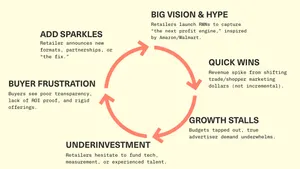
"Most people are running the exact same playbook in new ways and expecting different results: outsource sales to Criteo, Instacart, a demand network or a programmatic onsite player; buy only the cheapest tech; don't ask for much funding for resources; park change management; prioritize only PLAs because offsite is less profitable and in-store is expensive.
"Walmart, Amazon and Instacart are winning because they took this business seriously and invested. You get out of it what you put into it."
That, to me, is the most compelling version of the skeptical case.
Will enough retailers will build media businesses that are worthy of the budgets they want to capture?
There will likely be winners and losers in the retail media game over the next few years. In fact, the IAB has already written about possible consolidation and more sustainable growth models.
The best retail media networks won't win by taxing suppliers harder. They'll win by giving brands something genuinely useful: better signal, better measurement, and better access to the moments when people are closest to buying.
The weaker networks will prove the critics right. They will over-monetize the shelf, underinvest in the product, frustrate merchants, annoy shoppers and call it innovation.
Retail media can be a tax. The next few years will decide whether it becomes anything more.