I've been clearing out the house on Facebook Marketplace lately, and I noticed something pretty ironic.
Marketplace has long let buyers fire off an instant "Hi, is this available?" with one tap. Anyone who's sold on there knows the exhaustion of getting flooded with these. So what was Facebook's fix? They gave sellers an auto-reply feature. Now my automated responses answer buyers' automated inquiries, all natively in the platform.
Facebook created the problem, then "solved" it by automating both sides of the conversation. Bots talking to bots. Nobody actually deciding anything.
Which is more or less the pitch retailers keep making to advertisers right now: objective-based, AI-driven ad buying. Tell the platform your goal, hand over the keys, let it optimize bids, placements, products, channels. Retailers are racing to launch these. But I kept wondering whether advertisers actually want them.
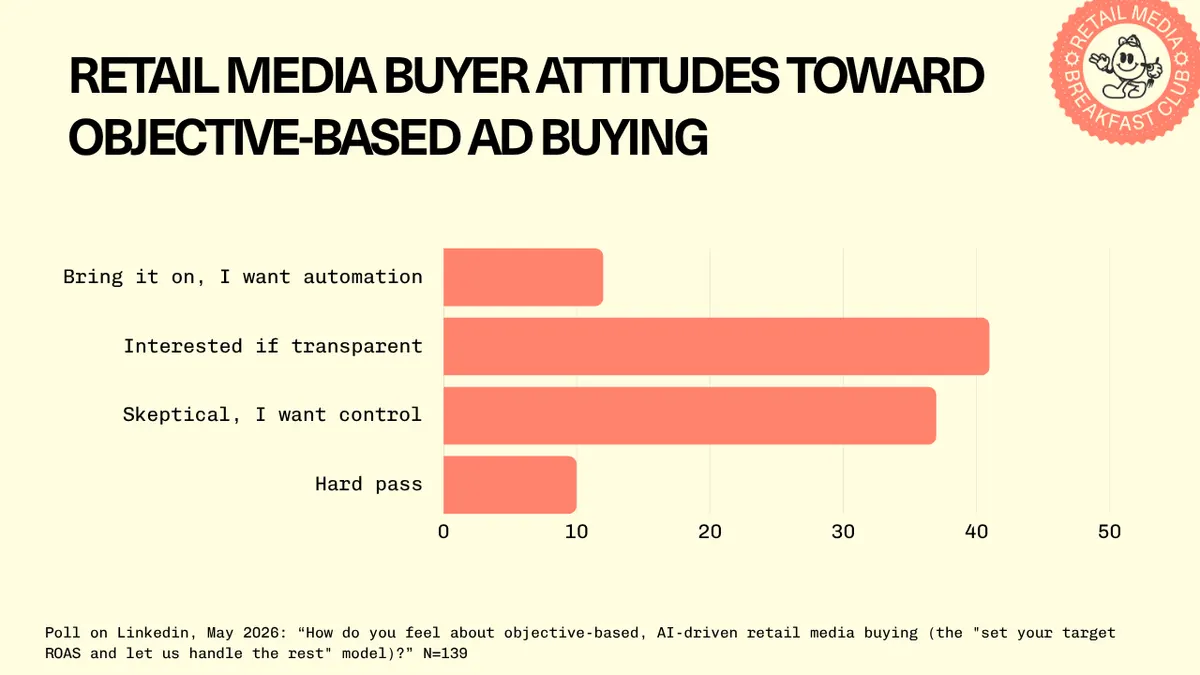
So I asked. I ran a poll, and 139 of you voted.
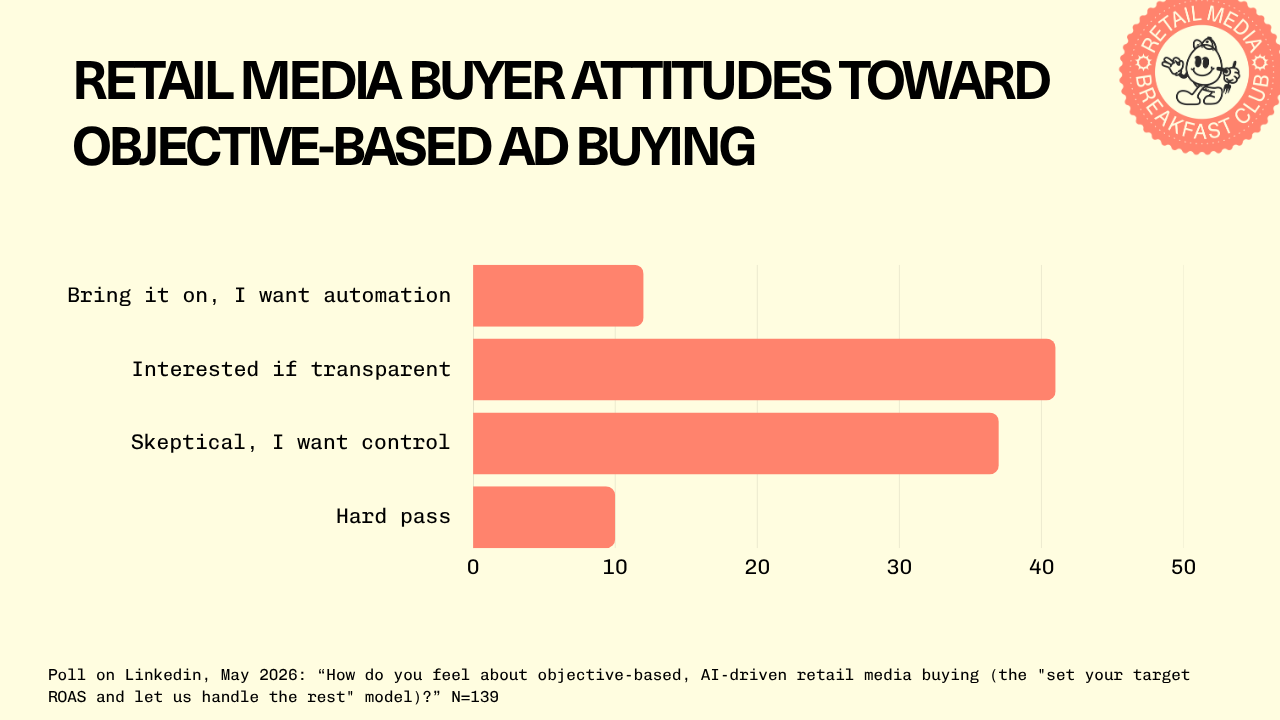
- Bring it on, I want automation — 12%
- Interested if transparent — 41%
- Skeptical, I want control — 37%
- Hard pass — 10%
Look at the middle. Nearly four out of five of you didn't object to the capability. You objected to handing it over blind. "Interested if transparent" and "skeptical, I want control" share the same instinct: show me what's under the hood first.
The Agentic AI Revolution is here. The competitive edge belongs to those who move faster than disruption itself.
Join Mirakl Ads in New York City on June 10, 2026 for strategies, insights, and connections built for the era of agentic commerce.
Discovery is shifting. Media economics are following. The brands and retailers who figure out what comes next won't be the ones who wait — they'll be the ones already moving.
Corey Buller, Senior Director of Commerce Media at dentsu, said this was Epsilon's entire offsite targeting strategy across their RMN partners — and it always performed badly on incrementality. His reasoning: the AI is built to find the most efficient attributable returns, so it over-indexes on people who were going to buy anyway. The automation optimizes toward the sale that didn't need help.
Evan Walsh, who heads partnerships at measurement firm Incremental, named two hurdles he keeps hitting. One, retailer bias — without the right controls and visibility, buyers stay skeptical about what's actually being prioritized. Two, what he called "ROAS Jail": these systems need a primary KPI to optimize against, and it's rarely "drive total sales." Pick any base ad metric and you're right back where you started.
And James Tenser, longtime retail tech analyst & journalist, raised the one that sits above all of it: what if the bots only optimize for short-term outcomes? Where does brand equity go? If retail media wants a permanent seat in the marketing mix, he argued, buying can't be confined to narrow technical objectives.
The resistance seems to be less about whether the machine can do the job, and more about whether you can see what it's doing.
I'm chewing on this one for a longer piece in my column at The Drum. I put the poll results to the head of Chewy's ad business in an interview last week, and his answer surprised me — he agreed with the skeptics, then told me how he's designing around them. More on that soon.
When we automate both sides of a transaction, are we removing the friction — or just removing ourselves?
PS – If you're in New York, join me at Mirakl's Outpace Summit on June 10! It's free for retailers and brands to attend.


![RMNs Are Launching MTA. Do Brands Want It? [Part 1]](https://storage.ghost.io/c/fd/2e/fd2ea2dc-8a41-4dfb-987b-e5e3b2c38c09/content/images/size/w300/format/webp/2026/10/NEW-Thumbnail-designs--4-.png)