
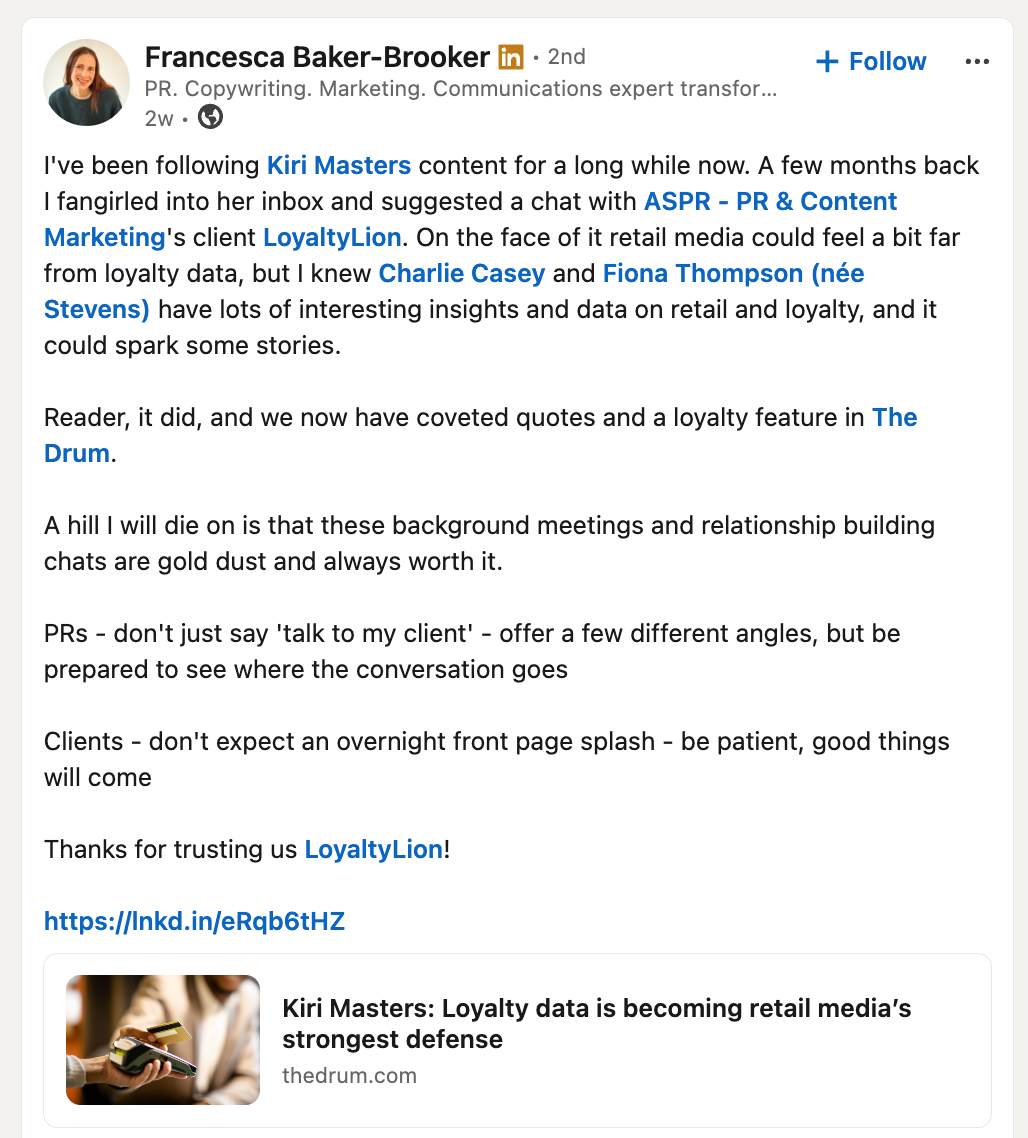
A few months back, a PR named Francesca Baker-Brooker "fangirled into my inbox" (her words) and pitched me on a conversation with her client, LoyaltyLion. Not an announcement, but a conversation with someone who she reckoned had interesting data on retail and loyalty.
There's nothing unusual about that, by the way. I get pitched conversations all the time — an intro to an exec, a chat with a founder, fifteen minutes with someone who has a "contrarian take." I say no to most of them. Partly it's timing, and partly it's the quiet burden a 'yes' creates: if I take the call and the person says nothing I can use, or I've got no upcoming piece it fits, I'm left feeling like I owe them coverage I can't honestly give. So the bar for a yes is higher than people think.
But this one I said yes. And I told them, candidly, that I probably wouldn't use anything from it for a while. The material was evergreen and I had other things in the queue.
Here's what Francesca did next: nothing. She didn't pester me. She didn't follow up three times asking when it was running. She trusted that good things take time.
And the good thing eventually came. A few weeks later I worked some of LoyaltyLion's leadership comments into a broader piece, where they fit naturally in a thematic piece that frankly got a lot more eyeballs than a whole feature on a tech company would.
But more importantly, because Francesca and her client were genuinely helpful and I never over-indexed on them, they're the first people I'll hit up the next time I write about loyalty. Francesca wrote about the experience on LinkedIn afterward:
So why am I, of all people, telling anyone how to do their job?
Let me be clear about what I'm not. I'm not trade media. I don't call myself a journalist or an analyst.... that would give both of those honest professions a bad name! I'm a regular person who fell into this field and never quite climbed back out, and these days I run a newsletter, a podcast, and a column more or less by accident. What I am is someone who gets pitched and cajoled a lot, from a seat that doesn't fit any of the usual boxes. So all I can really offer is my lived experience of being on the receiving end. Take it for what it's worth.
But I'll say this: that experience is changing, and not just for me.
The Agentic AI Revolution is here. The competitive edge belongs to those who move faster than disruption itself.
Join Mirakl Ads in New York City on June 10, 2026 for strategies, insights, and connections built for the era of agentic commerce.
Discovery is shifting. Media economics are following. The brands and retailers who figure out what comes next won't be the ones who wait — they'll be the ones already moving.
The roadmap has changed
For a long time, the PR playbook had a clear hierarchy. You landed the big trade or business placement first. The "real" coverage. Newsletters, podcasts, the LinkedIn crowd — those were the afterthoughts, if anyone thought of them at all.
That's all changing.
The Reuters Institute's 2025 Digital News Report — built on responses from nearly 100,000 people across 48 markets — found that in the US, more people now get their news from social and video platforms (54%) than from TV (50%) or news websites (48%). The report describes traditional outlets struggling to connect with audiences, while a fragmented environment of podcasters, creators, and newsletters picks up the influence they're shedding.
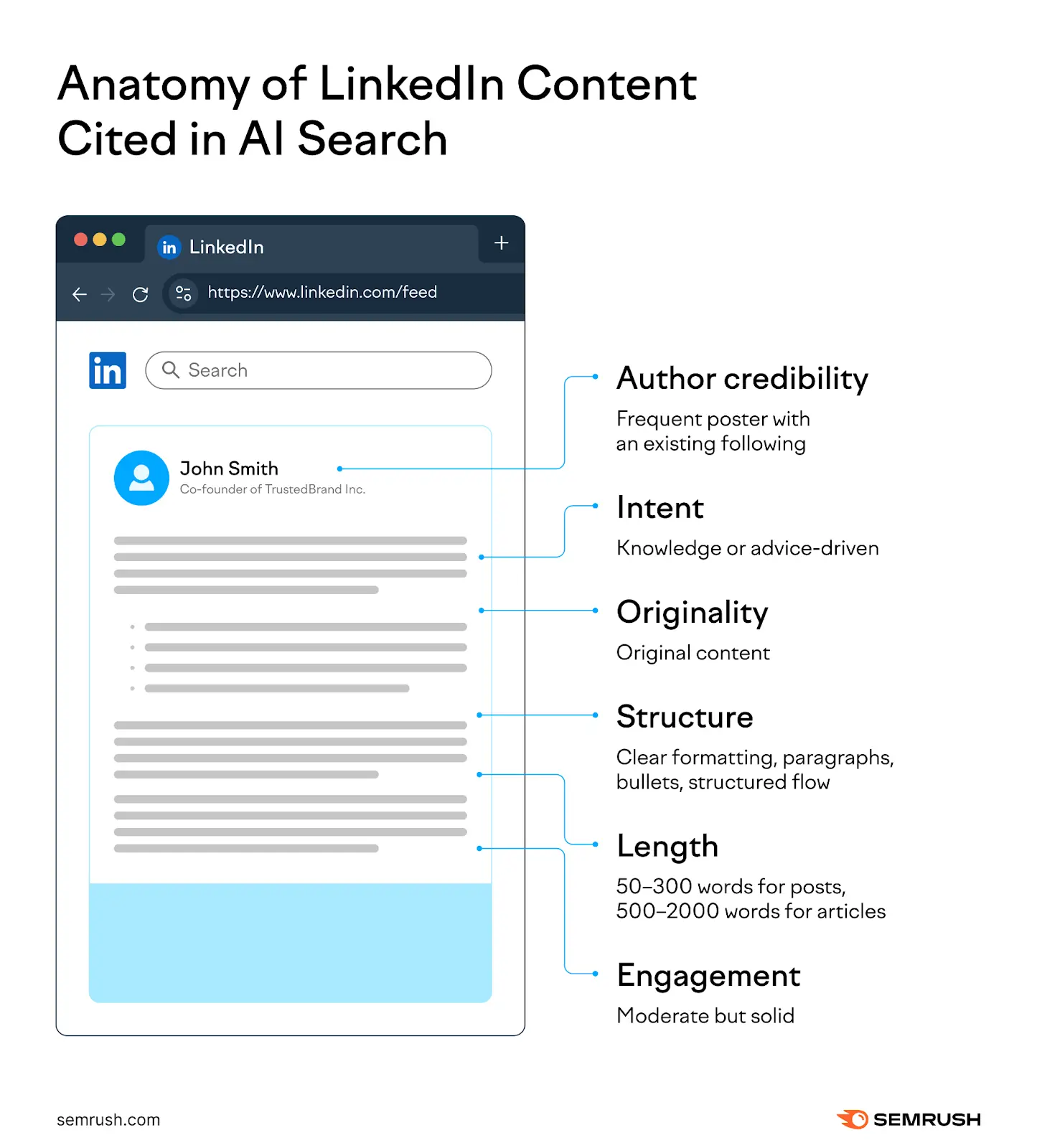
The LinkedIn Think-boi (credit to Mike Mallazzo for that term) is having a moment, too. Semrush published analysis of LinkedIn’s AI visibility in March 2026, looking at 89,000 LinkedIn URLs cited in AI search. LinkedIn content is increasingly appearing in AI-generated responses, especially when users query professional topics, companies, executives, categories, or brands.
I want to be careful here, because the lazy version of this argument is "traditional media is dead." It isn't. I'm a columnist at The Drum, and we've got a very exciting project coming up I'll be able to talk about soon.
A strong placement in a respected outlet still creates credibility that a LinkedIn post can't.
The sharper, truer claim is one that Joe Gallo, who leads comms at PayPal Ads, made in his own LinkedIn post recently: authority has fragmented. The reporters who cover any given space are stretched thin, covering more beats with less time. A niche newsletter sees open rates that embarrass legacy publications. As Joe put it, the programs that drove real narrative shift treated those channels as primary, not as add-ons.
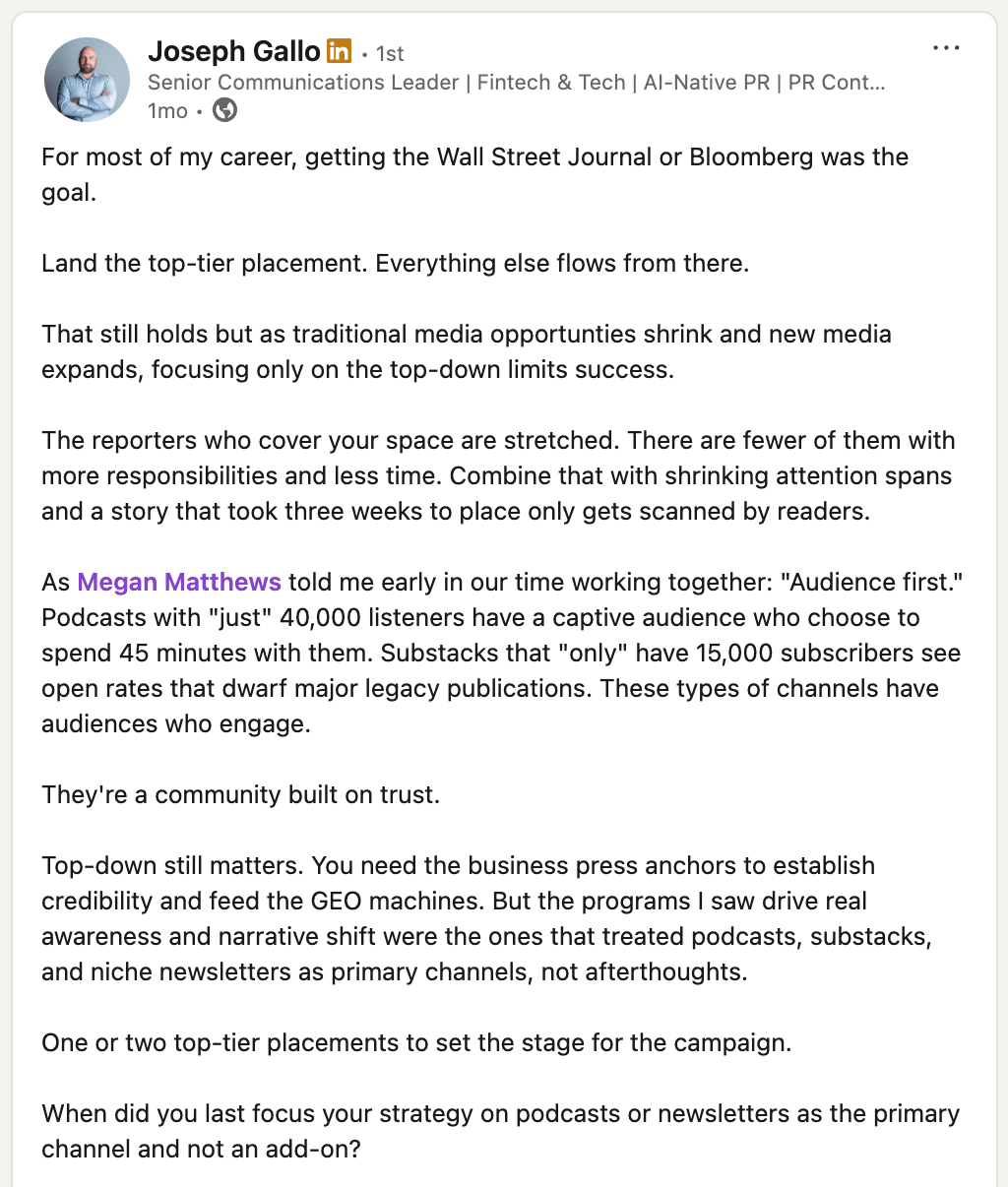
Megan Matthews, the exec director of Comms at Ford Motor Company, who Gallo quoted in his post, chimed in with two points:
- Trust has fragmented into psychographic tribes and influence depends on understanding the internal logic of each tribe
- Micro-communities are replacing mass influence. Influence has become precise, not broad.
I'm pleased to see independents getting legitimized as outlets in their own right. Andrew Lipsman (Media, Ads + Commerce) and Jason Del Rey (The Aisle) hold individual sway that rivals the institutions they used to write for (EMARKETER and Fortune, correspondingly).
Bring it on. Just understand that landing with an independent sometimes works differently — so here's four observations and tips on how to make it land with someone like me.
The Agentic AI Revolution is here. The competitive edge belongs to those who move faster than disruption itself.
Join Mirakl Ads in New York City on June 10, 2026 for strategies, insights, and connections built for the era of agentic commerce.
Discovery is shifting. Media economics are following. The brands and retailers who figure out what comes next won't be the ones who wait — they'll be the ones already moving.
1 - Know your audience
This should be the easy part in the age of AI, but somehow it's where most pitches fall down.
A few quirks of my particular coverage: I don't have guests on my podcast. I don't cover product announcements. And yet I am pitched both, constantly. I notice when it happens. It tells me you found my email but never spent ten minutes reading what I do.
On the announcements specifically — that's a deliberate choice, not an oversight. Plenty of trade press cover launches well and have the capacity to do it properly. I don't want to compete with that, and frankly, every time I've covered one announcement, someone else gets quietly wounded that I didn't cover theirs.
2 - Spill some tea
Remember that burden I mentioned — the feeling that a yes quietly puts me in your debt? Here's how you make it worth carrying: have something real to say.
Once I'm on the call, I genuinely want to find a place for you. The worst version is when I can't — when you stick to the approved talking points, the polished narrative, the thing already on your website. There's nothing for me to do with that, and now we've both spent the time for nothing. And it's not just the over-eager vendors who do this. Retailers and RMN leaders are every bit as guilty — maybe more so, because they've usually got the most interesting thing to say and the most layers of approval stopping them from saying it.
There has to be some tea spilled. And I'll protect the source — that's the whole point of background. I won't tell anyone who spilled it. But I need something real to work with, and a media-trained executive reciting the press release is the fastest way to waste both our time.
3 - Make it a no-brainer
Here's something I'd love to see more of: famils.
If "famil" isn't in your vocabulary — it's shorthand for a familiarization trip, borrowed from the travel industry, where a host shows media something best understood in person. And there's so much in our world that's genuinely better seen than described. In-store retail media is an obvious one.
Last year, one retailer hosted me for a tour of their stores and walked me through what makes them different. It wasn't excessive, they didn't lean on me for positive coverage. But because my understanding of their proposition deepened so much, I genuinely had more positive things to say — and I found organic reasons to reference them in coverage months later. It works.
Contrast that with the invitation I got recently: come to a three-day media event, pay for your own travel, oh, and it's in three weeks. That's a pretty easy no from me.
What about the big industry events? Here's what gets my attention:
- Berns & Co hosted a genuinely good press breakfast at Shoptalk this spring: Zia Daniell Widger (Global President, Connected Commerce at the event's parent company Hyve) shared some behind-the-scenes insight from the event, and they brought in an interesting panel pairing a tech vendor with a retailer. Media people love an opportunity to meet each other and, yes, gossip. It's a welcome break from the pitch treadmill.
- If you've got an announcement to make at one of these events, preview it under embargo. From the outside, I have no way of knowing whether your news is genuinely big or a minor feature you're hyping. Share it in confidence so I can digest it ahead of time. The alternative — a surprise reveal you're hoping I'll react to on the spot — rarely lands the way you want.
4 - One ask, if you're commissioning research
This one's for the companies, not the agencies — because you're the ones who decide what gets commissioned. Please, and I say this with love: don't fund another survey about media buyers' attitudes toward retail media. We have enough. We already know what buyers want: better measurement, more transparency, lower costs. Another self-reported preference survey isn't going to produce a novel perspective at this point.
You know what would? Research built on your own data. Tech vendors mining their own user behavior — clickstreams, outcomes, what people actually did rather than what they said they'd do in a survey. That's harder to produce. It's also genuinely novel, and it would stand out in a sea of sameness.
None of this comes from a place of ingratitude. I'm in an extraordinarily lucky seat, and great PR folks make this whole thing a pleasure. I'm telling you how the pitches land because I suspect most of you genuinely want to know, and almost nobody on my side of the inbox says it out loud.
So consider it said. Now spill some tea.