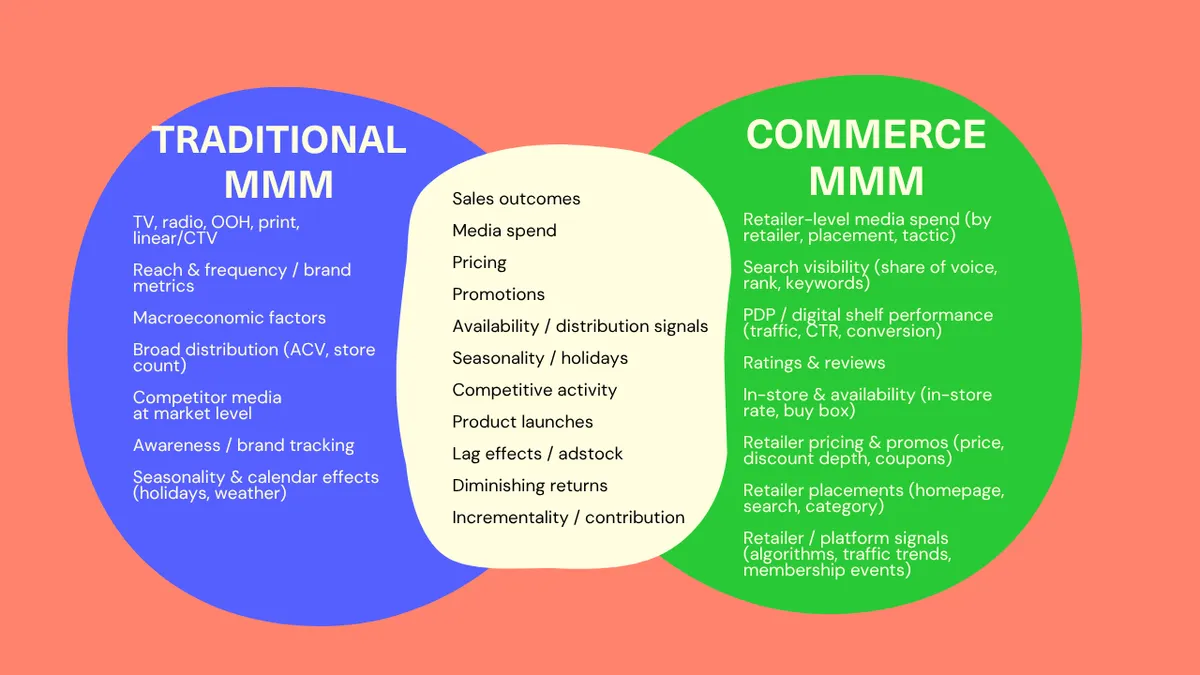
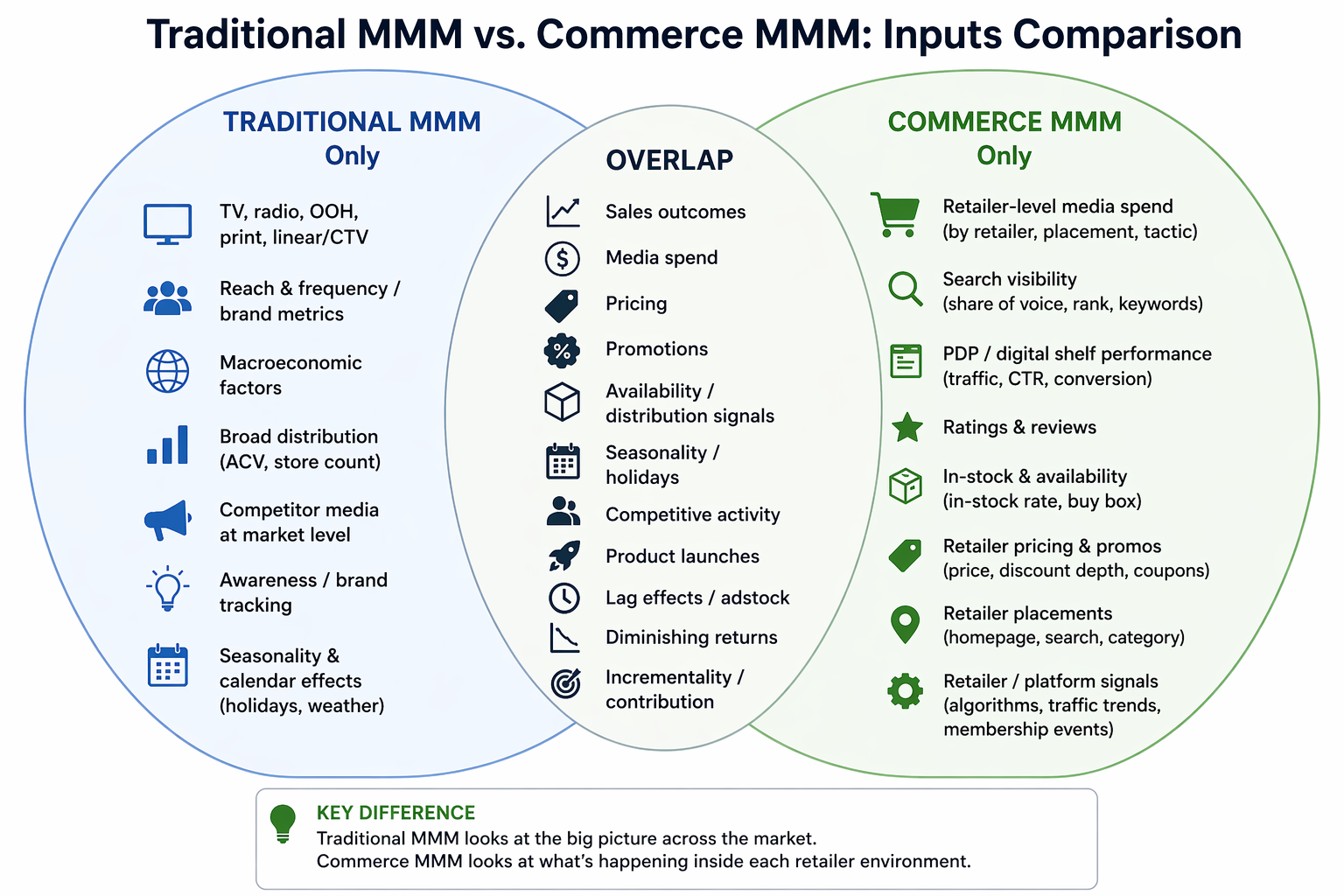
A CPG brand-side retail media leader recently wrote in with a question I suspect a lot of teams are wrestling with right now: How should brands think about commerce-specific MMMs — tools built to measure retailer-level ROI — versus traditional marketing mix models that measure total market impact? Can you use both? Should you? And how do you hold retail media to the same rigor as national media without forcing the wrong tool onto the wrong problem?
It's a good question. And based on the responses I got when I put it to my network, there's no tidy answer — but there is a useful set of guardrails taking shape.
The consensus: Different objectives need different measurement
Just like sprinters and bodybuilders don't train the same way, retail media and national media are optimizing for different objectives.
So says Jordan Witmer, head of retail media at the agency Salt XC.
Retail media optimizes for conversion, SKU movement, retailer-specific algorithms. National media optimizes for reach, frequency, brand building. Jordan says when a single model tries to assign one ROI to spend that serves both purposes, it blends two optimization strategies into one output.
Jaiah Kamara, Founder of Signal to Summit, an advisory firm working with retail media networks, landed in a similar place but framed it with a different analogy. Think of it like camera lenses, he said: a wide-angle lens can technically shoot macro, and a macro lens can technically shoot wide — but neither does the other's job well. Commerce MMM vendors and traditional MMM vendors will both offer to measure across each other's lanes. And they can technically do it. But the models are trained for different data types and different decision cycles, and forcing a cross-lane read produces a blurry picture.
James Deaker, who advises RMNs through his firm Korukea Media, was the most skeptical of the bunch. "Retail ROI and total market ROI answer different questions, and trying to collapse them into one number often creates more confusion than clarity," he said. Retail media sits closer to trade spend — it's about driving outcomes within a specific retailer. National media is about growing overall demand. Both matter, but James argues they should be evaluated against their own objectives before anyone tries to unify them.
What happens when you get this wrong
Jordan shared two failure modes he's seen firsthand:
- A brand uses a single traditional MMM across everything, and every time the model runs, the retail teams are pressured to justify their investment. It turns into a defensive spiral. In one case, Jordan flagged that a retail media campaign was driving lower CPCs and higher click-through rates on top category terms — strong signals by any platform-native measure. But the MMM evaluated it as "Search CPM" and called it too expensive. The analytics team's response? "We don't like to question or adjust the methodology to make our work look better."
- A sales leader asked whether they should sign a JBP with a retailer specifically "to protect us from the dollars getting cut when the MMM runs." When your measurement framework is driving teams to seek shelter in joint business plans, something has gone sideways.
One other failure mode is subtler. A brand sets up multiple measurement approaches — commerce MMM alongside traditional — but doesn't cleanly assign objectives upfront. So they default to legacy measurement, and when it doesn't look good, they pull out the secondary model as a backup. Jordan's take: "You're not really doing things differently. You've kind of just set up a backup plan." The upstream issue — clearly defining what each investment is supposed to deliver — never gets addressed.
This connects to something Jordan and I discussed recently: whoever owns the budget — sales team vs. brand team — determines what retail media is even allowed to be, and what it gets measured against.
So who should own this?
Anne Hallock, VP of Sales, Americas at Mirakl Ads, took a different angle from the others. She's less focused on which tool and more focused on who should be running the measurement.
Her framework: three groups need to get MMM right, but they'll each do it differently.
- Agencies will do it at scale — they have to, to maintain authority with clients.
- Brands will do it in hyperfocus, building their own views even if it means investing in tooling and data portability.
- Most RMNs will find it difficult due to other competing priorities. In a perfect world, every RMN would build world-class MMM capabilities. The reality is they're triaging: delivery and execution come first. This is not a failure of ambition, it's a rational prioritization, she says.
And there's a structural reason brands and agencies need to own this, Anne argues. "The walled garden can't smell the flowers outside." RMNs only see what happens on their own platform. Brands and agencies are the ones with the whole-picture view — they're the only ones who can stitch together retailer-level performance with total market impact. (note: Mirakl Ads sponsors this newsletter)
A question of maturity
Jaiah raised one more point worth flagging: this whole conversation assumes a certain level of sophistication on both sides of the table. "It's the more mature brands and media buyers asking for these more sophisticated measurement approaches," he said. "And it's the more mature RMNs that are investing in incrementality and outcome-based measurement rather than defaulting to impressions and CPM. Both sides have to be ready for this to work."
That tracks. The reader who sent this question is clearly operating at an advanced level. But a huge portion of brands are still taking the ROAS number at face value — and a huge portion of RMNs are still handing them one. (Though I have argued before that ROAS has its place in the measurement universe.)
The instinct to hold retail media to the same standards as national media is right. But as Jaiah put it, same standards should mean same rigor — not same methodology. The tools need to be fit for how retail media actually works, not shoehorned into frameworks built for a different problem.
There's no single model that answers every question here. But the experts I talked to broadly agree on the starting point: decide what job each dollar is supposed to do before it gets spent, and measure it against that objective — not against a universal number that tries to be everything to everyone.
Do you have a burning industry question you want answered? Subscribe to my newsletter and reply back. I love hearing what's on your mind!
Read related posts on this topic:
 Kiri Masters
 Kiri Masters