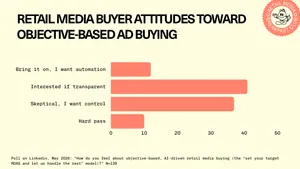

Every parent has said at some point, "We need to cut back on screen time." And we mean it.
But then 5pm rolls around. You need to cook dinner, there’s a meltdown…. And in flies the iPad as the soothing balm, because the incentives of the moment — a cooked meal, your sanity — overwhelm the noble principle from a few hours ago.
That's like ROAS in retail media. Everyone agrees it's flawed. But we’re still using it.
SPONSOR: MIRAKL ADS

Did you know leading retailer media networks drive 85% of their ads revenue through mid- and long-tail advertisers?
Mirakl Ads provides full funnel ad formats tailored to both 1P and 3P advertisers, leveraging unique AI-capabilities that provide unprecedented levels of relevance and engagement.
Retailers who want to capture ad spend from the long tail of 3P marketplace sellers use Mirakl Ads in their tech stack.
The Gap Between ‘Say’ and ‘Do’
A new report from adtech publication ADOTAT puts real numbers and experiences behind a paradox in the industry: brands are frustrated with retail media measurement but keep spending anyway.
Advertisers say they're not confident in measurement. Per the Path to Purchase Institute's latest study, 19% now call RMNs "a simple money grab for the retailer" — more than double the 8% who said so last year.
Yet retail media budgets keep growing. Skai’s State of Retail Media report shows that media buyers are pumping investment into retail media across all its incarnations:
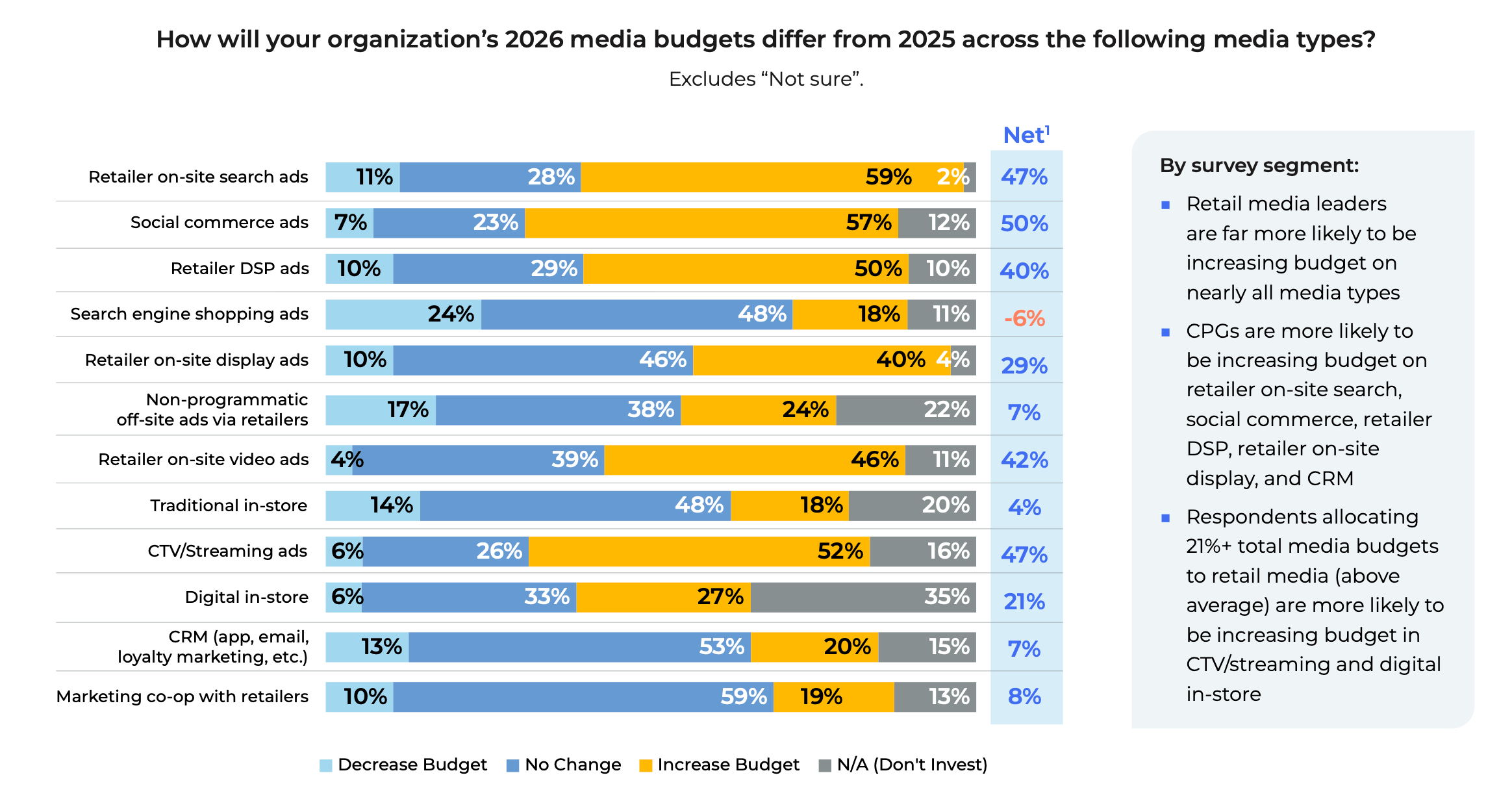
This mirrors a pattern I wrote about last year when looking at consumer attitudes toward retail media ads: what people say in surveys and what they actually do are often at odds. Harvard Business Review research found 65% of consumers say they prefer eco-friendly brands, yet only 26% buy them. The gap between stated preferences and revealed behavior is well-documented in consumer research. Turns out, it applies to media buyers too.
A Collective Action Problem, Not a Knowledge Problem
The ADOTAT report nails why ROAS persists. It lays out a collective action problem where every actor in the system is behaving rationally. But the system stays broken as a result.
From the report:
For retailers: Higher reported ROAS means more ad spend. No incentive to implement measurement that might show lower effectiveness.
Brand retail media teams use strong ROAS to justify their budgets and headcount. Rigorous incrementality testing might reveal wasted spend — and threaten the very program they've built.
Agencies are often compensated on ROAS targets. Questioning the metric means questioning their own performance. As I wrote last year, even strategically-minded agency teams default to promotional tactics when they know they'll be judged on next quarter's ROAS. It's rational behavior in an irrational system.

CFOs and finance teams love ROAS because it's simple, comparable, and fits on a slide. Incrementality is complex, expensive, and takes months to produce results. When the CFO asks "is our retail media working?", a ROAS number answers in seconds. An incrementality study answers in quarters.
This is the bit that gets overlooked in the "ROAS is broken" discourse. It's not that people don't know better. It's that the incentive to keep using ROAS is stronger than the incentive to replace it — for every single person in the chain.
Andrew Lipsman wrote last year in his Media, Ads + Commerce newsletter, "ROAS is the single greatest force that determines ad spending today." This creates a vicious cycle where even strategic retail media investments get evaluated on short-term metrics.
Demonstrating positive return-on-ad-spend has become how media sellers, agencies, and brands capture more dollars. But as Lipsman points out, "true marketing effectiveness typically plays out over months and years, not days and weeks." Retail media networks, desperate to prove their worth to budget holders, have leaned heavily into immediate attribution and conversion tracking. Media buyers inadvertently created their own worst nightmare.
In Defence of ROAS (Sort Of)
Here's where the "ROAS is dead" take has become its own kind of lazy consensus.
The ADOTAT report includes counter-arguments that deserve a hearing:
- "ROAS is good enough for most brands, most of the time." When you're managing four or more RMNs with fragmented data, ROAS is the only common currency across different retailer dashboards. It's imperfect, but it's functional. And as one industry commentator noted, the problem isn't the metric itself — it's how retail platforms can game it.
- "Incrementality testing doesn't pencil out for smaller spenders." Below a certain threshold in total retail media spend, the cost and complexity of geo-experiments can outweigh the benefit. For brands at that scale, the priority should be avoiding big mistakes — not running perfect experiments.
- "The gap between measuring incrementality and acting on it is huge." This is the one that really stings. Brands run expensive tests, get results, and then... nothing changes. The organizational inertia is too strong. Incrementality has been called "the most misunderstood concept" in retail media, but perhaps the bigger issue is that it's the most unused concept.
This is the lived reality for a lot of mid-market brands. And it helps explain why ROAS clings on — it's not just about misaligned incentives, it's that the alternatives aren't within reach for everyone.
What Actually Breaks the Logjam
So if ROAS won't die by industry consensus or panel discussion, what kills it?
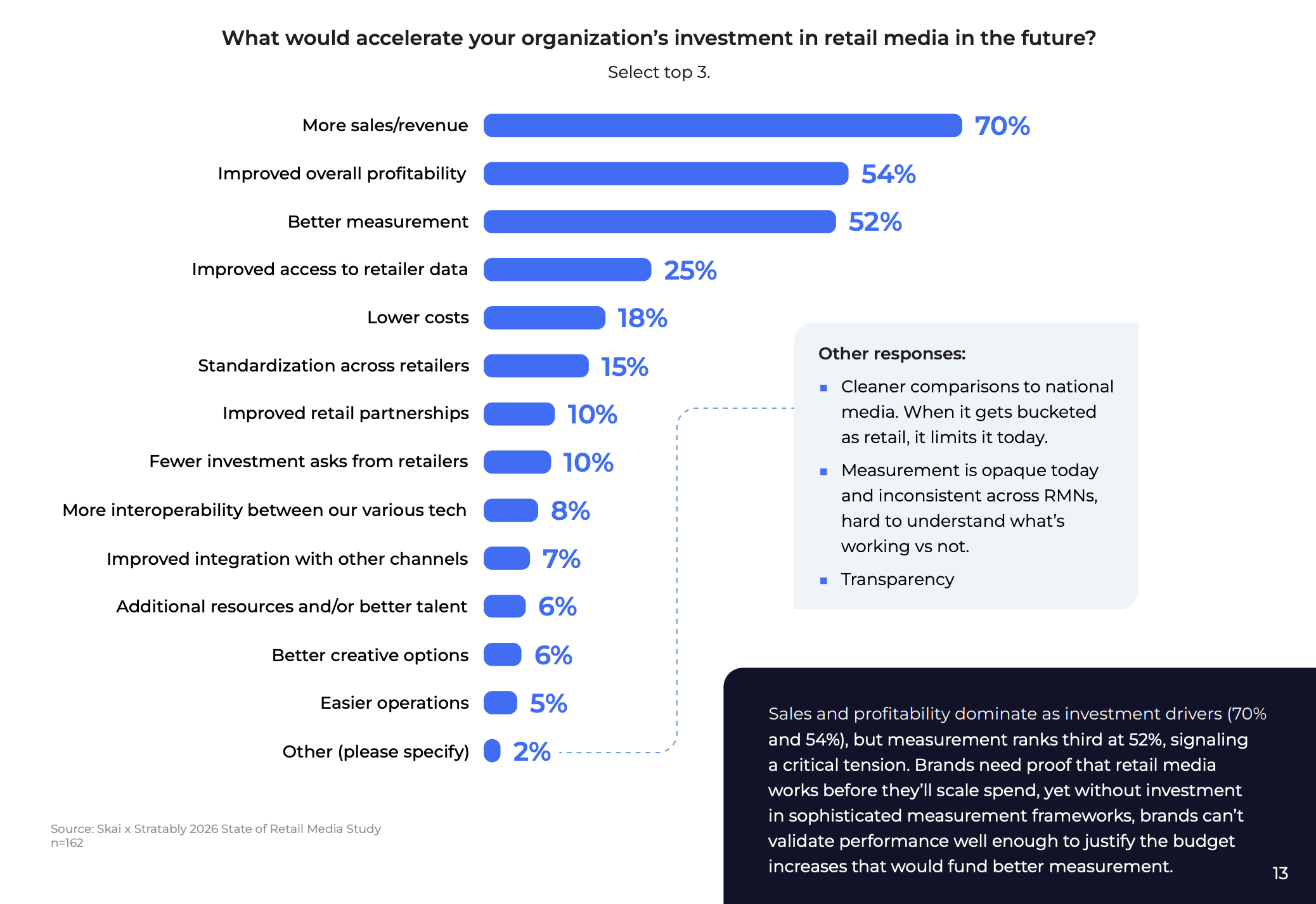
The Skai × Stratably 2026 State of Retail Media Study offers a clue. When asked what would speed up their retail media investment, "standardization across retailers" came in at just 15%. Better measurement scored 52%. Brands want proof that it works more than they want everyone measuring the same way.
The brands pulling ahead aren't waiting for the industry to sort itself out. As I wrote recently, top performers are building their own operating systems on top of retail media — cross-retailer normalization, independent measurement, incrementality testing on their own terms. They're building the connective tissue that doesn't exist natively.
Read more:

The Monday Morning Test
As the ADOTAT report notes:
“Everyone knows measurement is flawed, but no individual actor has sufficient incentive to fix it. Organizations are KPI’d and bonused on last-touch ROAS. Until incentive structures change, measurement practices won’t.”
Until then, we should expect just as many panels about how ROAS is broken, and people agreeing that things need to change.
And then Monday morning arrives, and everyone opens their dashboards and optimizes against the number that keeps their budget safe, their bonus intact, and their CFO happy.
Just like you meant it about the screen time. Right up until 5pm.
Check out the full Retail Media Research Report from ADOTAT here (free for ADOTAT+ subscribers)


![RMNs Are Launching MTA. Do Brands Want It? [Part 1]](https://storage.ghost.io/c/fd/2e/fd2ea2dc-8a41-4dfb-987b-e5e3b2c38c09/content/images/size/w300/format/webp/2026/10/NEW-Thumbnail-designs--4-.png)