I was delighted to be a guest on Wendy Liebmann's postcast, Future Shop, a few weeks ago.
Talking about retail media to people who are intimately familiar with retail, but less so with advertising, is always a treat because it reminds me how cosmically linked these two things are.
Amazon wouldn't have produced its astounding Q2 results last week without its hugely profitable media business – not just on the pure margin it contributes, but also because it offers Amazon's enormous 3p seller base a legitimate way to show up and compete with the big incumbents. The 3P marketplace stokes the core retail business, which is also the key asset behind its ads business. (For a great recap of Amazon's earnings results and this mechanism, check out the most recent episode of the Jason + Scot Show podcast)
On Wendy's podcast we were talking about how retail media got built — the last four or five years of it, the sponsored-product machine that most networks have assembled. And she asked: is that the way it's going to continue to evolve?
I don't think so. I think we may be in for a reset of sponsored product ad volume. And that might mean some changes in the economics of retail media – both for the advertisers, and the retailers.
The 3 surfaces for onsite ads
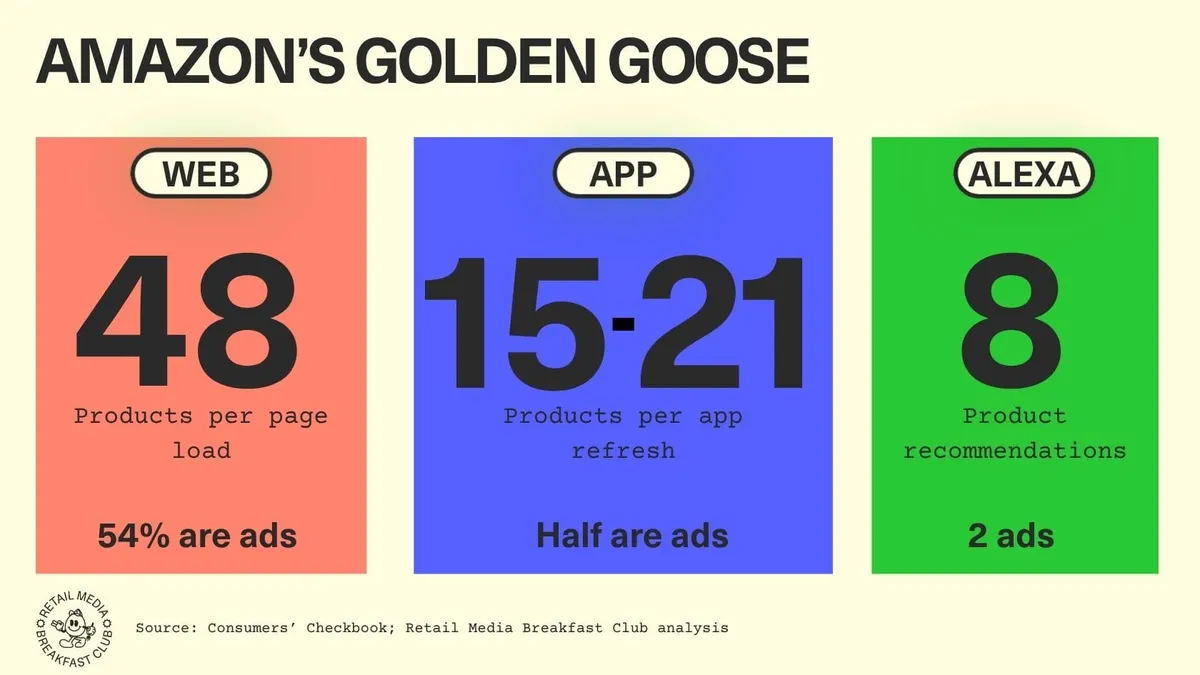
On a desktop search results page on Amazon, accounting for continuous scroll, you're looking at something like 40 to 50 products. Roughly half of them are sponsored listings.
On the mobile app, there are fewer SKU's but still about half are ads.
Then you ask the same question of Amazon's assistant, Alexa for Shopping, you get about six to eight SKU results. Two of them, on average, are sponsored.
As Amazon touts Alexa for Shopping as a major contributor to sales, ad supply is falling.
Is ad demand elastic?
Economics 101 would say that when supply falls and demand holds, the price goes up.
And I imagine that AI assistant placements should carry a premium:
- Two products surfaced in response to a conversational question are more considered than the twentieth tile on a scroll.
- The shopper is closer to a decision – fewer, better-qualified impressions could be more performative for the advertiser.
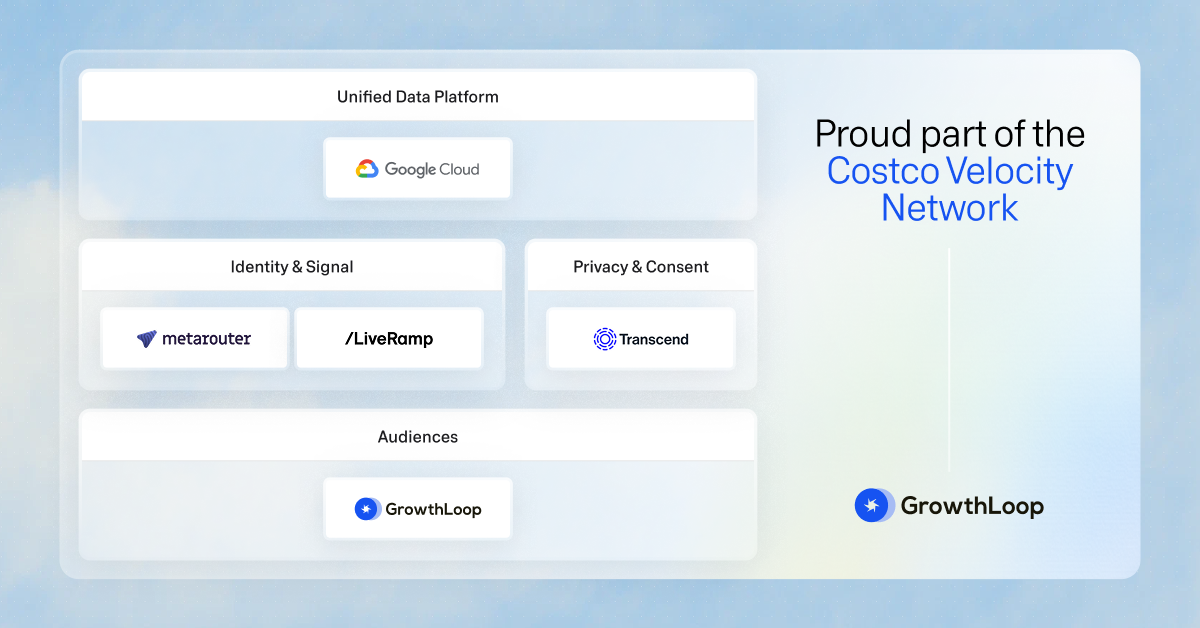
Costco isn’t scaling its RMN with legacy adtech and manual solutions. It’s leaning into a cloud-centric, composable stack.
As part of the Costco Velocity Network, GrowthLoop empowers the retail media team to build audiences directly from the data cloud, enabling faster activation, greater relevance, and better performance — all while maintaining privacy and governance standards.
The result? Exceptional value and experience for Costco members and better ROI for brand advertisers.
Learn why the GrowthLoop Composable Commerce Media solution was the right choice for Costco’s Velocity Network.
Retailers aren't pricing this inventory separately (yet)
But the performance of these ad units is still speculation, because Amazon is not yet charging for these ad units separately, or even splitting out the performance of this inventory. (This gets my spidey-sense going)
Looking further afield:
- Walmart's Sparky assistant does not display PLAs in its AI assistant, only sponsored prompts.
- Albertsons delivers sponsored products via its demand partner, Criteo. Both buying and reporting is bundled.
- Kroger Precision Marketing launched new AI assistant ad units just last week. Like the others, AI assistant inventory can't be bought separately. But, in an apparent first, they will be splitting out performance results!
| Retail Media Network | Breaks Out AI Search Ad Performance? | Bidding / Campaign Model |
| Amazon Ads | No (Bundled into Search/Product pages) | Automatic inclusion via Sponsored Products |
| Walmart Connect | No (Bundled into standard Search & Browse) | Automatic inclusion via Sponsored Prompts |
| Albertsons / Criteo | No (Bundled into overall Criteo campaigns) | Automatic inclusion via Criteo inventory |
| Kroger Precision Marketing (KPM) | Yes | Separate Reporting in Report Builder (auto-included in campaigns) |
So there's a question about whether the ROI will hold for advertisers, but there's also a question about economics for the retailers.
Will any pricing premium for these ad units backfill a volume shortfall?
There's another wrinkle here too. Fewer ads per answer isn't the same as fewer ads per shopper. A conversation with the AI assistant can take multiple turns. If a shopper asks four follow-up questions, that might end up showing a lot more than just 2 sponsored product ads.
Will this new landscape be as equitable for challenger brands?
On the podcast with Wendy I made the case I always make for sponsored products: they're the escape hatch for challenger brands. Organic ranking at most retailers leans on sales velocity, volume, and recency, which means a smaller brand with a genuinely better product for a specific shopper stays buried more or less permanently. Ads allow brands to buy their way into the consideration set.
What changes when 20 possible ad slots becomes 2? The price goes up, and it is unclear so far if the performance outcome scales with it.
What's next
Obviously, ads inside chat assistants are a very nascent format. With other retailers now launching PLA-type ads inside their chat assistant, I will be tracking their ad load to see if anyone is game enough to try something different.
But it also may not become the dominant ad format.
I'm contributing to some new research that's coming out soon which found that once consumers see an ad in an AI assistant, they assume that future references to that brand are because of the ad.
Kroger is the only retailer I'm aware of that's actually going to split out ad performance, so we're low on performance clues at the moment.
There's less satisfying answers right now, and more questions. As always, I'd love to hear what you think, and what you'd like to see me cover in more detail on this topic.
Check out my full conversation with Wendy on the Future Shop podcast — we cover a bit of my career background, and also get into why perfect price visibility isn't producing the race to the bottom everyone expected.