What is the 'job to be done' of a McDonalds milkshake? It wasn't, as business guru Clayton Christensen learned doing field research in 2005, to be a sweet treat. The milkshake was being 'hired' to keep morning commuters full until lunch.
The jobs-to-be-done framework has persisted because many businesses fall into a common trap: improving a product without asking what it was hired for.
Today, retailers are preoccupied with onsite AI chatbots. They are either shipping one, upgrading one, or introducing ads to one. They all kind of look the same and have similar capabilities. Even the names for these little digital servants are similar in their perkiness: "Olive!" "Sparky!" "Mylow!"
The one-note-ness of them all makes me think we might be losing touch from the thing these consumers are 'hiring' them to do.
Three jobs to be done, not one
A written interview in The Aisle got me thinking about this. Jason Del Rey interviewed Mukesh Jain last week.
Jain spent nearly five years at Walmart in product leaderhsip roles across online grocery and search & personalization. He then spent eight years at Amazon leading the team behind the "Product Graph" — the long slog of turning the unstructured mess of product descriptions and box photos into attributes a machine can actually query — and later held a similar role on Rufus. Today he runs SignalAI, a startup helping job seekers close AI skill gaps.
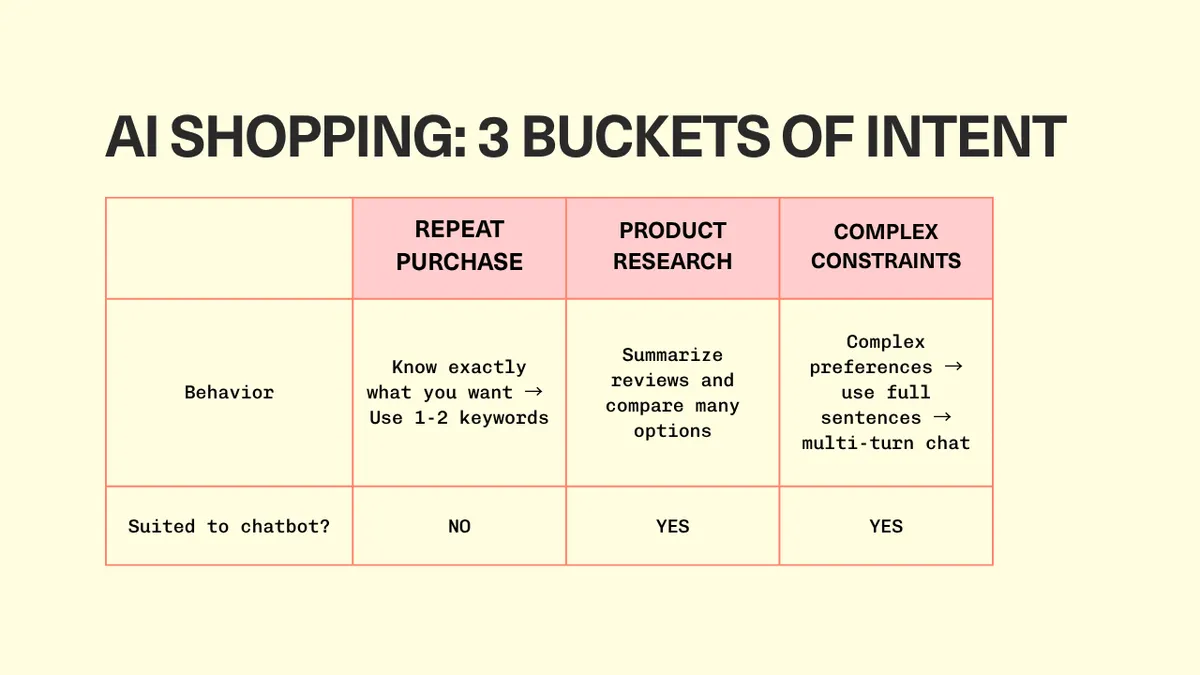
Jain splits shopping into three jobs. But only two of them want a chat-style conversation.
- Repeat purchase. You know exactly what you want. "I need this Heinz ketchup eight ounce bottle." You type it, you see it, you check out. A conversation here is unnecessary.
- Research. You're reading reviews and comparing five things.
- Constraints. A gift for an eight-year-old nephew who's into space and Lego and probably owns all the space Lego already, under $100. As Jain described it, that kind of demand was invisible to the retailer.
Asked at the end of the interview what shoppers want from these tools, he answered by naming what they don't: "Nobody wakes up wanting to chat with a retailer. If the answer could have taken one message and it took five, that's not good engagement." What they want, he said, is "less work between 'I need something' and 'it's on the way.'"
The month-three test
There has been fair pushback that the adoption we're hearing retailers touting about their AI assistants is due to those customers already being the most-engaged cohort.
Jain had a sound test to run that through.
"I'd judge any of these products on how the repeat cohorts behave at month three and month six, not on month one." Everyone's first query looks like a keyword search with a few extra words, because we're all carrying thirty years of habit. The question is whether the queries get longer after that.
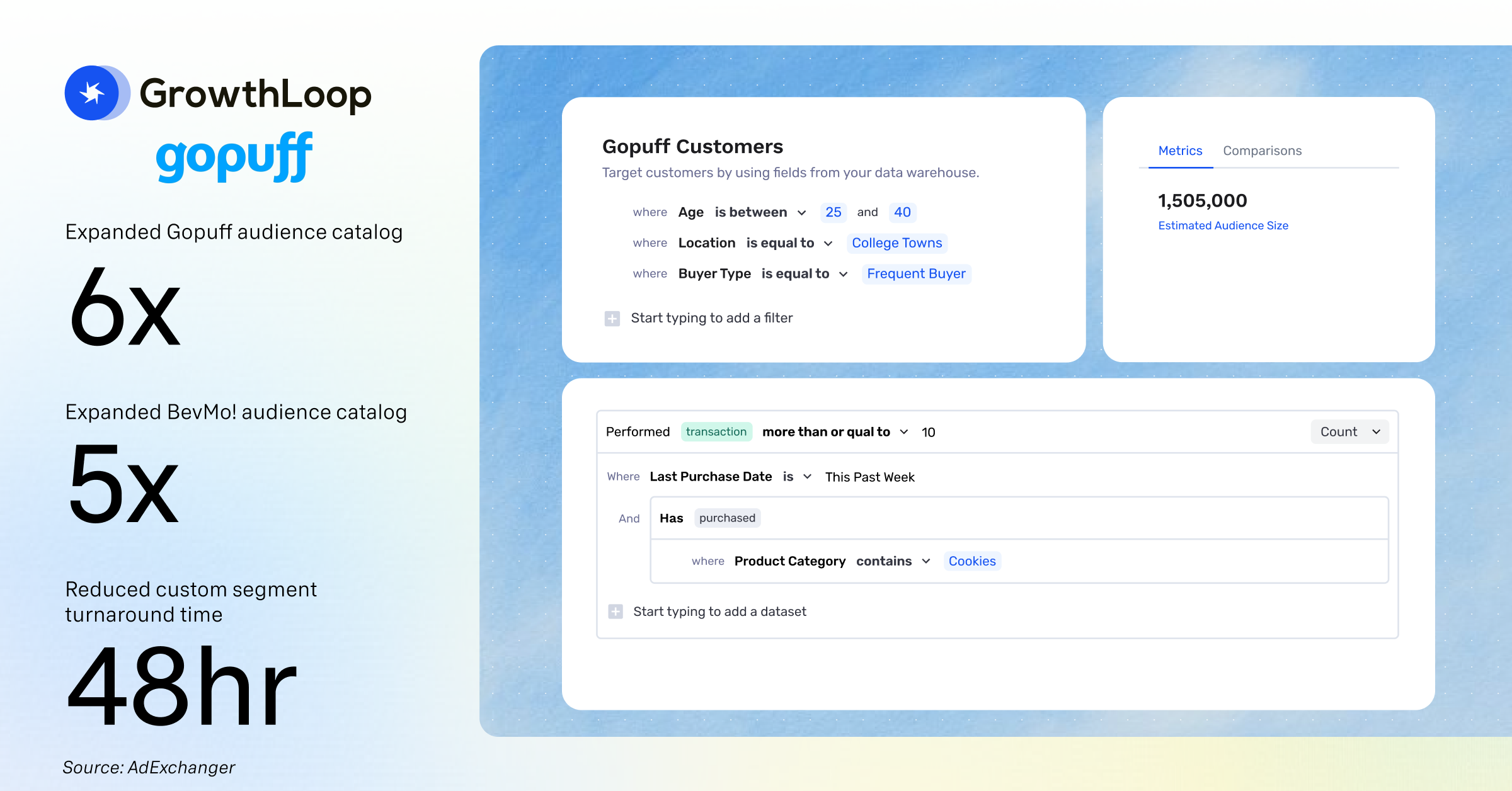
Poor audience targeting is frustrating. But for retail media teams, it can be costly, too.
With GrowthLoop’s Composable Commerce Media solution, you can turn your first-party data into hundreds of high-value audience segments and launch campaigns faster.
After partnering with GrowthLoop, instant commerce pioneer Gopuff scaled from 100 syndicated audience segments to more than 600. And it now takes less than 48 hours to turn around a custom segment for one of their brand partners.
Learn more about how GrowthLoop is powering Gopuff’s best-in-class retail media operations.
Who owns the start
Next, the harder question: who will win, the horizontal assistants (chatGPT, Gemini etc) or will the retailer's own?
Jain is even-handed. The general assistants have "the habit of hundreds of millions of people already visiting them daily," and they can see across retailers — they can compare products from anywhere and recommend across the whole market, which an agent embedded in one store structurally cannot do. Retailers, for their part, own the transaction, the data, and the wallet.
His verdict: "I think they can coexist, the way search and retail coexisted. You have discovery in one place, and the transaction in another. The open question is who ends up owning the start of the shopping journey, and that fight is very much still on."
Kantar is less neutral. Wave 1 of its AI-Enabled Commerce Pulse — 2,000 US shoppers, fielded April 2026 — found 58% want AI tools that work across multiple retailers, and 41% of AI shoppers already use AI to compare prices across retailers. Kantar's read is that retailer-specific assistants produce stronger satisfaction among the people who use them, but platforms "will likely have an advantage since product and price comparison lead utility."
Jain's POV is that owning the checkout, the purchase history and the card already on file evens the fight. Kantar's data suggests that comparison is the thing shoppers rate most useful. But that's what a single retailer can't do.
(A noteable exception being Amazon's Buy For Me agent)
Where I was wrong
I've been arguing for a while that retailers building standalone chatbots were building digital ghost towns, and that the winners would be the ones plugging into wherever consumers already spend their time.
Then last August Rufus rolled out persistent memory. I asked it what kind of person I was in real life and it knew I play pickleball, own a cat, and covet expensive Japanese camping gear.
I was convinced that Amazon had proven me wrong, because I thought the moat was memory — that retailer bots lose because they forget you between sessions while ChatGPT remembers everything.
Kantar's research says memory isn't the deciding variable. Breadth is. And Jain, who built this from the inside, says nobody has delivered the memory part anyway: going from search box to true assistant "is the hardest part and nobody has fully delivered on it yet."
The job-to-be-done for a retailer's AI assistant is not a single job-to-be-done, and that's why the current chatbot modality isn't the final boss version of AI-enabled shopping. The fact that even Amazon hasn't cracked the code yet, should be encouragement enough to retailers to keep iterating on the chatbot form, function, and reason for being.