The really fun thing about being an analyst in this industry is that behind the scenes we're all very friendly and collegiate. We share a lot of background intel. But when it comes to our actual opinions, we're interested in different things and we hold quite different hypotheses about how this plays out. Which is a wonderful thing, because nobody can predict the future. There are too many sources and signals to keep track of everything. So I love keeping up with fellow analysts and hashing our views out in public.
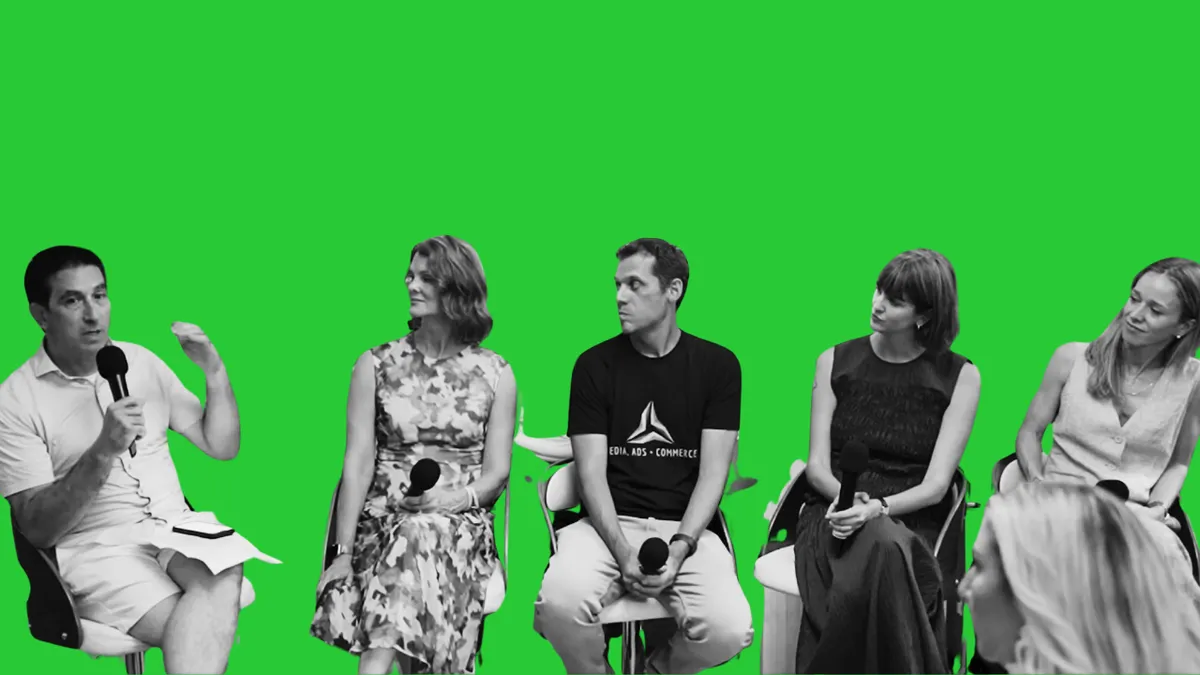
Today I'm sharing snippets from a replay of a panel I was on at Cannes, hosted by The CPG Guys and sponsored by Sensor Tower. The session was called "Retail Media Executive Brief: Separating Fact From Fiction," and I sat on it with three other analysts: Debbie Aho Williamson of Sonata Insights, Andrew Lipsman of Media, Ads + Commerce, and Sarah Marzano of eMarketer. Ian Simpson, SVP at Sensor Tower, moderated. The CPG Guys just aired this panel on their podcast, which you should certainly check out.
It was a lively discussion, because there are some things we all agree on and several things we don't.
What We Agreed On: The Constraint Is Internal
Ian opened by asking me about a series I ran a couple of months ago on the internal demons of retail media networks — what holds an RMN back that has nothing to do with AI or tariffs or the economy.
My argument is that where retail media sits in an organization dictates what it is allowed to be. Who it reports to. Who funds it. Where the profits go — the two biggest club retailers in the US have publicly shared that they push retail media profits back into the member experience, whereas other networks send them straight to the bottom line. And who builds the technology, and who pays for it. At some retailers, retail media is both the profit center and the forward-looking innovation function, so it ends up funding foundational infrastructure like CRM and data pipelines that the rest of the company gets to benefit from. Retail media is being asked to do a lot of things that aren't only about producing media revenue.
 Kiri Masters
Sarah came at the same problem from the long-tail side — the 60-plus RMNs that sit out beyond Amazon and Walmart.
"A lot of the retailers that fall into that long tail are the ones who aren't gonna hit really scaled massive growth by using the first version of the retail media playbook," she said. "They're the ones who are gonna have to figure out how to activate their physical stores, how to activate their off-site data to better reflect the size and scope of their consumer data assets."
Her examples:
- Best Buy has deep category expertise in a high-consideration category, and is turning its stores into media platforms where brands can tell stories.
- Dollar General is leaning into in-store audio, which makes sense given the small format.
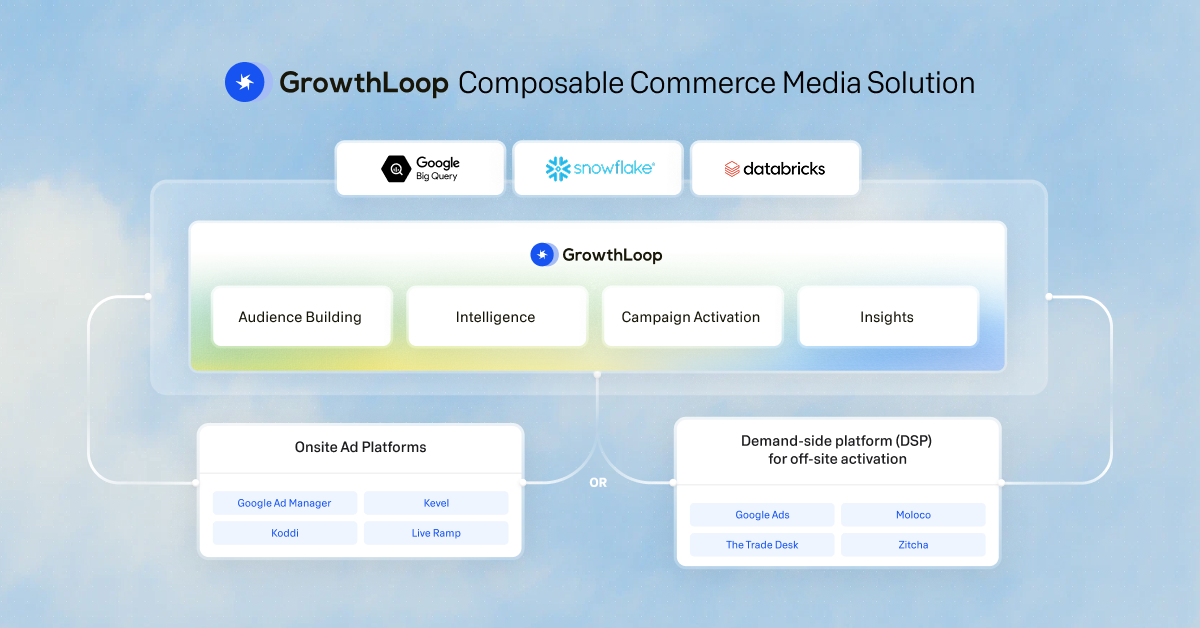
Are manual processes slowing down your RMN momentum?
With GrowthLoop’s composable commerce media solution, retail media and ad teams can build and launch precise audiences in minutes, activate across DSPs and ad platforms, and deliver transparent ROI reporting that drives advertiser revenue.
Learn how retail media leaders at Costco, Fanatics, and Gopuff use GrowthLoop to deliver stronger results for their brand partners.
Andrew is well-known as an avid supporter of in-store media. Another growth mechanism he underscored was marketplaces.
"Marketplace is where the money at! We don't talk about this enough. This is what Amazon was built on. This is why Walmart is scaling so much. This is the foundation for a huge long tail of advertisers."
He noted that Best Buy, Lowe's and Ulta all implemented marketplaces in the past year, and that you can already see it surfacing in public discussion of their earnings.
Where We Split: Whether AI Changes That Math
Then Ian moved us onto AI. Debbie was the AI analyst in a room full of retail media people — the self-described "a vegan at a barbecue" — and she brought Sensor Tower data on who is actually buying ads inside ChatGPT.
"Almost 40% of ad impressions Sensor Tower saw in the first couple few months were from retailers," she said. "That was by far the largest category of advertisers on ChatGPT." Within that, Best Buy was the top advertiser in the period. (Read Debbie's analysis here)
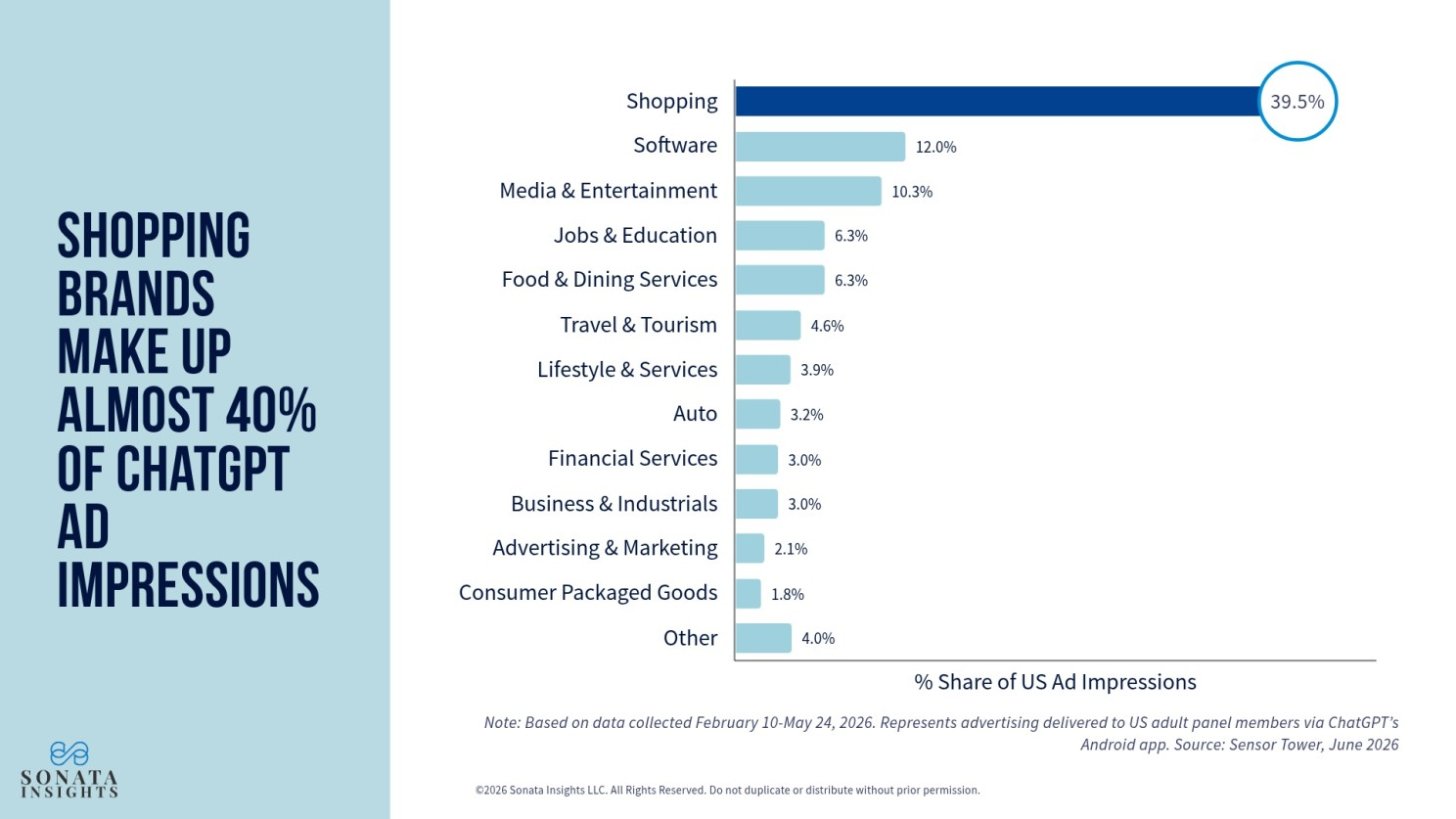
And within that, Best Buy wasn't marketing itself as a retailer. It was marketing its brand partners. This presents a potential interesting collaborative advertising surface for retailers to extend to brands.
Another hot topic: how visible is the path from AI recommendation to eventual purchase?
I shared how most AI-assisted shopping today ends in a referral to a retailer or a brand.com.
Shopify data indicates that 55% of AI-referred traffic lands directly on a Product Detail Page (PDP), compared to roughly 20% of traditional organic search, bypassing the homepage.
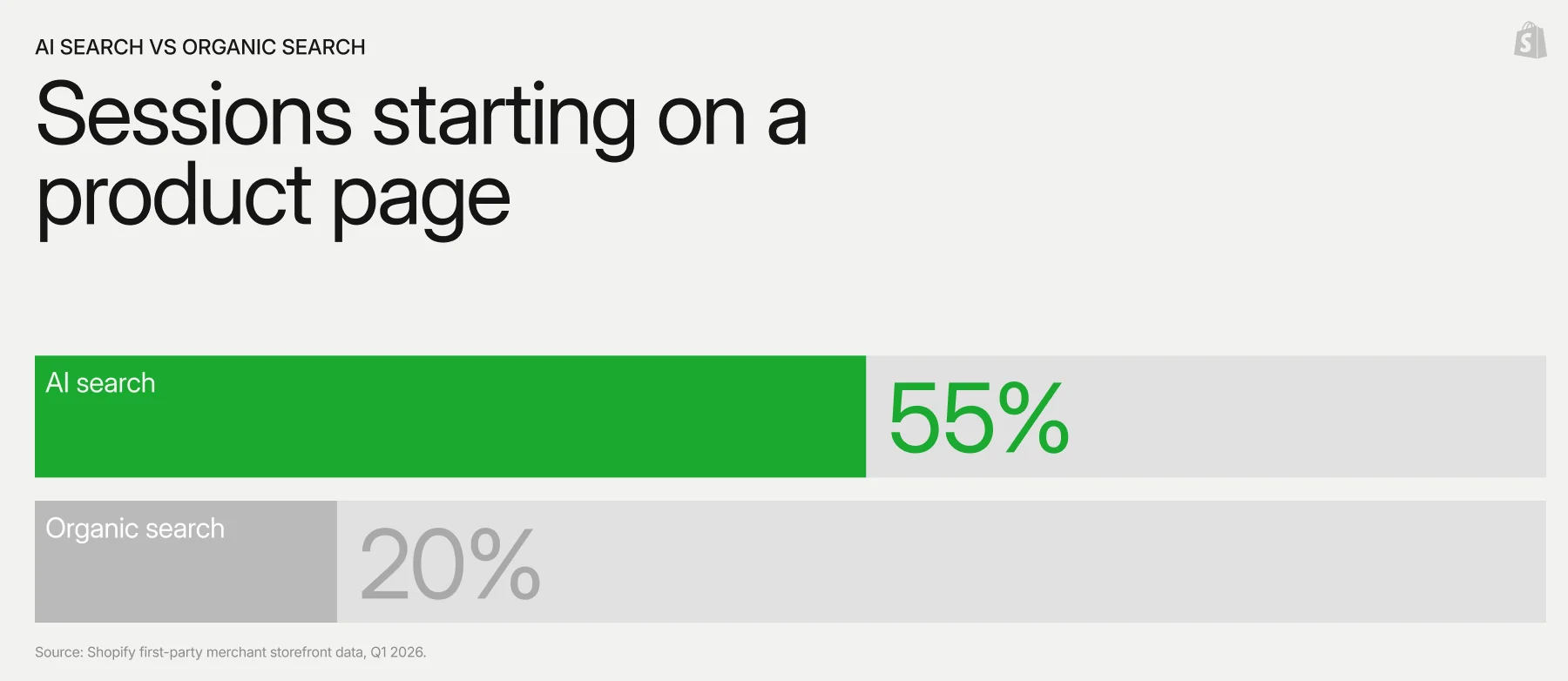
And a lot of those referrals arrive with no tag showing they came from an AI assistant — especially from mobile AI apps. To the retailer or brand, that looks like direct traffic. So I believe traffic coming to these sites from AI is severely undercounted.
Andrew isn't buying it.
"It's not totally dark, though. It might be dark from an analytics perspective, but if you're looking at panel-based data, you can see what visit precedes that visit, so it's not truly dark. You can reconcile multiple data sources to get a view. You might not have the granularity of the referral — you don't have that UTM — but I think you can at least get a holistic perspective of how much it's influenced."
Sarah extended some grace to the retailers and brands currently navigating all of this.
"Retailers have been grappling with imprecise purchase journeys for a really long time," she said. "We do a massive path to purchase study every year at eMarketer, and we know how important word of mouth from friends and family are for both product discovery and also making a decision. Talk about something where there are no signals to understand what shapes that."
She pointed to the physical store's role in discovery even when the purchase happens online, and to lower-funnel entry points skyrocketing ever since you could swipe up on social. "Retailers are used to customers evolving and changing the way they make a decision to make a purchase. And they're used to saying, how do we show up in this environment? How do we make sure we're top of mind?"
So there we have it. Four analysts, no argument about the internal work. The split is whether AI is a new measurement problem or an old one wearing new clothes — and whether it's the right problem to be working on compared to the more immediate growth opportunities sitting in front of these businesses.
We didn't settle it on this session, and I don't think we ever will. That's what makes this space interesting. None of us will ever say we have all the answers. We're all learning from each other, and the conversation continues.
You can listen to the full conversation on the latest episode of The CPG Guys podcast.