I launched my first podcast in 2017. At the time, I thought it was too late, that I would get lost in a sea of podcasts that already existed.
Looking back of course, 2017 was still early! A great number of people have started podcasts in 2026, and most of them probably wished they had started earlier.
(By the way, that podcast was Ecommerce Braintrust, and it's still going today under the expert hosting of my former colleagues at Acadia, Jordan Ripley and Julie Spear)
As a media company of one, I'm existentially aware of changes and trends in media consumption. But also that what is trending in the consumer space might not always translate to a B2B audience. (Hello, short-form video)
In 2017, I worried I'd picked a format that was too competitive. Nine years later I still second-guess myself, but I'm not so sure the format is what matters.
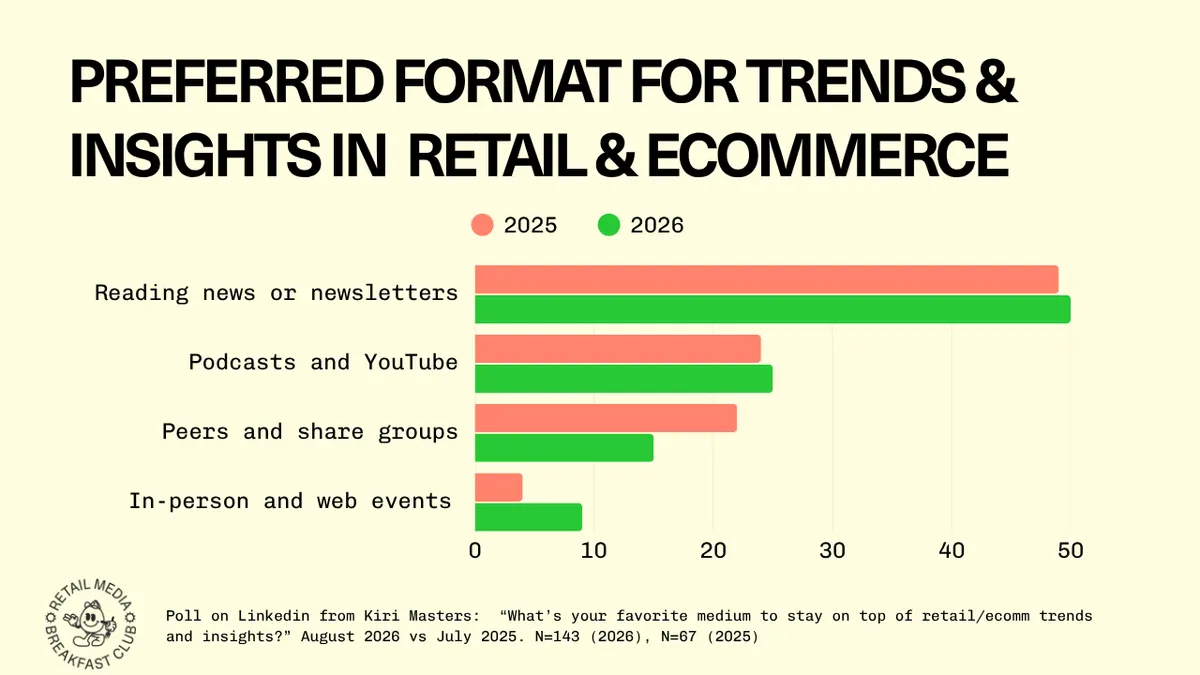
A year ago I ran a poll on LinkedIn asking my network how they keep up with retail and ecommerce trends and news. I ran the same poll again a few weeks back, to see what might have changed over the year.
It hadn't.
- Reading news or newsletters took 50% of 143 votes, against 49% last year.
- Podcasts and YouTube took 25%, against 24%.
- Peers and share groups came in at 15%, down from 22%.
- In-person and web events landed at 9%, up from 4%.
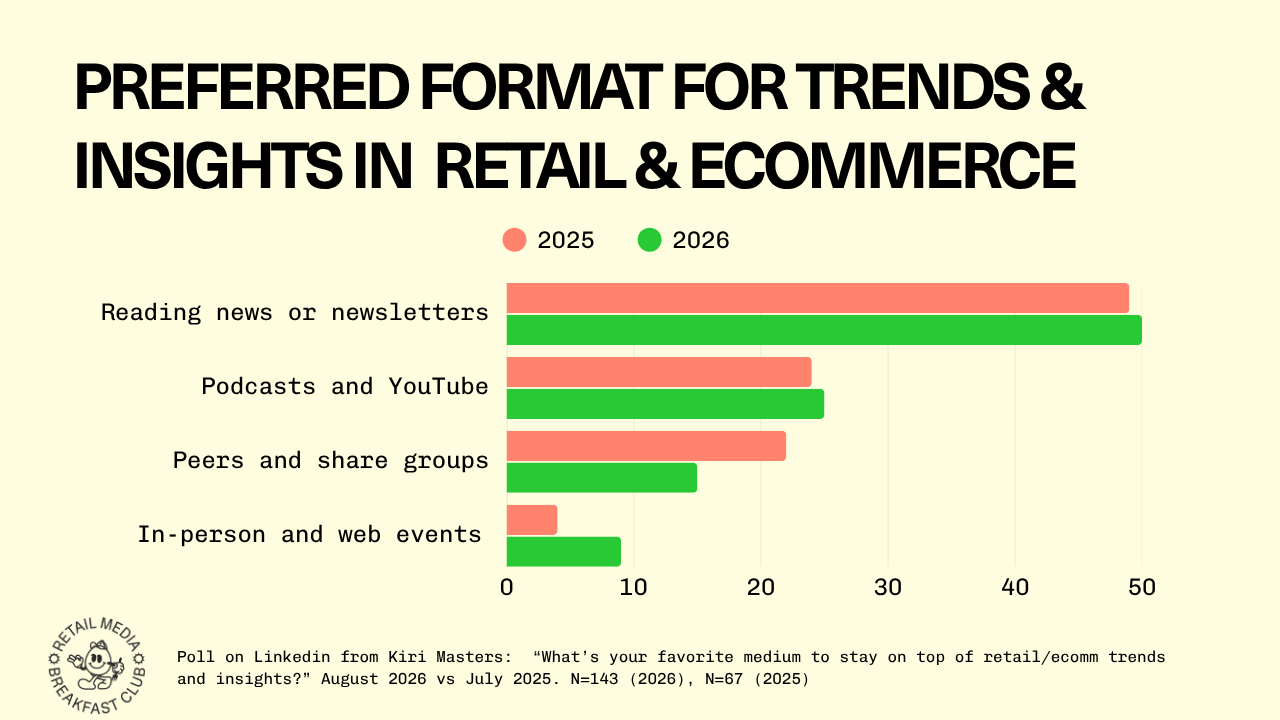
Half of you still choose to read, even though written content is now the easiest thing to fudge with AI.
That's not just helpful for me to know. Here's why that matters to you, as a practitioner.
AI slop, but make it B2B
In the twelve months between those two polls, text became the cheapest thing in the world to produce. Pangram, which builds AI-detection tools, estimates that more than 40% of long-form LinkedIn posts are now entirely machine-generated. LinkedIn seems to share the diagnosis.
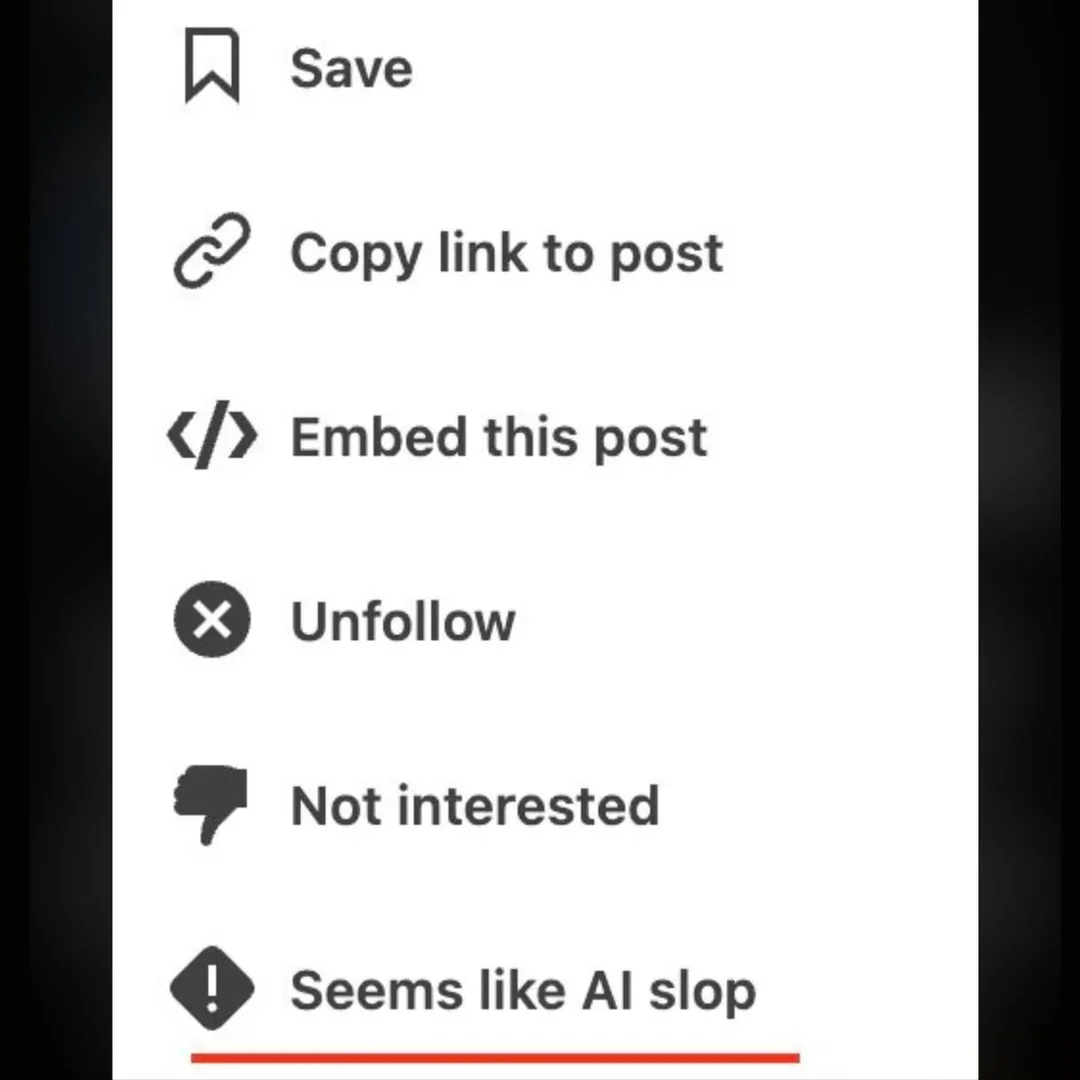
On July 30 it added a "seems like AI slop" option to the three-dot menu on every post.
This is a pretty major reversal from some earlier LinkedIn's features like the "enhance your post" writing tool which transformed any garbled thought into a 'masterclass' or 'load-bearing' insight.
But the format that's easiest to fake is still the format we prefer.
Your advertisers can’t wait weeks for audiences.
GrowthLoop’s Composable Commerce Media solution helps media teams turn first-party data into high-value audiences, launch campaigns faster, and prove what’s working across every channel.
Learn how retail media leaders at Costco, Fanatics, and Gopuff use GrowthLoop to create highly segmented audiences and deliver stronger results for their brand partners.
Why text still holds up
Comments from last year's polls explain why:
- Phillip Jackson, co-founder of Future Commerce said: "information density wins. video is linear. text is nonlinear."
- Caroline Powell, event operations manager at tech company Pipl, is efficiency-minded: "I read faster than people can say something to me."
- Colin Perkins, digital success analyst at 3M: "I liken them [newsletters] to a 'choose your own rabbit hole.'" He can scan it, and when something lands, follow it down to the source material.
None of that has changed. Reading is still the fastest route into a busy person's head, and it's the only format you can skim, quote, forward, and paste into a Slack channel with a line of your own on top.
But other formats aren't safe from slop either. Think of audio: upload a PDF to NotebookLM and you'll get two plausible-sounding hosts discussing it for nine minutes. Video is heading the same way. None of these formats resists automation.
So if the format isn't protected, what's left? Where I land is whether the reader knows whose judgment they're getting, and whether that person has access to something a model doesn't — that is, the things people working at large companies aren't willing or able to commit to sharing publicly. The vibes at events, the corridor track.
What this means for practitioners
For most of you reading this, the sharper version isn't about publishing. It's about your job.
For years, one of the more reliable ways to build visibility inside a large organization was to send a weekly summary of what was happening in your category.
You read the trade rags, picked what mattered, added some commentary, and sent it to an internal distribution list.
That hack is gone. Now anyone can get a AI summary that's personalized to their interests, with the added bonus of answering endless follow-up questions patiently.
But what still works is the note where you say what you think the company should do about it, which is not something an executive is going to trust to outsource to an AI (yet). Not "here are five things that happened in retail media this week," but "these are the two of them that change what we should be doing in Q4."
If I run this poll again next August, I don't expect the top line to move. I do expect the quality bar to be higher.
In 2017 I was certain I'd missed the podcast window. I hadn't, though it already took more than it would have three years earlier.
You're not too late to start a newsletter, or to be the person in your org whose weekly note people actually open. You're only late to the version where just showing up was enough.
Upcoming pieces
Here's some topics I'm currently working on. Please reach out to me if you have something to contribute on these topics.
- The opportunity for B2B retail media
- Agentic media buying - how will it impact retail media?
- The Gem Browser beta - what happens to retailers, and retail media, when websites are truly customized and personalized? (Background here)