
A version of this piece originally appeared in my column at The Drum last week. I've split it into two parts for RMBC — this is part one of two.
On a recent call, a retail media leader at a mid-sized US network told me how technology decisions actually get made. Let’s name them “Art Vandelay”.
Vandelay joined the company and did what any competent operator would do: audited the onsite ad stack. What they found was an ad server built for legacy publishers, doing a job it was never designed for. Its forecasting couldn't read a retailer's traffic pattern. After a tentpole promotion week, it assumed the spike would continue, paced campaigns against that assumption, and then underdelivered when traffic came back to earth.
Vandelay asked for funding to replace the ad server. The request was denied.
So they built a seasonality-adjusted forecast model by hand — last year's data, assumptions layered in for promotional calendars and outside factors — and now Vandelay individual manually feeds it back into the platform every week or two, because otherwise the system looks at the most recent traffic and reverts to its own bad guess. Without it, my source estimates, the network would have missed seven figures in ad opportunities it didn't know it had.
That is just one example of the manual labour, the kind of spreadsheet macros that are holding up a US retail media network in 2026.
Retail media might feel new, but it isn't. It has been through several eras and reinventions in over the past decade or more, and today's operators have more technology options available to them than at any previous point.
What they don't have is a straightforward way to get it approved and installed.
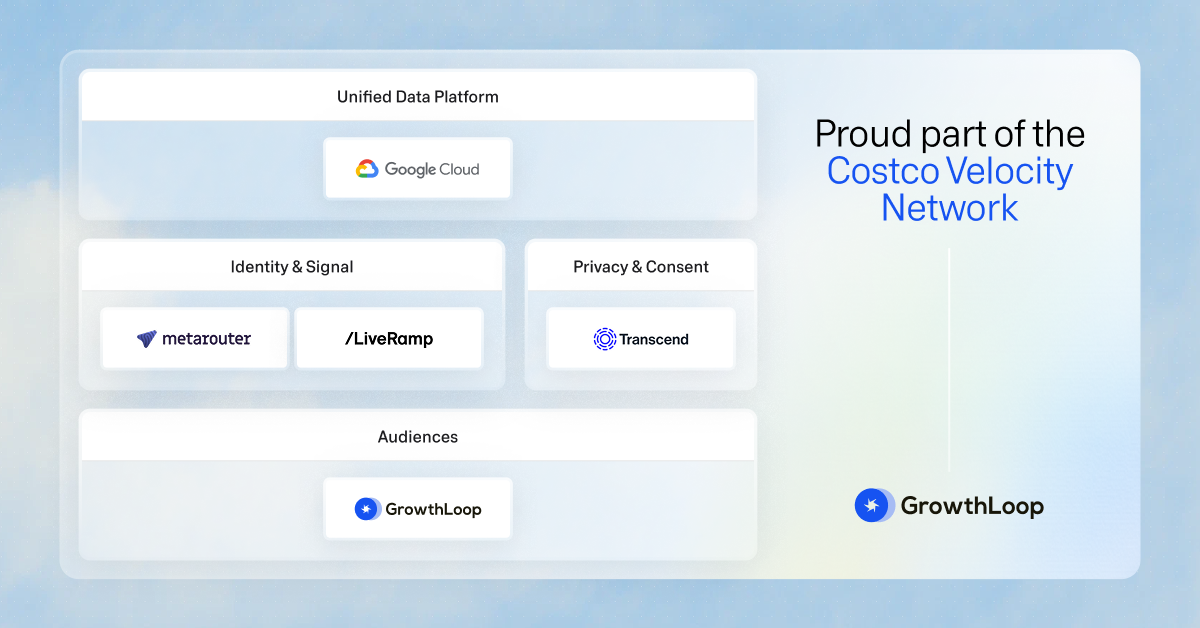
Costco isn’t scaling its RMN with legacy adtech and manual solutions. It’s leaning into a cloud-centric, composable stack.
As part of the Costco Velocity Network, GrowthLoop empowers the retail media team to build audiences directly from the data cloud, enabling faster activation, greater relevance, and better performance — all while maintaining privacy and governance standards.
The result? Exceptional value and experience for Costco members and better ROI for brand advertisers.
Learn why the GrowthLoop Composable Commerce Media solution was the right choice for Costco’s Velocity Network.
The four eras of retail media
To get some historical context, I spoke with Somer Simpson, vice president of product at GrowthLoop. (Disclosure: GrowthLoop sponsors this newsletter and podcast, and last week launched a product directly relevant to what follows.)
I offered her my own version of era one: Amazon built its entire stack in-house, Walmart built its own core engines with some third-party tech, and Criteo sold an all-in-one to the other early players. Simpson picked it up from there.
Era two isn't really an era. It's a pendulum that swings on the economy rather than on technology. Budgets tighten, and retailers cut point solutions and consolidate onto all-in-ones. Budgets loosen, and they build in-house again. "It all kind of follows the economy," Simpson said. "When the economy gets better… they're like, 'oh, we'll just build the stuff ourself. We'll build our own CDP.'"
Which means a network's stack often says more about the year it was chosen than about anything the network actually needed.
Era three is the cloud, and it inverted the default. Instead of copying customer data out into each vendor's system, the data stays in the retailer's own warehouse and the vendors come to it. That inversion is what "composable" means, and it's why the word seems to be everywhere right now: it's the difference between renting your capabilities and owning them.
Era four is AI, and the bar it sets for data. "Your data has to be good enough, not just for your data analysts and your marketers to leverage and for BI and reporting, but it's also got to be in a state that's usable by AI."
GrowthLoop has a dog in this fight. On 20 August it launched an end-to-end commerce media network solution — pre-integrated with The Trade Desk, Moloco, Snowflake, BigQuery, Databricks and identity provider Audience Acuity — designed so a retailer can stand up or upgrade a network without assembling the plumbing itself.
An "RMN in a box" only makes sense as a product because of the problem it concedes: there is a boundless array of good technology available, and very little organizational appetite to integrate any of it.
The eras aren't sequential. They're simultaneous.
While Costco Velocity runs a hand-built composable stack, Ace Hardware's Red Vest Media runs its entire platform on CitrusAd, now owned by Epsilon — and its head of retail media, Molly Hjelm, told me last year she considers that a feature, not a compromise. Meanwhile the operator from my introduction is on a general-purpose publisher ad server because that's what a management consultancy specced a few years ago.
The eras don't play out over a neat timeline. Across the universe of RMNs, we see a cross-section. And that's not because some leaders are smarter than others. It's that technology moves faster than either of the two clocks that actually govern a retail media organization.
The budget clock turns over once a year. As my source put it: "It's June. I need you to submit your full annual business plan with your requests for expenses for next year." You cannot anticipate a technology launch three months out.
The career clock runs two to three years, and it's tied to a revenue number rather than to the quality of anything you build. My source was blunt about where that leads: "What can I do to hit my goal? And I've been told my goal is 'this revenue number'. Do I care if a brand does well enough to come back and keep spending with us next year? I don't care right now."
Costco is the exception that proves the rule. Mark Williamson's stack reportedly took around two years to assemble, much of it change management and building enterprise data infrastructure that didn't exist inside the company before retail media asked for it. Very few leaders have that runway. The ones who don't aren't making a technology error — they're making a rational bet with the time they've got.
Coming in part two tomorrow: all of this still treats technology as the axis that matters. It isn't. A UK retail media leader has laid out a different way to think about where a network ends up — one that explains the doom loop better than any tech argument I've made, and that turns the "easy button" from a compromise into a strategy.