
Editor's note: Today's post is a guest contribution from Mike Shields, who writes Next in Media — a newsletter and podcast covering the media and advertising business. When Mike writes about retail media, it's from the media side of the fence rather than the commerce side: outside of the fishbowl, so to speak.
So his view on these topics are "outside of the fishbowl," including this one: should retail media networks be trying to become media companies at all? Or is the smarter play to put the retail back in retail media?
You can read the original piece here. My own thoughts are at the end. — Kiri
Over the past several years, the talk in retail media circles has been the need to “go off platform” - and “definitely full-funnel.”
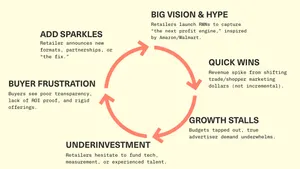
Which has essentially been code for “we’re running out of room and ad dollars on our shopping website and app” and “we want access to bigger brand budgets.”
At a media offsite last week, I talked to an industry exec about just how hard this can be for most retail networks, outside of the Amazon/Walmart realm. Right now, bringing a retailers data out to every DSP and the open web and TV may not lead to a clear payoff.
"Most RMNs are still being funded by shopper marketing budgets,"said Melissa Gallo, VP of Solutions & Delivery, Vantage, a retail media tech firm. However, Gallo noted that budget flows are becoming multi-dimensional. “If you build only for the hardcore media buyer, you miss a large swath of investment; if you build only for the shopper marketer, you miss the incremental dollars. That tension is really the heart of [this debate.]”
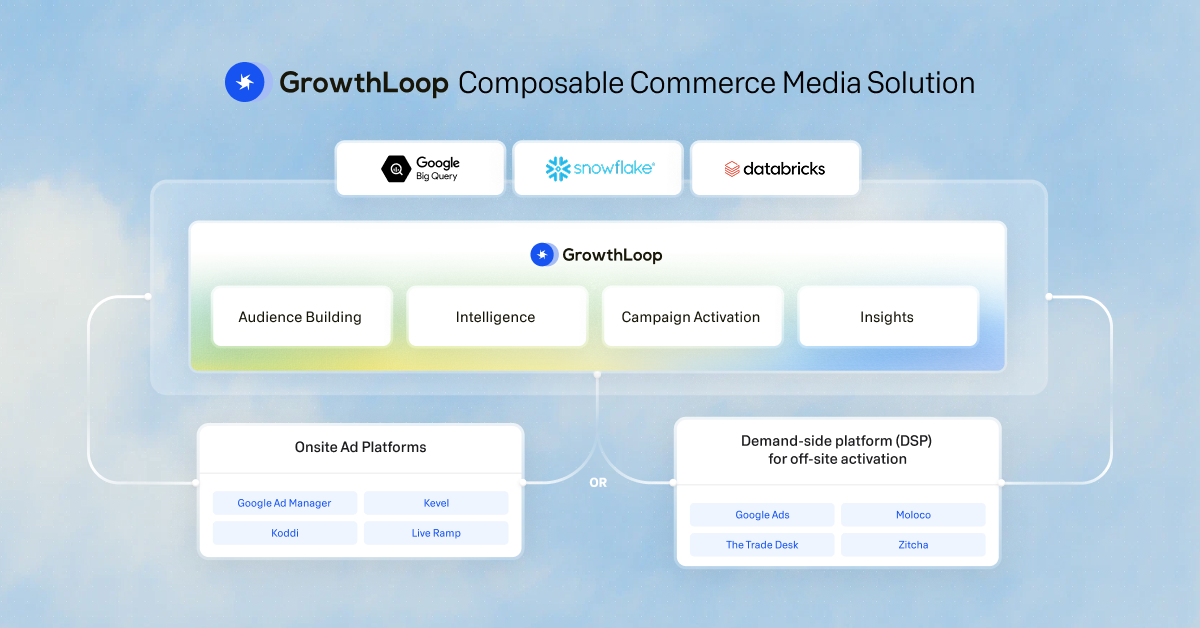
Are manual processes slowing down your RMN momentum?
With GrowthLoop’s composable commerce media solution, retail media and ad teams can build and launch precise audiences in minutes, activate across DSPs and ad platforms, and deliver transparent ROI reporting that drives advertiser revenue.
Learn how retail media leaders at Costco, Fanatics, and Gopuff use GrowthLoop to deliver stronger results for their brand partners.
Some argue that this debate misses the point. They might even ask, are too many RMNs hoping to become full-fledged media brands? “I think retail media needs to re-embrace retail,” said Molly Hjelm, corporate Vice President and General Manager of RedVest Media at Ace Hardware on this week’s episode of Next in Media. “For a long time we’ve been attempting to be media companies, or really trying to position ourselves as media companies.”
Mike's interview with Molly Hjelm of Ace Hardware
In a business where every RMN wants to announce a shoppable ad deal or a CTV extension, and most watch with envy as Amazon streams the NBA or Walmart buys Vizio and Vibe, Hjelm’s point of view serves as a pretty hot take. "Pushing your data unfettered into other environments really divorces your audiences of the meaningful context of how you can grow a business within that retailer."
"It's not a never for us, but we're thinking intentionally about how and where... we're thinking about audience extension."
Of course, that may make sense for a hardware seller like Ace, since people who’ve recently shopped for high ticket items like lawnmowers or bone saws may not be as receptive to being retargeted all over the place. Or it may be an admission that there’s a ceiling to this business.
Which would potentially scream for more alliances. For many retail media networks, “the smarter strategy is to make their shopper data portable into premium CTV environments through strong partners,” said Goodway Group CEO Paul Frampton-Calero in a recent conversation. A retailer like Ace or Lowe’s, “ These are not generic audiences; they are valuable, category-specific audiences with real commercial intent.”
“At that scale and in those categories, these retailers do not need to become Walmart. They need to make their data actionable, measurable, and easy to activate where consumers spend time.”
Hjelm tends to agree. “I think we can’t tolerate hundreds more retail media networks,” she said. “The ones that will kind of make it in this environment are the ones that have the scale... the e-commerce scale and reach... the best data on their customers.”
Kiri's notes
Re-reading this piece to share with you set off a whole bunch of thoughts based on recent conversations I've had with RMNs and with brands. Here's some further thoughts, and links out to further reading.
Onsite still can't shake its reputation as a tax
The endemic, onsite sponsored product ad type still has this hangover of being a tax. It still has a shopper marketing aura around it. It's spend that gets baked into a JBP, and brands absolutely want to see a return on it — but in some cases it is just a cost of doing business with a retailer.
Offsite media spend is more speculative. It often comes out of a different budget on the brand side, and if not a different team's budget, then at least a different mentality about what that spend should look like and what it should return.
I've written before about how whoever owns the budget determines what retail media is allowed to be.
Wanting those dollars is the easy part — the money sits behind agencies, and most RMNs are still pitching them reach when what agencies actually want is the data they can't get anywhere else.
We asked for total measurement, and now we live in it
Brands have been asking for better measurement, for more measurement, for everything that could possibly be measured to be measured. That has created a bit of a prison of our own making.
If we want everything measured, we have to recognise the limitations of performance metrics — and recognise that not every retailer and every category is going to want to measure the same things the same way, because they have different purchasing behaviours that require different look-back periods.
These are all genuine arguments. And I understand the brand point of view: you want your ad spend to be accountable and measurable, because you have to sit down in a meeting and explain why you spent the money where you did and what it produced. But there seems to be recognition on both the brand side and the retailer side that measuring absolutely everything with this amazing closed-loop sales data might ultimately be counterproductive in some situations.
I've written about this before in Retail Media's Measurement Problem: It's Not Just the Retailers, and Retail Media Buyers Say They Want Transparency, Then Ask for ROAS.
The attribution math doesn't add up
One of the clips I pulled from a podcast last week was from the agency Acadia, who have found across a lot of their clients that if you add up all of the ad-attributed sales from the different retail media platforms you're advertising on, your sales look a lot higher than what's actually landing on your own P&L.
All of these retailer models are attributing whatever sales they can back to their own networks. Of course they would.
In a piece about what retail media is really optimizing for, I quoted ad veteran Andrew Covato: "Ad platforms are not necessarily in the business of optimizing advertiser outcomes. They're in the business of optimizing their own revenue."
As it so often is, this is a question about incentives.
Thanks again to Mike for allowing me to re-publish his piece. I highly recommend his Substack & podcast (Next In Media) for everyone in the retail media space.