
A version of this piece originally appeared in my column at The Drum. I've split it into two parts for RMBC — this is part two of two, and part one is here.
Last post I walked through the four eras of retail media — the Criteo all-in-one, the economic pendulum, the cloud and composability, and now AI — and argued that they don't run in sequence. They run simultaneously. Right now one network is hand-assembling a composable stack while another runs on a publisher ad server a consultancy specced years ago, and the difference between them has almost nothing to do with who picked better technology. It's that technology moves faster than the budget cycle and the average leader's tenure.
Here's what I left out. All of that still treats technology as the axis that matters. But there's another way to look at this.
Technology isn't the only axis
Dean Harris, head of Co-op Media Network — the UK's first convenience retail media network — recently laid out a different sequence on the Retail Media Therapy podcast. Not eras of technology, but end-states for networks:
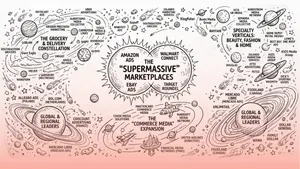
- Rocks. The scaled walled gardens. The default line in most media plans: enormous audiences, online and offline, first-party data. Included in this bucket is the retailer big enough to aggregate other retailers. Dunnhumby is doing it in the UK with its network alliance pilot alongside Tesco, B&Q, John Lewis and Waitrose. Amazon is doing it with its Retail Ad Service, which in June signed Asda as its first UK retailer. (I wrote about this last week)
- Pebbles. The specialists. In Harris's words, "the catalysts, the cherry on the cakes" — what a media plan can't get from the rocks.
- Sand. Low-cost reach extension, the long tail, accessed through aggregation.
- The squeezed middle. His fourth state, and the only unsustainable one: "those that are quite reluctant to aggregate but don't have the differentiation and don't have the scale."
Harris was candid on the podcast about playing for the pebble slot — and about his own stake: Co-op's network is run by Threefold, whose parent SMG launched a retail media exchange of its own this year.
Poor audience targeting is frustrating. But for retail media teams, it can be costly, too.
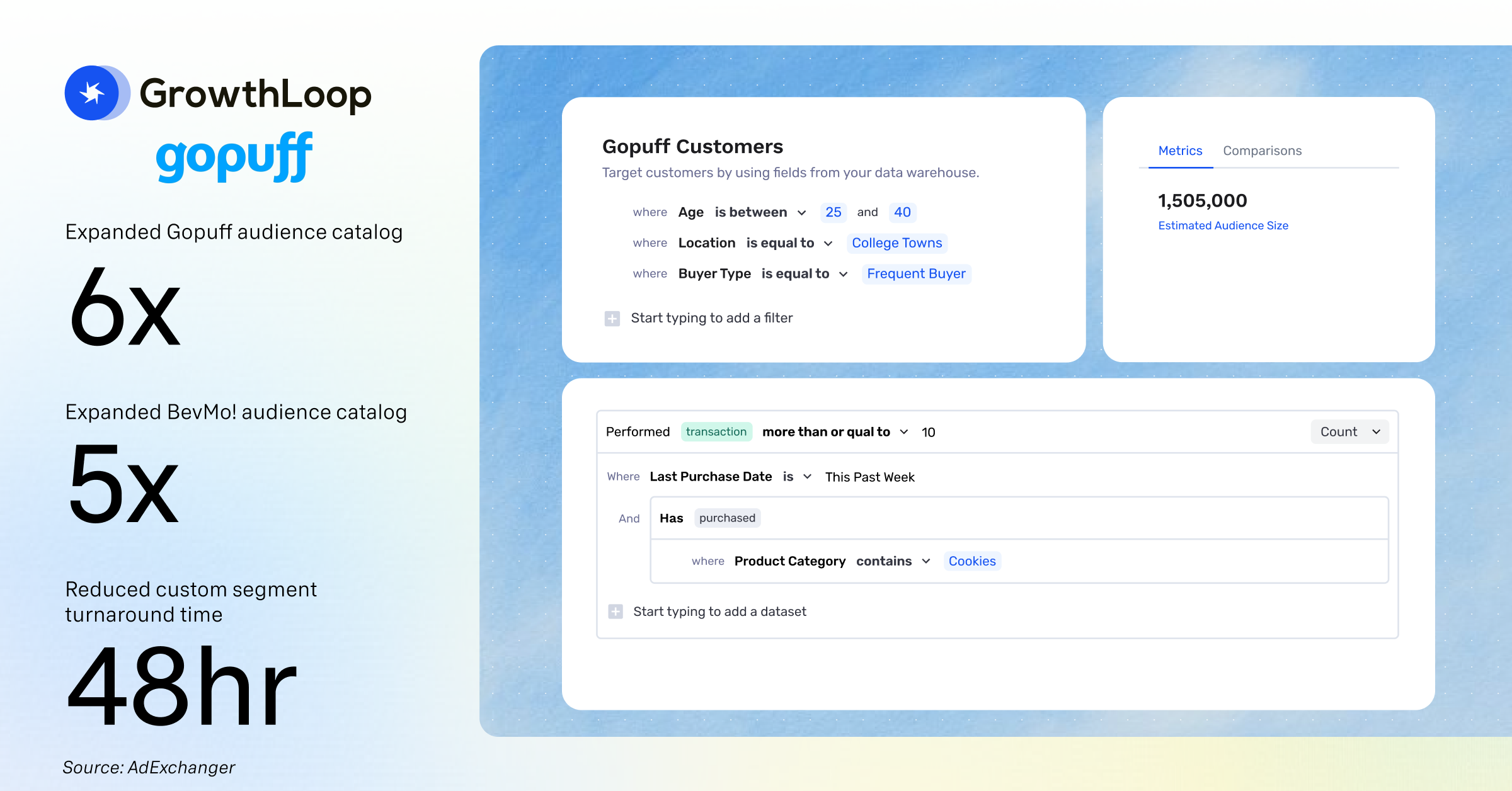
With GrowthLoop’s Composable Commerce Media solution, you can turn your first-party data into hundreds of high-value audience segments and launch campaigns faster.
After partnering with GrowthLoop, instant commerce pioneer Gopuff scaled from 100 syndicated audience segments to more than 600. And it now takes less than 48 hours to turn around a custom segment for one of their brand partners.
Learn more about how GrowthLoop is powering Gopuff’s best-in-class retail media operations.
Proposition before products
Put the end-states next to the eras I wrote about yesterday and a more complete picture emerges.
Composability is a rock strategy, or a large-pebble one, and it's realistic for maybe a dozen US networks.
The "easy button" is a sand strategy. The strongest argument for an all-in-one isn't that it's simpler. It's the network effect: immediate access to brands already buying through Criteo or Epsilon. These are the earliest and most successful aggregators we have.
And the squeezed middle is the doom loop I've been writing about for two years. These aren't networks that couldn't afford technology. They bought era-four ambitions on an era-two budget while holding neither scale nor differentiation.
Molly Hjelm, at Ace Hardware, has been unusually direct about choosing position first. "I think advertisers are tired at this point, and are leery, of retailers building technology, building UI/UX, and building highly customised measurement within their walls," she told me. She's equally clear it isn't universal advice: retailers who have already invested in data science teams and CDPs might need a different approach.
None of which makes the new tooling irrelevant. GrowthLoop's Somer Simpson — whose company sponsors this newsletter, and whose new pre-integrated product I covered in part one — calls this "the era of no more crying": no data leakage, no pipelines to maintain, campaign results flowing back automatically, audiences built in minutes rather than weeks. Publicis's acquisition of LiveRamp has sent a lot of retailers back to their identity stacks looking for exactly this.
But pre-plumbing lowers the integration cost. It does not lower the organizational cost, and the organizational cost is what stops most initiatives cold. The RMN leader I opened part one with couldn't get an ad server swap funded. No amount of pre-integration solves that.
And there's an echo chamber in this industry where every question gets asked from the retailer's side. What does the buyer want? Not twelve interfaces. Brands are already consolidating through Skai, Pacvue, The Trade Desk, Amazon's DSP and DV360, because buying across a dozen networks is undoable.
Asked what networks should do, Harris didn't talk about technology at all. "We've always done proposition before products," he said. "A lot of people that went into retail media went in with a, 'I need to get a product live.' We always went through a, 'What's our proposition?'"
And he is unusually clear-eyed about where that leaves Co-op. "We've got to leave our ego at the door and know where we sit in the media plan."