The agency Ovative Group asked seven retail media networks how they calculate ROAS. The four that went on the record handle some things the same way, like a 14-day attribution window, but differ widely on others, such as how they split credit for a sale when a shopper has seen more than one ad. In Four retail media networks, four ROAS calculations I looked at what that means for brands comparing results across networks, especially the long tail of advertisers who make budget calls based on what networks self-report.
When I shared my initial read of the findings on LinkedIn, the most common reply skipped the comparison altogether and pointed to incrementality as the holy grail. "Compare incremental revenue or stop comparing at all," wrote James Collins of Armand de Brignac Champagne.
In other words, count only the sales that wouldn't have happened without the ad. Sounds so simple, and something that advertisers seem to universally want. So why isn't it how networks report by default?
The incentive problem
David Pless, senior director of sales at the retail media platform Surfisde, described it firstly as a lack of incentive overlap between the retailers and the brands:
- A brand wants to follow the same shopper across every store it sells through.
- A retailer wants to optimize ROAS to win ad spend and bigger baskets in its own stores.
He also described a lack of incentives for retailers to cooperate: "When no single retailer represents more than ~15% of a brand's total volume, is it realistic that retail media networks will align on unified incrementality, or are new strategies centering on third-party omnichannel measurement the only realistic path forward?"
I've watched that conflict play out. I heard of a retailer trying to win more business from a major CPG asked a larger rival to put its sales and ad exposure data into a clean room alongside its own, so the brand could compare the two. The larger retailer saw no obvious benefit to itself and refused.
Pless is right that the incentives don't line up. But that's only part of the story. Even a network that wants to prove incremental impact runs into practical limits.
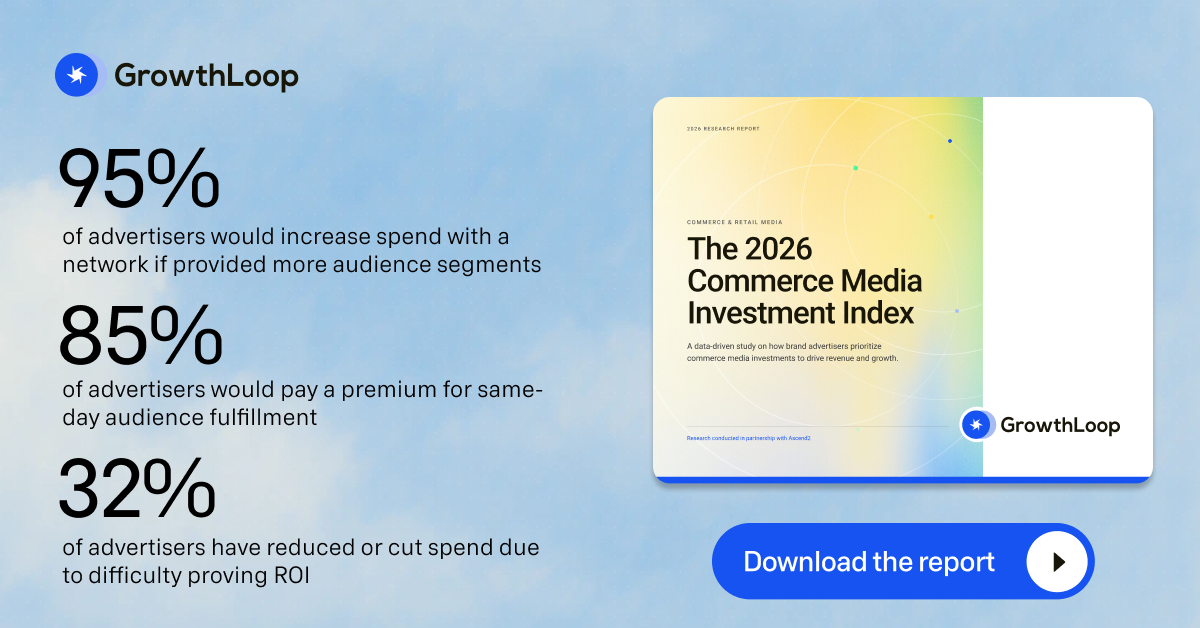
85% of advertisers plan to increase spend with media networks in the next year. So, how do you get a bigger share of those budgets?
New research from GrowthLoop & Ascend2 reveals that activation speed and audience options are decisive factors in where advertisers place their dollars.
- 86% would reduce spend or leave a network if their audience fulfillment is too slow
- 85% would pay a premium for same-day fulfillment
- 32% have reduced or left a media network because of difficulty proving ROI
For more insights into what brand advertisers are looking for in media network partners, download The 2026 Commerce Media Investment Index.
Hard even for networks that want to do it
Jack Foster, head of measurement products at LiveRamp, said the question itself is simple: would these purchases have happened without the ads? The hard part is answering it consistently across every product a major retailer sells.
He listed the obstacles.
- A fair comparison needs a control group, which means holding back scarce ad inventory, or building a synthetic control, which usually takes first-party data.
- Some retailers won't give up the holdout or don't have their data set up to support one.
- Small campaigns may not produce enough data for a reliable result, especially when the method has to match the same households across media, audience and sales data.
"A large portion of retail media spend goes toward smaller-budget campaigns that bump up against feasibility minimums and statistical significance questions," Jack said.
Those small campaigns belong to the brands I wrote about earlier: the long tail of advertisers who can't fund their own studies and rely on what networks report.
"I wouldn't assume slow adoption means retailers lack incentive," Jack said. But I am still picturing some bleed here: A network that won't give up the ad slots for a holdout is making a commercial decision, so difficulty and incentive overlap.
Best Buy Ads shares how a network thinks about it
"Retail media is moving from ROAS to incrementality as the primary measure of advertising effectiveness," said Stephen Sheron, senior director of ads analytics at Best Buy Ads. In his view, a single lift test can't carry that weight. Best Buy runs multi-touch attribution and marketing mix modelling for day-to-day reporting, and uses incrementality testing "to validate and calibrate" those models. The models produce the numbers advertisers see, and the tests check whether those numbers hold up.
Chaitanya Seri, associate director of product management, said Best Buy holds new ad formats, including the digital screens it's adding in stores, to the same standard, asking whether the revenue they bring brands is incremental. When one partner ran an in-store takeover, Best Buy's geo-lift measurement showed 11.7x ROAS in incremental sales.
Geo-lift compares regions that saw a campaign with regions that didn't, so it doesn't rely on matching households. It still needs a campaign big enough to show up in regional sales, which, by Jack's account, a lot of retail media spend isn't.
A simpler toolbox for everyone else
And "incrementality" as a concept is open to interpretation. Jack Foster says that incrementality results vary a lot with the method, the campaign design and the data available. Simpler measures built on deterministic data, like deduplicated reach and counts of exposed shoppers who converted, give brands a baseline that's easier to compare.
"Simple attribution and unique reach should be pretty consistent, and hopefully give a brand that wants to spend across smaller retailers a better toolbox," he said.
He added a caveat. Using those simpler measures on their own, without incrementality studies, can over-index on loyal customers. Used together, they give a fuller view of how people actually buy.
"Just measure incrementality" is the right goal. And networks are working toward it, mostly to check their own models and on campaigns large enough to test. For most brands, the realistic version for now is a set of simpler numbers that at least get counted the same way everywhere, and understanding their inherent limitations.
Read more from me on related topics:
 Kiri Masters

 Kiri Masters

 Kiri Masters