![RMNs Are Launching MTA. Do Brands Want It? [Part 1]](https://storage.ghost.io/c/fd/2e/fd2ea2dc-8a41-4dfb-987b-e5e3b2c38c09/content/images/size/w1200/format/webp/2026/10/NEW-Thumbnail-designs--4-.png)
A couple of years ago, two neighborhood cats started visiting us. "Bill and Ben" were both adorable, and we wanted them to keep coming back, so we fed them.
Then one day they both turned up wearing new collars. The tags read: "Do not feed unless starving."
Their owners had noticed the cats were getting fatter. But really, no-one had any idea who was feeding them, how often, or how much.
Brands have their own version of this problem. When they add up the attributed sales from every retail media network they spend with, the total somehow comes out bigger than their actual sales.
So I was curious when, within a week, two unrelated retailers announced new MTA (multi-touch attribution) capabilities. MTA tries to split the credit for a sale across every ad a shopper saw along the way, rather than handing all of it to the last click.
On 17 September, Albertsons Media Collective announced Retail Media Incrementality-Based Multi-Touch Attribution, built with LiveRamp and piloted by PepsiCo. It connects impression-level exposure across Albertsons' own channels, its offsite media and participating platforms against Albertsons transaction data.
A little over a week later, Best Buy Ads launched its own multi-touch attribution, built in-house, which went live to every advertiser on 30 September inside My Ads, its self-service reporting interface.
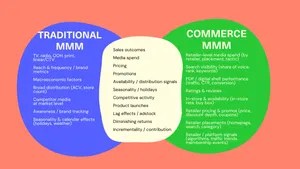
I was surprised. I don't hear brands asking for MTA, and certainly not from a retailer. What I hear is brands bringing in their own mix modelling provider, and using reporting platforms that normalise performance metrics across networks so they can be compared and halo effects identified — something no retailer has a competitive interest in doing for them.
As I asked around my network to write up a piece for my column at The Drum, this perspective was mostly validated on face value. It isn't solving the underlying need from brands. Is it a bit of a cop out? Or simply a curious thing to be building at all, given MTA fell out of favour in broader marketing circles years ago? (Read that piece here, Why retail media networks are resurrecting multi-touch attribution)
There's a credible case on the other side, and I'll make it in part two. This part is about the demand.

Poor audience targeting is frustrating. But for retail media teams, it can be costly, too.
With GrowthLoop’s Composable Commerce Media solution, you can turn your first-party data into hundreds of high-value audience segments and launch campaigns faster.
After partnering with GrowthLoop, instant commerce pioneer Gopuff scaled from 100 syndicated audience segments to more than 600. And it now takes less than 48 hours to turn around a custom segment for one of their brand partners.
Learn more about how GrowthLoop is powering Gopuff’s best-in-class retail media operations.
Did MTA fall out of favour, or fail to launch?
MTA came back on my radar in August when Acadia — the agency I sold my agency to in 2022, no ongoing affiliation — put the boot in. Sally Kazin, its head of analytics, said on the agency's podcast that the promise of MTA "was beautiful, and we all wanted to believe it." Privacy restriction and fragmentation killed it. "Today's reality means we aren't seeing a full picture anymore," she said. Acadia replaced it with mix modelling, incrementality testing and platform optimisation.
Kazin's purview is not retail media. It's the broader walled gardens, which is where MTA was tried and found wanting. Retail media never got that far. It is still largely running on last click.
Skye Frontier, executive vice-president at Incremental, gave the history on the Measure Up podcast last year. Marketing mix models were built to answer the big allocation questions. MTA was supposed to sit underneath as the tactical layer — which campaigns, what pacing, what frequency, what audiences.
"You could make the argument that MTA was never good or never reliable or, technically not incrementality-based if we wanna get really strict here," he said, "but there was still this job to be done."
That job is the bind that retail media is in now. A CPG has a tuned mix model for the strategic questions. It 'has' to spend with its retailer customers either way, under a joint business plan. What it doesn't have is a way to deploy that money week to week — and, as Frontier put it, the only option today is last touch attribution.

Is MTA a cop-out for the real needs of brands?
I put it to a contact at a multinational CPG, who asked not to be named. "I think MTA is a dying breed," they said. "Maybe it took too many too long to build it."
My source compared the customer journey to a route on a map. "MTA tells us all the intersections taken, but it fails to tell us the diversion signs or broken stop lights which caused a consumer to truly end up at the destination."
"MTA is hard to optimise," they said. What's more credible, they said, is isolation studies to understand sales and show if a piece of ad inventory delivered.
But the harshest criticism I heard was from an industry consultant who believes that MTA is even more of a black box than ROAS, the current pariah of media measurement. "What level of data are you getting from each channel, and how is it being resolved and modelled?" one consultant asked. "It's still a black box."
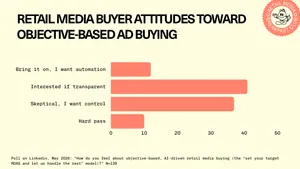
Another consultant I asked was more measured. They could see the logic: if you're running sponsored products, display, video, offsite, CTV and social, understanding relative contribution across them is a reasonable thing to want. But what they weren't seeing was demand. "I'm not hearing that MTA is table stakes for RMNs today or that brands are regularly asking for it as a condition of spend."
Against these criticisms, the retailers say the demand is there. I asked Patrick Albano, chief revenue officer at Best Buy Ads, why MTA now. "It was one of the most requested measurement tools from our partners," he told me. "And so we're really responding to an ask from the market."
And from Albertson's Liz Roche, its vice-president of media and measurement, says that "Advertisers expect measurement that reflects how consumers actually engage across channels, because conversions are not stimulated from one single ad impression." PepsiCo is the launch pilot partner, and the release says it is using the product to see how its investments work together across channels, "with a level of clarity the industry has not had before."
Different buyers, same advertiser
On a panel I moderated at Ad Club of New York's inaugural Commerce media Exchange last month, Dave Kersey, VP of global media at SharkNinja, said his company does work with both MMM and MTA models. SharkNinja uses both of these systems to understand how its demand generation, such as CTV and social, carries over into sales elsewhere.
Albano agreed that Best Buy's MTA may not be one-size-fits-all: "I don't think it's all or one. Certain brand groups will have their own MTA or MMM, and then certain shopper groups do want retailer-specific (measurement tools)."
Coming next week: When we zoom out and look at the incentives for retailers to actually build MTA. And that while retailer-operated measurement tools have their limitations, they can still be useful and credible for brands.