
This is part 2 of my series on MTA.
- Do brands really want MTA?
- Why retailers are reviving MTA [What you're reading right now!]
- Is MTA past its expiration date? [Subscribe to get it!]
A couple of weeks back I asked why Albertsons Media Collective and Best Buy Ads both launched multi-touch attribution (MTA) capabilities, when the brand-side leaders and consultants I spoke to weren't asking for it.
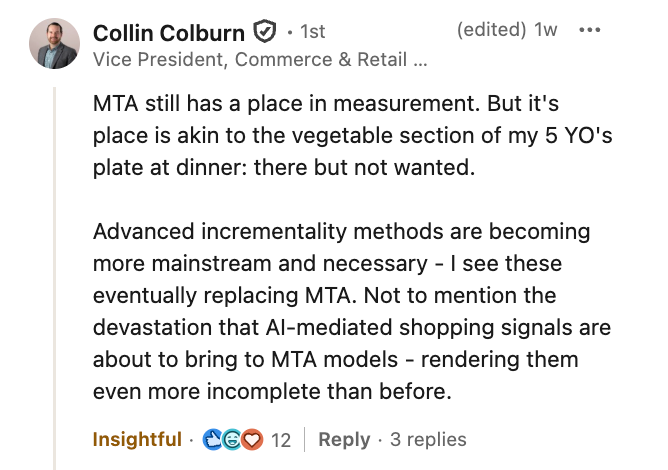
Some readers of that piece on LinkedIn had an even stronger POV:
But the retailers building these tools could ultimately be right, I concluded, because shopper marketing and media buying teams want something different from the central analytics teams that gave up on MTA years ago.
Today I'm going to look more closely at the retailers' side of it: what they get from building MTA, and how that lines up with what brands want.
An earlier signal
At the Ascendant Network's RMN Bootcamp in Palo Alto in September, a retail media leader responded to the usual hand-wringing about measurement by pointing out that the industry already has a standard metric. "It's called market share." I agreed, and so would most brands.
The trouble is that market share shows up months after the decisions that produced it, and doesn't say which tactics got you there. In the meantime, as Skye Frontier of Incremental said in part one, last click is the only tool most brands have for week-to-week decisions.
Jack Foster, head of measurement products at LiveRamp, which built the product behind Albertsons' MTA, made a similar case to me. "An MMM is cool, but you're going to get it every quarter," he said. In his view, a signal that arrives sooner is worth having "even if it's directional."
A key to the brand budget
Retailers aren't building MTA just for yucks. It costs money and engineering time that could go elsewhere. So why here?
The answer is access to a different budget. Sponsored product ads are believed to be close to tapped out as a growth story for many RMNs, and the money left to win is brand money. Under last-click ROAS, a streaming ad almost never gets credit for a sale.
Patrick Albano, chief revenue officer at Best Buy Ads, told me that more marketers will combine their shopper and national budgets, "and so MTA will become a really important part of how they measure that."
At least one other person on the retailer side agrees. Dan Waldman, senior technical product manager for reporting and measurement at Chewy Ads, wrote in the comments on part one that once brands have tapped out onsite spend, MTA "is still the best way to help them understand where to invest their next dollar."
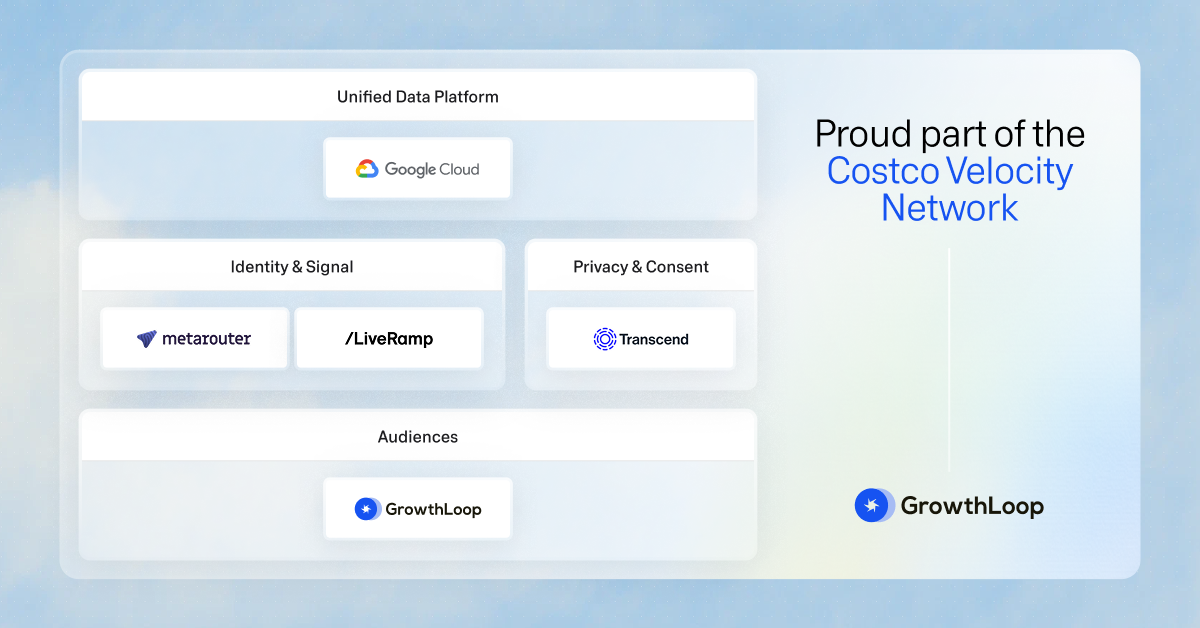
Costco isn’t scaling its RMN with legacy adtech and manual solutions. It’s leaning into a cloud-centric, composable stack.
As part of the Costco Velocity Network, GrowthLoop empowers the retail media team to build audiences directly from the data cloud, enabling faster activation, greater relevance, and better performance — all while maintaining privacy and governance standards.
The result? Exceptional value and experience for Costco members and better ROI for brand advertisers.
Learn why the GrowthLoop Composable Commerce Media solution was the right choice for Costco’s Velocity Network.
And that prize is tantalizingly close to being a reality if only retailers can stick the narrative. At the Advertising Club of New York's Commerce Media Exchange in September, I asked the room who believed commerce media can build brand, and most hands went up. But when I asked who had actually funded a brand campaign through a commerce media network in the past 12 months, let's just say that far fewer hands stayed up.
Measurement also decides which networks get a shot at that money. Most brands work with six to eight networks. On the same panel, Ellen Hawes, SVP of performance and strategy at eos, said that when her team considers adding a new network, measurement capabilities are a key factor. That lines up with practically all the advertiser perception surveys out there. For a retailer trying to get onto that list, MTA is one type of measurement capability that's already familiar to media buyers.
Where the ceiling is
The two retailers who launched MTA capabilities last month took different routes. As I wrote in my column for The Drum, Best Buy built its MTA in-house, and says it covers onsite and offsite media, paid search, CTV, social, creators, affiliates and in-store. Albertsons went through LiveRamp, which is how Meta and Google were corralled in. Both still stop at the edge of what the retailer can see.
- Google is in, but only partly. The Albertsons model includes the third-party inventory Google brokers through Display & Video 360 and Google Ad Manager. Google search isn't included.
- Amazon isn't in it at all. For most CPG advertisers, Amazon is the largest single piece of the picture.
- It's exclusive. The release describes the LiveRamp collaboration as "first-to-market, grocery exclusive," so a brand can't get the same view from competing grocery retailers. (That's one heck of a lock-out, by the way.)
- Category changes the value. Ivan Fedorov of Retail Media Machine argued in the comments that MTA suits long, considered purchases, while for impulse buys, what's on the shelf matters most and last touch does the job. That works in Best Buy's favor. Albano also noted that consumer electronics doesn't involve the same type of normalizing across partners that brands in the grocery category often demand.
The tools brands bring in themselves, such as Clerdata, Incremental, Keen Decision Systems, Circana, and many more, are built to compare retailers against another.
Neither retailer’s MTA can do that. But perhaps that's not the first problem to solve. Comparing retailers means competitors sharing data with each other, and that part might frankly be a pipe dream.
Liveramp's Jack Foster sees the realist scenario is one where a brand can see the total impact of its spend with one retailer, onsite and offsite together. For a brand whose media plan spans both, that view is still worth having.
The test
When Dave Kersey, VP of global media at SharkNinja, weighs up adding a new network, the question he asks is: "Are we growing share or are we stealing conversion from another platform?" A report that stays inside one retailer can't answer it.
One consultant I interviewed for the Drum column offered a test for when retailer MTA is worth building. Skip it if:
- The retailer is mostly onsite
- There are few tactics to compare
- A brand can't do anything differently with the output.
Albertsons and Best Buy both sell offsite media and have several channels to compare, so they pass.
Kersey's question hangs out there. But "no comment," is the only valid answer for a retailer to give.
In the final edition of this series: Is MTA past its expiration date? I got plenty of comments on the Part 1 of this series, mostly dunking on MTA. But there's some good arguments for a continued place for MTA, especially if we can shake off the dust of what it looked like in the past. Make sure you're subscribed to receive it!

![RMNs Are Launching MTA. Do Brands Want It? [Part 1]](https://storage.ghost.io/c/fd/2e/fd2ea2dc-8a41-4dfb-987b-e5e3b2c38c09/content/images/size/w300/format/webp/2026/10/NEW-Thumbnail-designs--4-.png)