
Brian Spencer, marketing director at Kroger Precision Marketing, posted a take on LinkedIn last week that he probably knew would get a reaction. "There are only 10 or 20 successful retail media networks," he wrote. "Let's stop saying 200."
He isn't disputing that 200 networks exist. His point is that monetizing some website traffic "doesn't make you a media business." Ouch.
What a 'real' one needs is three things, according to Brian: scale, addressability and technology.
With such a spicy take, the comments section kicked off with good arguments on both sides, and it sent me back to some of the commentary I've shared on each side over the years. Today I want to dig into the first of Brian's criteria, scale, and whether size really matters.
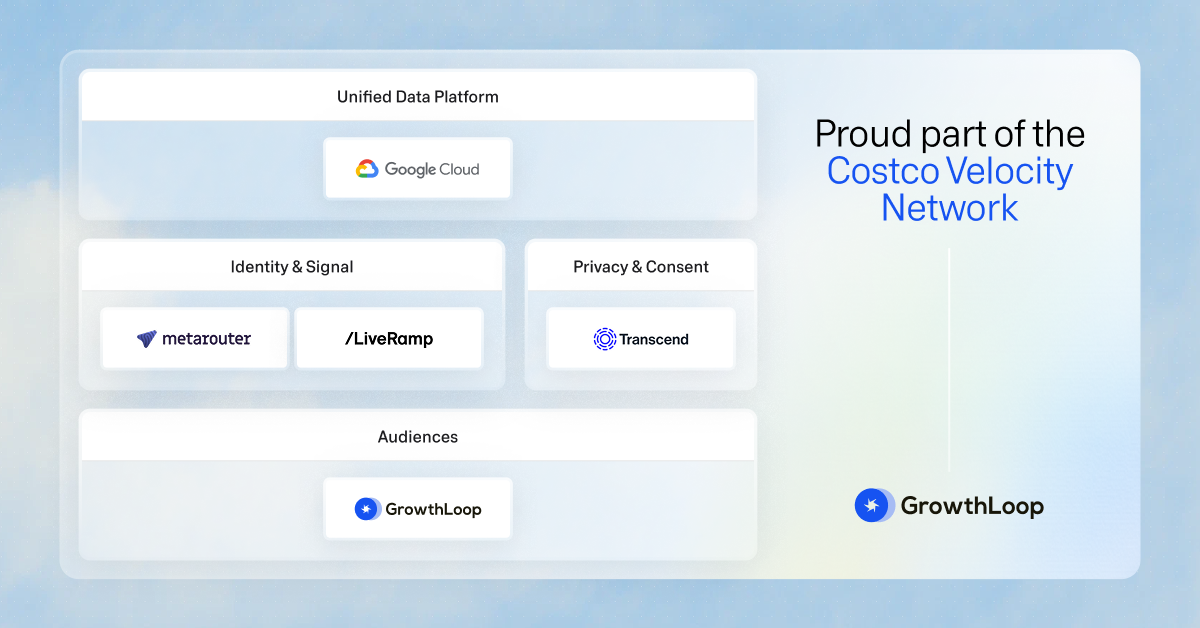
Costco isn’t scaling its RMN with legacy adtech and manual solutions. It’s leaning into a cloud-centric, composable stack.
As part of the Costco Velocity Network, GrowthLoop empowers the retail media team to build audiences directly from the data cloud, enabling faster activation, greater relevance, and better performance — all while maintaining privacy and governance standards.
The result? Exceptional value and experience for Costco members and better ROI for brand advertisers.
Learn why the GrowthLoop Composable Commerce Media solution was the right choice for Costco’s Velocity Network.
Brian is right about one type of ad buyer
Let's start with the national brand media team, because that's who Brian's filter is built for.
I've told this story before, because it captures that one type of buyer. The retail media leader at a major CPG conglomerate was walking me through their requirements for spending with an RMN: scope, growth profile, targeting capabilities and the like. I asked if they'd start spending with ten more retail media networks if those networks suddenly met all their standards. "Absolutely not," they said. They already worked with six. The cost of planning, buying and reporting across more networks wasn't worth it, even for a company with their resources.
And let's look at the $1bn club.
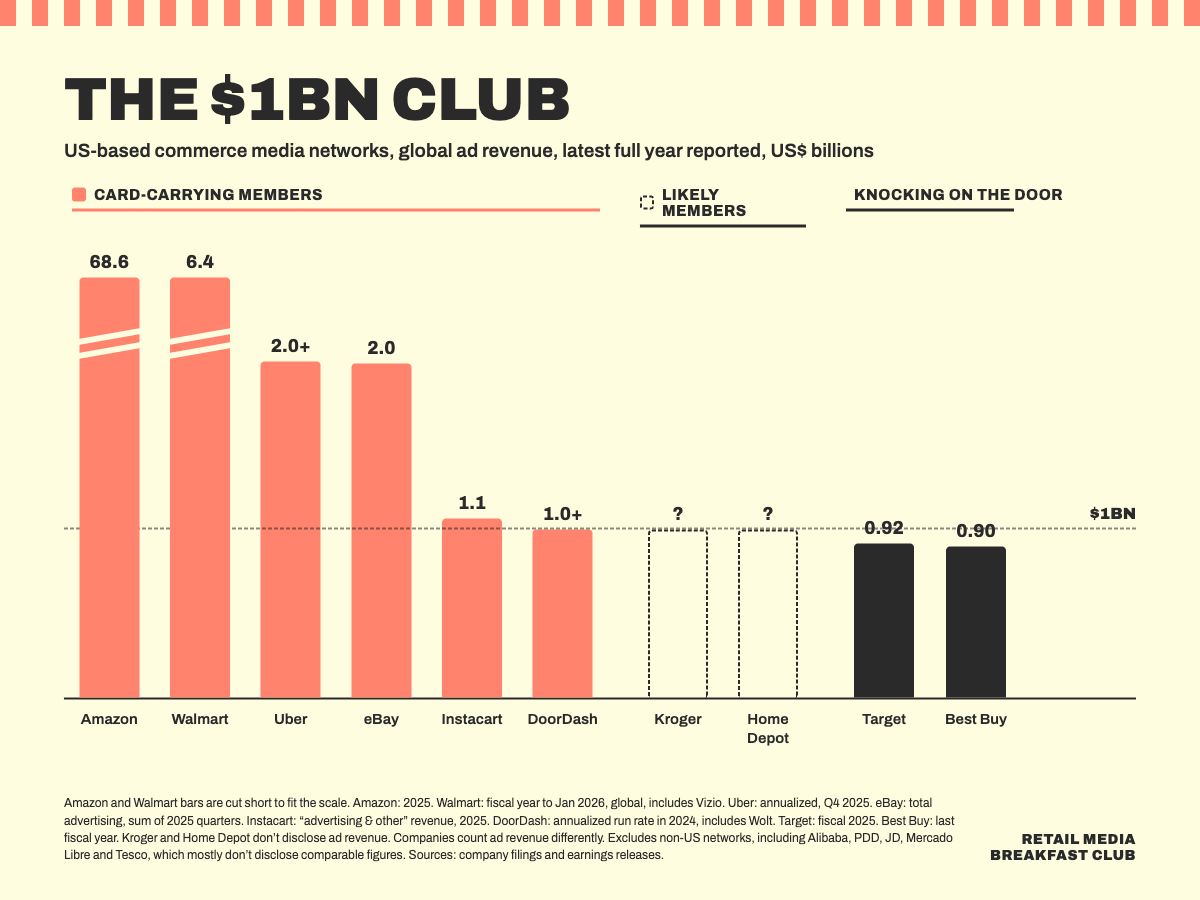
Five US commerce media networks have publicly said they're past $1bn in ad revenue, though they count it differently: Amazon, Walmart, eBay, Uber and DoorDash. Instacart is reported to have crossed the line too.
A couple more are pounding on the door. Target's Roundel made $915m in ad revenue last fiscal year and is growing fast, and Best Buy expects close to $1bn this year.
Then there are the networks that don't disclose their ad revenue but are probably in the club, Kroger itself included. Kroger's only disclosed figure is $1.5bn in operating profit from "alternative profit businesses" for fiscal 2025. Kroger is very likely over $1bn, but there's nothing public to cite. That's a little ironic, given the post that started all this.
Amazon and Walmart have been investing in this business for more than a decade. Uber and DoorDash got to $1bn within a few years, because they started with huge bases of logged-in customers.
If you're a national CPG media director with a fixed number of networks you can closely manage, the scale filter is a sensible way to choose them. But it's not the only way.
Scale depends on where you're standing
Colin Lewis questioned what counts as "successful" in the first place, pointing to New Zealand and Ireland, markets of about five million people each with their own retail media networks. Brian agreed that "a regional brand or division might be completely fine with regional reach." Adam Rogers put it more broadly: "Scale is of course relevant to the market/territory."
Those networks are tiny by US standards, and they're still the ones brand teams in those countries have to win on.
I moved back to Australia this year, and Kroger's scale means nothing here.
Australia has two dominant supermarket chains. The larger, Woolworths, is roughly the same size as H-E-B at the group level, while H-E-B operates in a single US state (plus Mexico).
So is either one a scaled network? That depends on who's buying. To a US national media plan, H-E-B is one state. But its dominance in Texas makes it hard for any brand that wants to win there to leave it off the plan.
Likewise, to a major CPG's Australian division, Woolworths is one of the two most important networks in the country. That team has its own targets and its own budget.
Who buys the small ones?
If the core retail media team cuts its list of RMNs off at six or eight, the smaller networks need a different buyer.
One is the shopper marketing team. Retail commentator Bryan Gildenberg's POV is that brands should run their smaller retail media networks through the shopper marketing teams that have always managed long-tail retailer relationships. Many of those teams already buy digital media, and they know which retailers matter to which parts of the business.
I wrote a couple of years back how shopper marketers have embraced retail media, often having gone through an internal rebrand already. They have fully embraced the dynamic, measurable, accountable aspects of retail media.
And marketplace sellers are a growing pool: Lowe's grew its long-tail advertiser count 23% year over year after launching its third-party marketplace.
And this is why Brian's POV can be correct for the national media buyer profile, AND retailers with a smaller footprint can still offer something compelling to their suppliers.
Where I land
I revisited my retail media doom loop a couple of weeks back. Brian's scale test describes the loop from the inside: without scale you can't afford the technology and talent, and without those you can't win the budgets that would give you scale.
So it depends which club a retailer wants to be part of. The $1bn club sounds great, until you look at what growth requires once you're in it. Those networks now have to win upper-funnel brand budgets, and new EMARKETER research suggests that's proving hard. The long tail has a different problem, which is getting a seat at the table at all.
For most of those networks, the seat is more likely to be with a shopper marketer or a regional team than with a national media director. Is that a fully fledged media network in the same echelon as Kroger Precision Marketing? Perhaps not. But maybe they doesn't have to be.