
Andreessen Horowitz just dropped some major insights on their blog about the adoption of consumer AI technology, and the implications for the rest of us. The rapid deployment and adoption of this technology over the past few weeks has had everyone talking, so today I'm going to share the findings that were the most new and novel to me – and those with the most obvious through-line to the world of retail and advertising.
It's the seventh edition of their Top 100 Gen AI Consumer Apps report, and the first to include consumer spending data. a16z partners Olivia Moore (who authors the report) and Josh Elman also unpacked it on the a16z podcast, which I've pulled from below.
An essential daily utility... that barely anyone wants to pay for
Although the share of Americans who pay for AI has doubled in a year, it's still a small percentage of overall users.
- About half of Americans say they use AI, and about a quarter think they use it close to daily.
- Only about 4.5% of US consumers pay for an AI subscription. That's from YipitData's panel as of August, and it counts paid personal subscriptions to ChatGPT, Gemini or Claude. Other sources put it at 2–2.5%. Either way it has roughly doubled in a year (from 2.1% in the YipitData numbers).
- Spending is very concentrated. The top 10% of payers bring in roughly half the revenue, and the top 1% bring in about 20%. The top 1% spend an average of $903 a month on personal cards, while the median is $25.
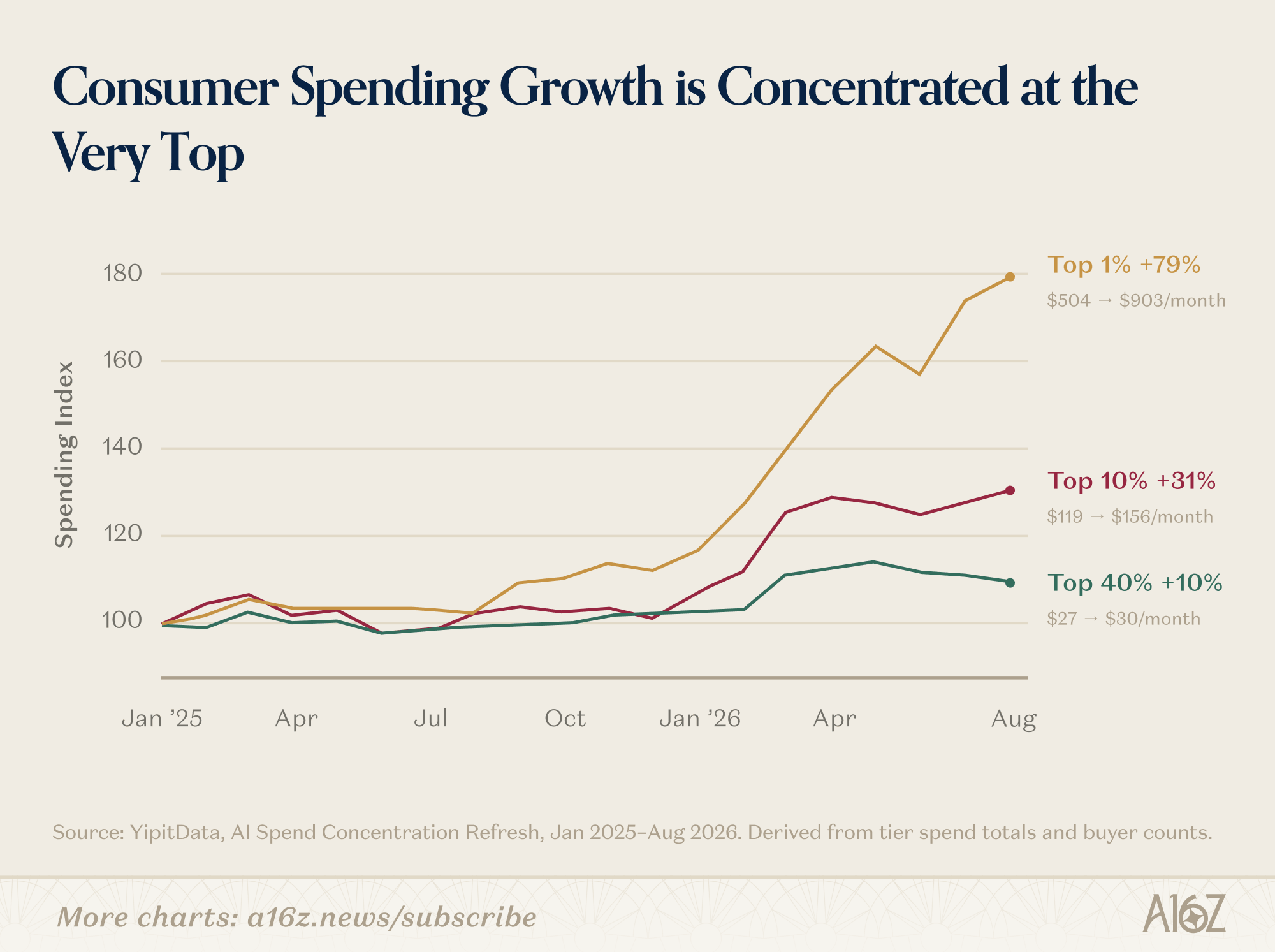
Subscriptions only reach power users
The money goes mostly to developer, productivity and creative tools: things used to "build, make, sell." Not to everyday common consumer queries doing research, finding things, and getting advice.
Olivia passed along a line from Eugenia Kuyda, cofounder of the early AI friendship app Replika and now the consumer agent app Wabi:
"Most people aren't looking to save time. They're looking for ways to spend their time."
That's why social media, Netflix and TikTok are the most-used consumer products. Most AI so far helps people do things "a little bit faster, a little bit easier," Olivia said, "and that's not an incredibly compelling daily or hourly active value proposition for most people."
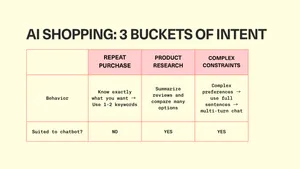
Shopping is one of the few categories that sits on both sides of that line. I wrote earlier this year that not all shopping is fun: re-buying milk is a chore I'd happily hand to an agent, while a bit of retail therapy at the mall is time I want to spend. Most AI shopping tools so far have been built for the first job. The second one, where people spend time and attention, is more sporadic.
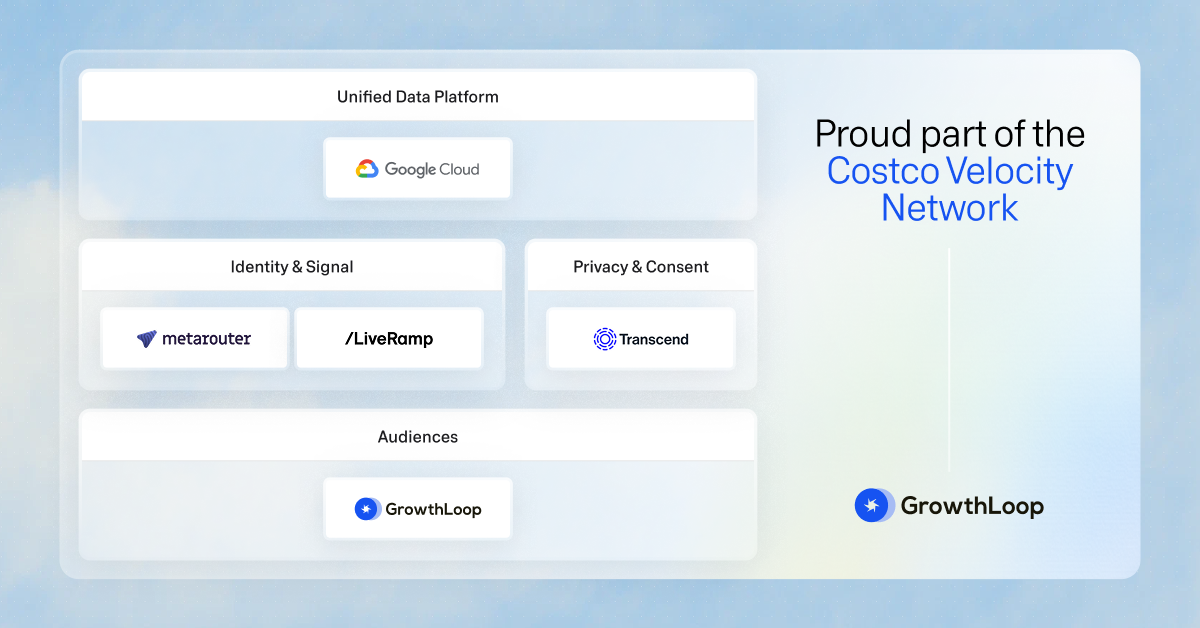
Costco isn’t scaling its RMN with legacy adtech and manual solutions. It’s leaning into a cloud-centric, composable stack.
As part of the Costco Velocity Network, GrowthLoop empowers the retail media team to build audiences directly from the data cloud, enabling faster activation, greater relevance, and better performance — all while maintaining privacy and governance standards.
The result? Exceptional value and experience for Costco members and better ROI for brand advertisers.
Learn why the GrowthLoop Composable Commerce Media solution was the right choice for Costco’s Velocity Network.
Growing paid subscriptions could stunt growth
The old rule of venture capitalists focused on consumer apps was to build up lots of users first as quickly as possible, often running at a loss in order to secure a land-grab. The sustainable revenue model comes later, with ads.
But AI doesn’t work that way. The running costs are far too high to give the main product away for free. This is why Olivia says she doesn’t want the share of paying users to keep growing.
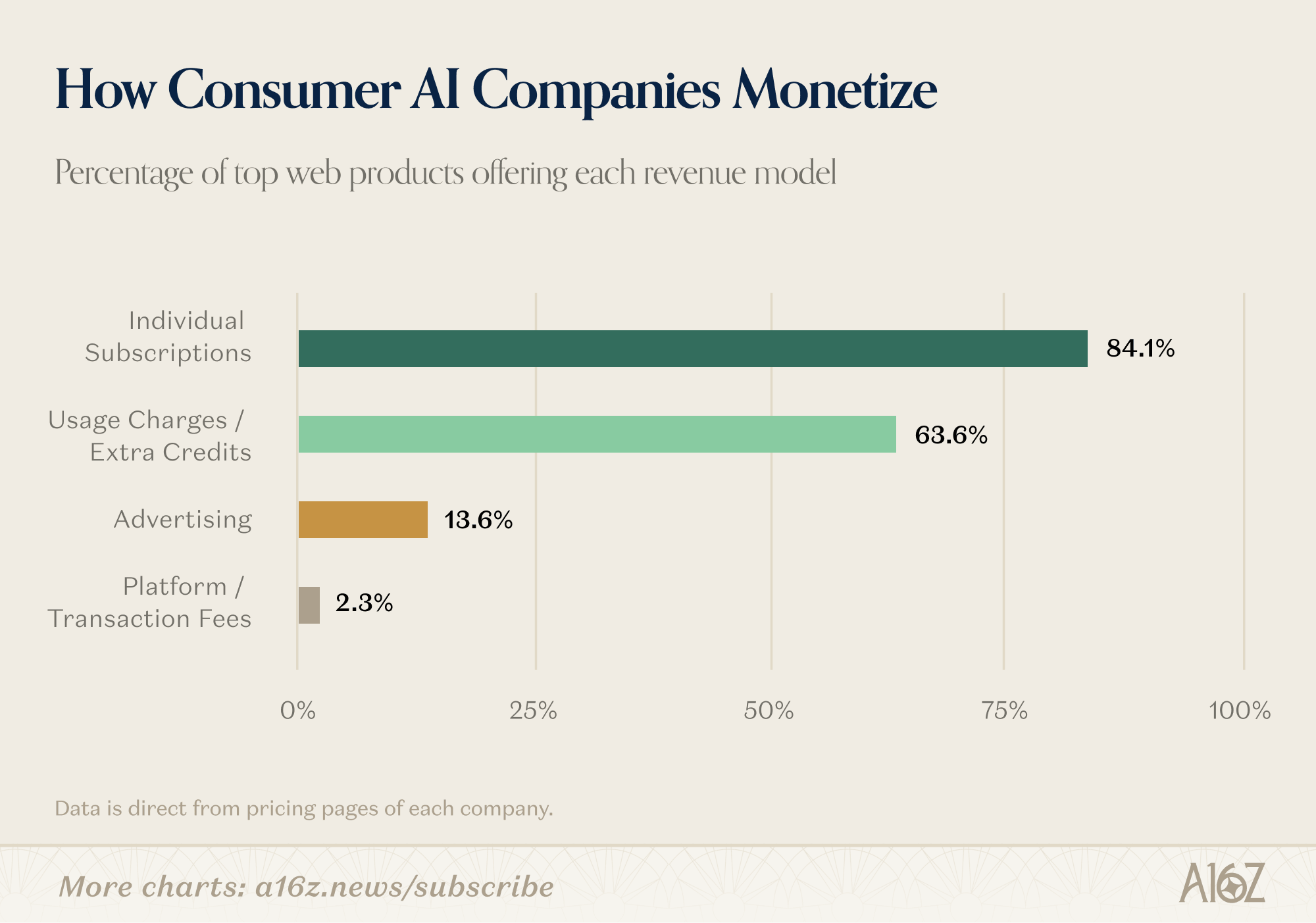
In their web list, about 85% of apps make money from subscriptions and 62% from credits or token top-ups. Only about 13% run ads.
Olivia calls this an “unnatural inversion” of how the consumer internet usually works. Most big consumer tech companies make their money from ads or transaction fees, not subscriptions. If the vast majority of your users won’t pay you, and each of them costs real money to serve, you have to find another way to earn from them.
"I think a wallet is coming"
OpenAI is at about $1B in annualized ad revenue. That figure is from August, so it's probably higher now. Olivia notes that this used to take companies "years and years" even after launching an ads product.
She gives two reasons it happened so fast. First, there are now enough users to sell against, about 1.2B weekly actives. Second, ChatGPT knows far more about each user, so in theory it can charge more and see higher conversion rates. This means there's the potential for even better targeting capabilities than the current king-pins, Meta and Google, due to the depth and breath of conversations that people are having.
Olivia then drops a bit of bomb by mentioning something called "Login with ChatGPT." "I think a wallet is coming," she said on the podcast.
With that suspicion from one of the world's most successful VC firms just left hanging, I have been thinking a lot about it.
A ChatGPT wallet would matter most for retail media because it gives OpenAI proof of purchase. Retailers’ biggest advertising advantage is closed-loop measurement: they can show an ad led to a sale because they see both ends. A wallet would give OpenAI that too, across every retailer where people pay with it.
In my agentic shopping series last year, I argued that once an AI platform sees the transaction, retailers’ first-party data stops being exclusive, and exclusivity is what offsite retail media sells. I assumed agents completing purchases would get it there. A wallet is a shorter route. (There’s a whole lot more to unpack, but until there’s further evidence, I’ll save my breath.)
AI Shopping is still open
The bigger risk, ChatGPT replacing the retailer’s site as the place people shop, depends on it building a great shopping experience, which it hasn’t done so far.
And to be fair, no-one has.
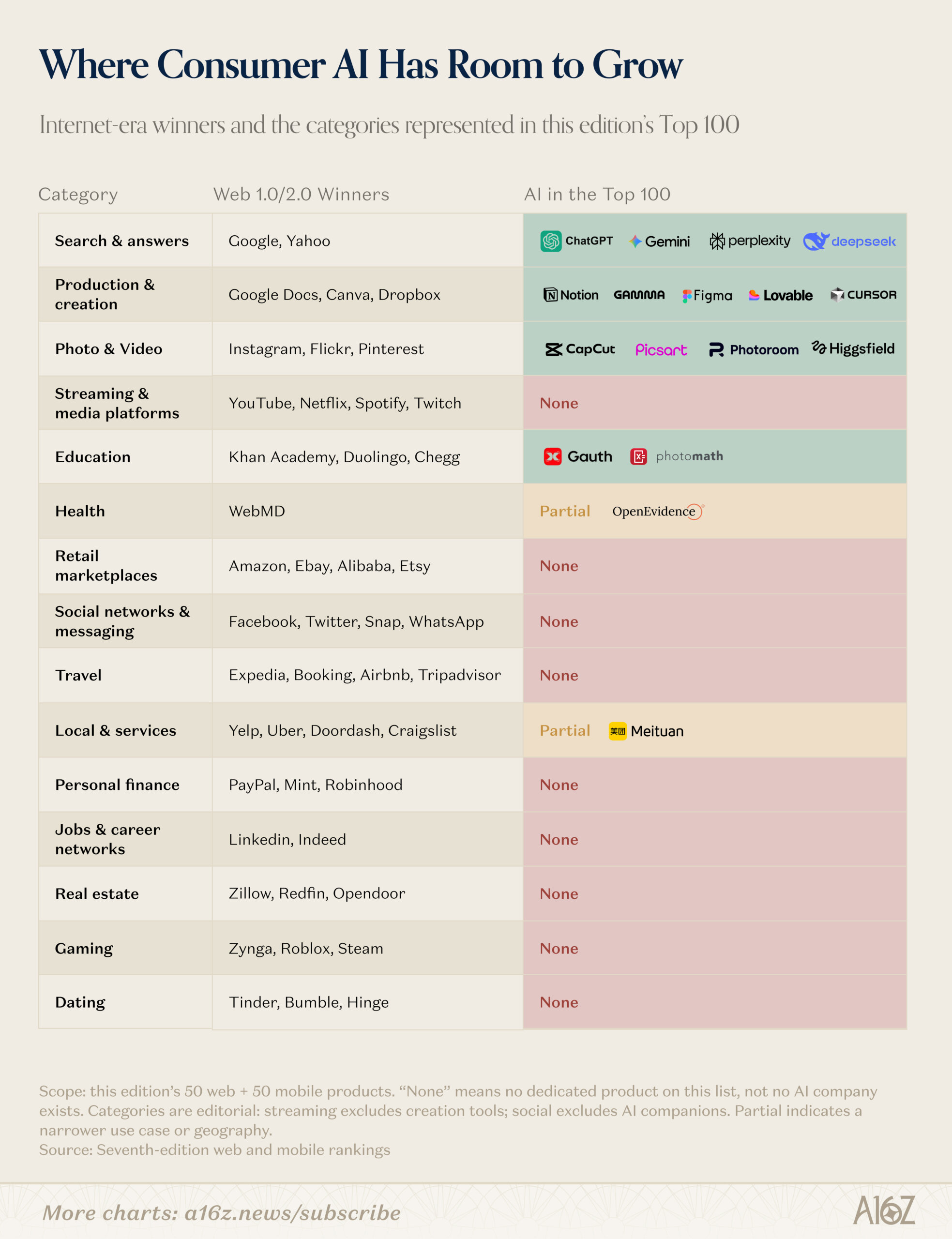
Shopping is one of several categories where no AI-native winner has emerged yet. On the podcast, Olivia asks whether they’ll live inside personal agents or as standalone apps. Josh argues shopping needs visual browsing, not just a chat window. "When you're shopping, you wanna visually see options and explore and have things customized for you," he said.
The new personal agents are already running into retailers' walls. Amazon shut off access for Meta's new Muse agent almost immediately, while Shopify, Instacart, OpenTable, Expedia and others have signed official integrations. Amazon is playing agentic commerce chicken because it can afford to – it has enough traffic to hold out against agents. But many other retailers don't, and the ones signing integrations seem to know it.
Read the full research report at the a16z blog.