

Today's newsletter is contributed by Matthew Fantazier, Vice President, Data Partnerships at The Trade Desk. Matt's newsletter, Matt's Hot Take is one of my personal favorites. You can subscribe to it on LinkedIn or Substack.
In Friday's edition, he covered two major topics of interest to the industry: the proliferation of CMNs, and the personal AI agent revolution. I have added a few of my own thoughts as a post-script at the end.
1: Does the World Need More Retail Media Networks? It Depends.
The latest development in the world of commerce media is that McDonald’s is launching their McMedia network (ok, this isn’t the name of it, but it should be!) (AdAge - LINK.) The fast food chain announced that they will be testing ads from other brands on the restaurants’ digital menu boards, kiosks, and inside their app. With nearly 14k locations in the US serving 26MM consumers each day, the restaurant’s reach is nothing to sneeze at. Also entering the commerce data game is Simon Property Group with the launch of Simon Media Network which will enable advertisers to activate against their visitation, transaction and consumer-engagement data (Modern Retail - LINK.) And if that wasn’t enough, Delta Airlines is also launching an ads business as well, joining rival United in the rapidly growing travel media space (AdWeek - LINK.)
Matt’s Hot Take™ - Just when you thought we’ve reached peak retail media, Ronald McDonald and Grimace kick in the door. The reality is the marketplace has gotten increasingly complex but inside of that challenge lies an opportunity that has largely gone untapped to date. From my point of view, the opportunity for data providers and brands is to be much more intentional. We need to be loudly asking the question who is this for? If I’m McDonald’s, Simon, or Delta, I’m thinking about what unique insights or moments they could tap into to differentiate themselves from the sea of data sets that exist in the marketplace.
If these new data providers (and everyone else) can establish a clear brand position and value proposition, it would go a long way to establishing a foothold in the market, reframing the potential for commerce data as more than a shopper lever, and ultimately driving meaningful outcomes for advertisers.
Kiri's hot take: Matt, I take your Delta, McDonald's and Simon Property Group, and I raise you Citi and Associated Food Stores, and ALDI and SPAR across the pond – all of which have announced their forays into commerce media in the past couple of months.
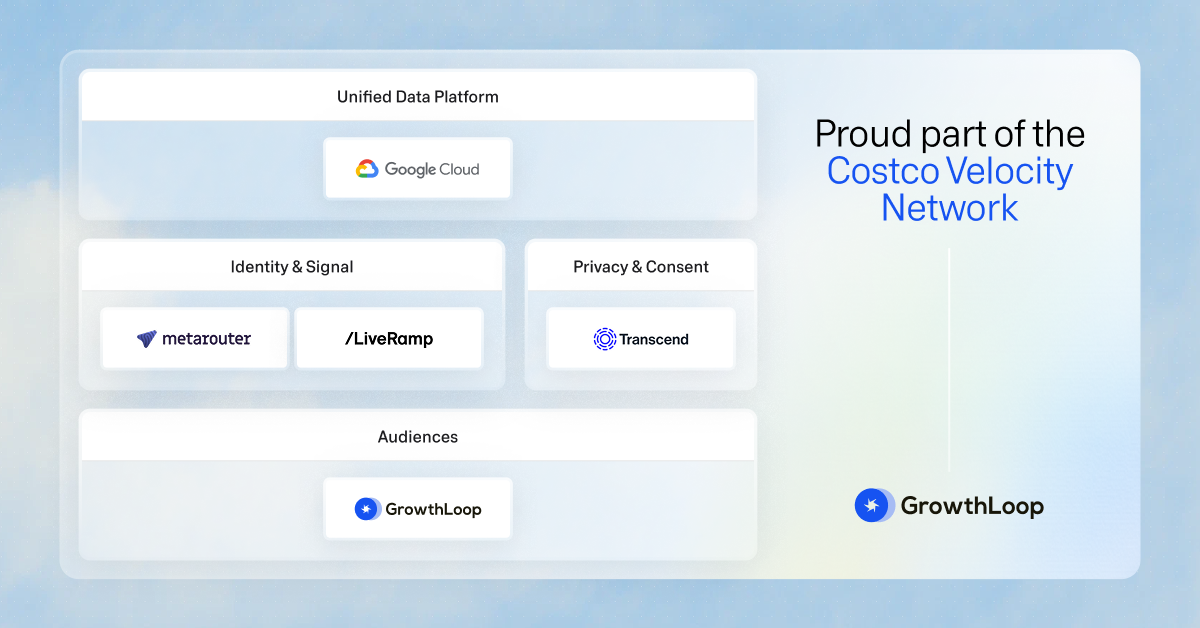
Costco isn’t scaling its RMN with legacy adtech and manual solutions. It’s leaning into a cloud-centric, composable stack.
As part of the Costco Velocity Network, GrowthLoop empowers the retail media team to build audiences directly from the data cloud, enabling faster activation, greater relevance, and better performance — all while maintaining privacy and governance standards.
The result? Exceptional value and experience for Costco members and better ROI for brand advertisers.
Learn why the GrowthLoop Composable Commerce Media solution was the right choice for Costco’s Velocity Network.
Matt's question, "who is this for?", is one I've come at from a few angles in this newsletter.
- In Some Retailers Want to Power Other Retailers' Ad Businesses. Will It Work?, a retail media leader at a major CPG company told me they would "absolutely not" spend with ten more RMNs, even if every one of them met their standards. Planning, buying and reporting across more networks just isn't worth it, even for the largest brands.
- Drew Cashmore's guest piece, Retail Media's Fermi Paradox, explains why most big retailers win so little retail media share. They copy Amazon and Walmart's playbook instead of building on what only they have.
- In RMNs Have A Marketing Problem, I argued that networks should court brands the way any B2B company courts customers, with direct relationships, useful content and less secrecy.
McDonald's, Simon and Delta are entering a market where brands already say no to more networks. A clear answer to Matt's question gives them the best shot at a yes.
PS, here's the links to the various 'Hello World' announcements from the various new GM's on LinkedIn, if you want to see how they are crafting their USP's in real-time:
- Chris Lindquist , VP/GM at McDonald’s Media Network
- John Carlson, VP, Simon Property Group
- Arvin Nuldloll, SVP Revenue and Audience Strategy at Citi
- Keri Paison, MD & Head of Delta's Media Network
2: An AI Agent Takes Over the App Store - Now What?
TL;DR – After only about 2 weeks, Meta’s new AI agent “Muse” has found itself sitting at #1 on the US App Store (Wall Street Journal - LINK.) If you aren’t familiar with the new app, what makes Muse different from other popular AI tools is that instead of only answering questions, the app can take actions on behalf of a user like sending emails, booking travel, shopping, and handling customer-service calls. Accompanying the agent is a new consumer device, the Muse Charm, which is basically a Tamagotchi that acts as a personal assistant. In the coming months, Meta will also integrate Muse into their smart glasses. However, an agent is only as good as the access it is granted and Muse suffered a blow this week when Amazon announced that were blocking Muse from accessing its site and purchasing items for its users.
Matt’s Hot Take™ - AI agents aren’t a totally new concept (how many times have we heard “agentic” used at conferences in the last 2 or 3 years?) However, Muse is perhaps the most consumer-facing application of this technology to date. Before we get too excited though, a ton of questions need to be answered to understand what impact Muse, or any other agent, will have on consumer behavior. First and foremost, the bar for trust is extremely high for a tool that without the proper guardrails could effectively become a dirty bomb for your personal information. Meta’s long history of negligent behavior makes them about as reliable as believing that shouting “Swiper, no swiping!” will keep Dora the Explorer’s backpack safe so they certainly will have a hill to climb here.
Along with trust comes access. Which tasks and environments will consumers be comfortable with an agent to work on their behalf? We’re a long way from Muse hitting the mainstream but with OpenAI also announcing their consumer-facing agent “dots,” there is certainly a lot of smoke around this technology at a macro level which could help spur consumer adoption. Lastly, this reinforces the increasing need for creating awareness before consumers turn to a bot or agent to hopefully drive branded requests vs broad category ones where you’re at the mercy of an algorithm.
I’m not totally sold that we’re ready for agents to take over day to day tasks but this is way too disruptive of a technology to not pay close attention to how it develops.
Kiri's hot take: Matt asks whether people will trust an agent like Muse. I'd add a second question: who pays for it?
At launch, Meta said Muse would be free for a generous allowance, and that "over time we will profit by taking a small fee from transactions." I don't expect it to stay at fees. Once merchants compete for an agent's transactions, they'll pay for a better spot in line, and paying for placement in front of a shopper is retail media. My bet is that ads come to personal AI agents, the same way they came to Google, Facebook and WhatsApp.
The version that worries me is paid rankings the shopper never sees. Ads that are relevant and clearly labeled are the least-worst option. I'm working on a longer piece about this, including what ads inside an agent could look like. More on that soon.