This article was originally published to my column at The Drum on September 15 2026 as 'Ads in AI can’t vouch for your brand yet. Here’s what can'. It is reproduced here with permission
Outside of our 9-5 in the marketing industry, most of us tolerate advertising as a tax that enables free or heavily subsidised services and modern utilities: TV, social media, and stupid games on your phone.
When a pop-up ad interrupts my Candy Crush game, it's annoying. But I’m not suspicious of the motives of the game developer. We understand the deal: the ad is the toll you pay for the free thing. The ad sits next to the content. It doesn't pretend to be the content's opinion.
So it’s interesting to learn that when it comes to ads in AI environments, consumers have their hackles up.
New research released today from Bazaarvoice, a study I worked on as co-author, found that 54% of consumers believe that if they've seen a brand advertised inside an AI tool, that brand is more likely to be recommended by the same tool.
The survey covered more than 3,600 adults across the US, EMEA and Australia in June this year. In these markets, people are already leaning on these tools heavily: 62% told us they've used AI specifically to help them shop.
What we found is that while consumers increasingly rely on AI to help them make buying decisions, the actual process of building trust in a brand is multi-modal, and running ads in that environment don’t appear to give brands a free pass.
Your advertisers can’t wait weeks for audiences.
GrowthLoop’s Composable Commerce Media solution helps media teams turn first-party data into high-value audiences, launch campaigns faster, and prove what’s working across every channel.
Learn how retail media leaders at Costco, Fanatics, and Gopuff use GrowthLoop to create highly segmented audiences and deliver stronger results for their brand partners.
The platforms say the answer isn't for sale
Now it should be said that there are two different things going on here, and they are easy to conflate.
The first is getting recommended in the first place as an organic mention. Brands are funding very large optimisation and AI visibility projects to influence this. The second is buying an ad slot inside the AI interface.
What our 54% of consumers are telling us is that they think the ad might be influencing the organic mention.
The platforms say it doesn't. OpenAI’s own help documentation says:
"Ads do not influence ChatGPT's answers. Ads run on separate systems from our chat model, and advertisers have no ability to shape, rank, or alter ChatGPT's responses."
So the suspicion appears to be misplaced. But shoppers missed the memo, and what they believe right now is creating drag on trust on ads running on AI surfaces.
Ad industry veteran John Ebbert, who founded AdExchanger and now writes the tipsheet.ai newsletter, says that the interesting shift isn't simply from search boxes to conversations, but where advertising can enter the decision. “Traditional retail media lets brands pay for visibility on a digital shelf or search results page,” he wrote in his newsletter in August.” An AI shopping assistant recommends what to buy, creating the possibility of moving upstream, from sponsoring shelf position to sponsoring consideration within the recommendation experience. That makes ownership of the recommendation layer more valuable."
More valuable, and also easier to ruin. That ad slot is only worth buying while people still believe the recommendation is honest.
And yet the money is already moving.
OpenAI announced at the end of August that ChatGPT Ads had reached a $1bn annualised revenue run rate in under 200 days, now running in more than 40 countries. So while consumers are wary, marketers are piling in.
Ads in AI, as a trust-building mechanism, are immature — and evolving very quickly, it must be said. But right now they can't be relied on as an awareness-building or action-driving tactic on their own.
Which raises the practical question for anyone holding a brand budget: if the sponsored slot inside an AI assistant can't yet be relied on to build trust, and shoppers are using these tools anyway, where does the trust actually get built?
So where does trust actually get built right now?
The most useful finding in our research isn't about advertising at all. It's about what shoppers do in the minutes after an AI hands them a recommendation.
They go and check.
Bazaarvoice's own data shows shoppers do their real vetting elsewhere — 76% want reviews with photos/video and 75% want written reviews before trusting an AI-recommended brand they don't know.
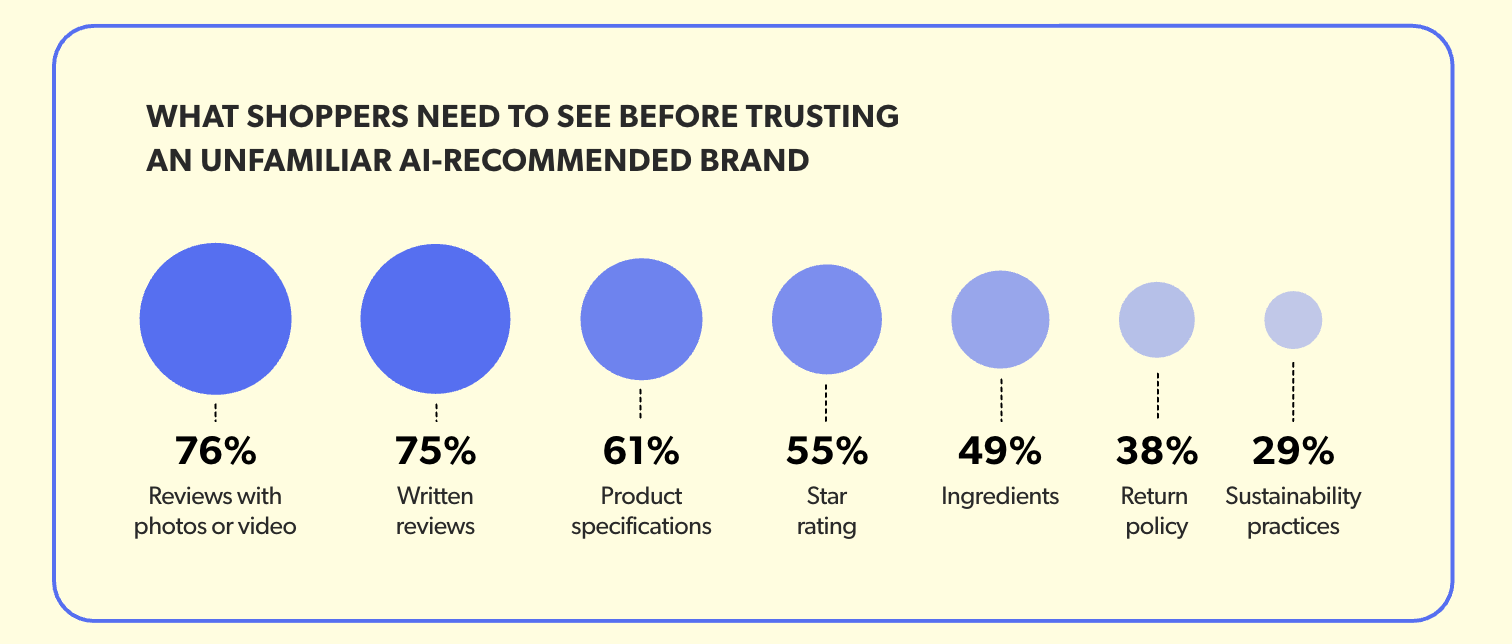
And after a product is recommended, consumers do additional research, and a great deal more time is spent on this when the recommended brand is unfamiliar to them, versus a familiar brand.
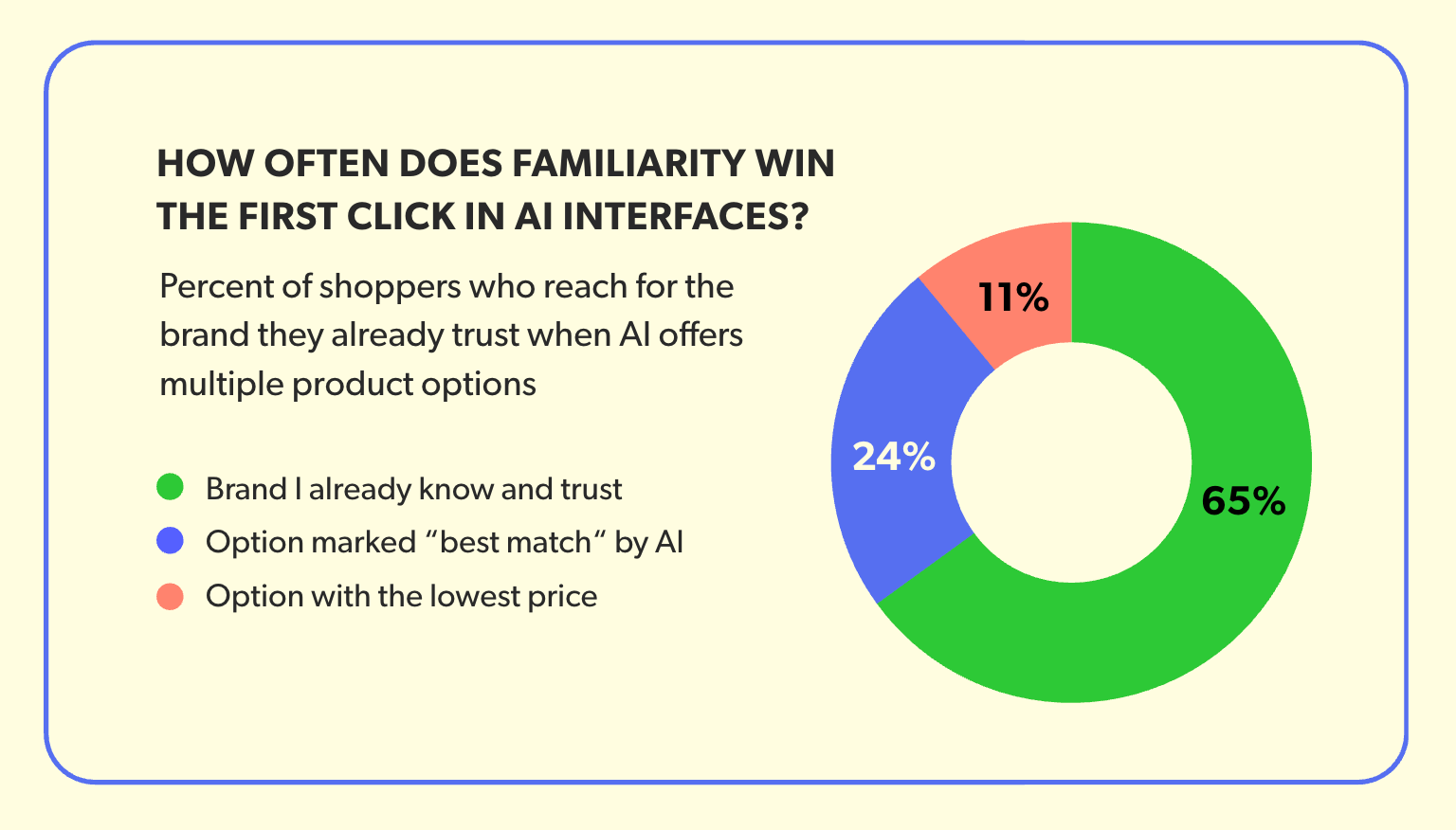
To fully get on board with an unknown brand that’s recommended by AI, 68% go to the brand's own website, 65% to social, 58% to a retailer site to double-check. The AI recommendation opens the door; trust gets built on human-derived channels.
What to do while the ads grow up
It’s inevitable that ad formats and disclosure norms within AI environments will mature. In the meantime, the immediate lever brands have is making sure the proof shoppers already seek out — reviews, user generated content (UGC), a rich brand.com experience — is genuinely accessible to both humans and AI crawlers. Bazaarvoice's own sidebar about UGC locked behind JavaScript some crawlers can't read is a good concrete, testable detail here.
Ash McMullen, head of e-commerce at Advantice Health, reacted to the research this way: "Consumers want unbiased opinions. LLMs read reviews differently than people do, scanning at a scale that surfaces patterns a human never would. How a brand shows up everywhere has never mattered more for winning customers."
What next
For a century, brands did their own vouching through packaging and mass advertising. Then retailers did some of it. Then other customers did, through reviews. Now an AI assistant is trying to do it — and shoppers, sensibly, are refusing to let it vouch alone.
Ads inside AI interfaces will get better. Formats will become native rather than borrowed from search, disclosure conventions will catch up to consumer skepticism, and at some point being advertised inside an assistant will stop looking like a thumb on the scale. I've argued before that ads in AI don't have to suck, and I still think that.
But that's a bet on the future. Here’s what hasn’t changed, in Ash McMullen’s words: “Brand trust needs to come from places other than the brand itself.”
Click through to get the research, What's a brand worth when AI does the shopping, from Bazaarvoice.