
Toddlers do this thing called "parallel play." They won't share, they won't engage, but they will happily play their own games while sitting right beside another child.
Collaborative play comes later, and it's more fun, though it takes a fair amount of hair pulling and squealing to get the hang of.
Two announcements this week put retail media somewhere in that transition. Best Buy is now selling Amazon's Fire TV ad inventory, and Instacart is selling Gopuff's delivery speed. The hair pulling, if there is any, is shielded from view.
Below is a quick read on these two announcements, what's in it for each party to team up, what it means for media buyers, and where it puts our industry on the journey of real collaboration.
1: Best Buy and Amazon
The news
- Today, the two companies expanded their Fire TV partnership, which dates to 2018.
- Fire TV stays the exclusive TV software on every Insignia set — Best Buy's house brand — under a new multi-year term.
- Best Buy Ads will now sell advertising on Fire TV across all Insignia sets, new and already in homes.
- From February 2027, Best Buy Ads will use Amazon Ads' programmatic technology — the automated systems that plan, place and measure campaigns — including its AI tools.
What's in it for Amazon
Amazon locks in its operating system on Best Buy's house brand for another multi-year term, and keeps the device relationship and the underlying data. Presumably it takes a cut of the media and charges for the technology.
What it gains is a second sales force that can sell that same inventory, potentially to a new group of media buyers — consumer electronics brands that buy Best Buy for shopper marketing and have never put trade or shopper dollars into CTV.
What's in it for Best Buy
Best Buy gets to sell ad space that until now only Amazon could sell. The placements inside the Fire TV interface — the autoplay banner above the fold, inline banners, the screensaver, sponsored tiles, sponsored content rows — run on Amazon's software, so they have always been Amazon's to sell, through its managed service or its DSP.
It also gets to put its own signals on top. Nobody could previously buy "households that bought an Insignia TV from Best Buy, are five years into a laptop refresh cycle, and brought a device into Geek Squad last month." Amazon knows the set registered to an account; it doesn't have Best Buy's in-store purchase history or its repair records. Albano said the signals are the product: "there's better signals to use in CTV than age demo show and … search data."
What's in it for the media buyer
- Targeting nobody else has — refresh cycles, repair history, in-store purchases — on living room screens.
- The sale it closes is a Best Buy sale. The same impression bought through Amazon reports against Amazon purchases. For a brand whose volume sits in Best Buy, including in stores, that's the number that matters.
- A different pocket can pay for it. CTV has come out of brand budgets; bought through a retail media network, shopper or trade dollars can fund it
- The catch: Best Buy Ads and Amazon Ads can now both sell against the same household on the same screen, and neither dedupes against the other.
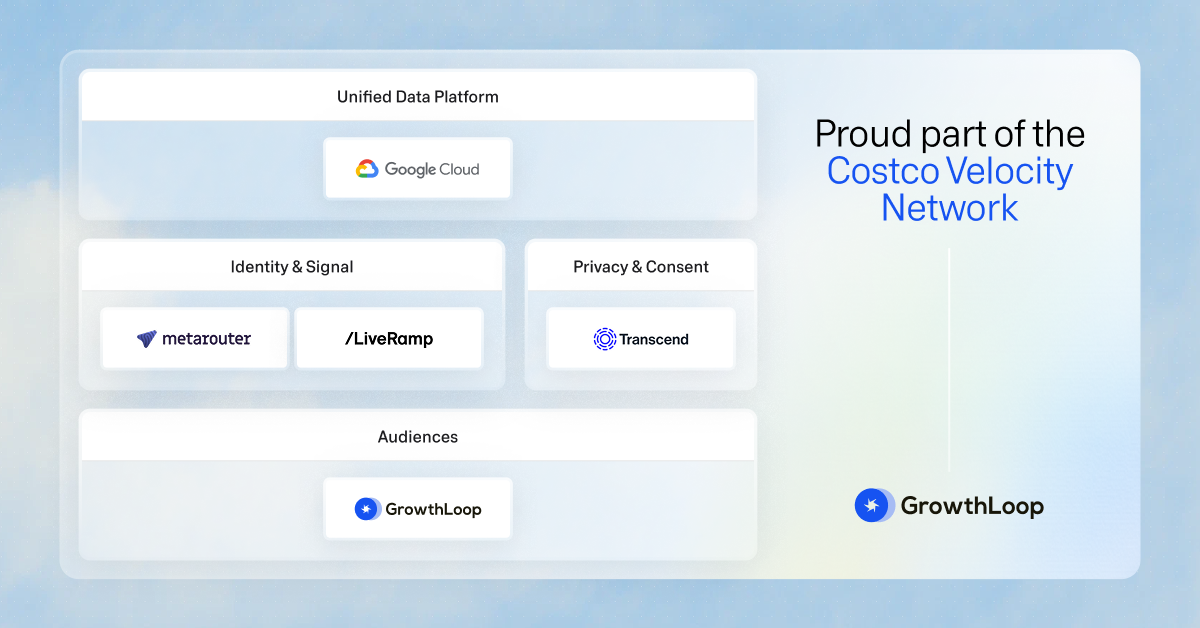
Costco isn’t scaling its RMN with legacy adtech and manual solutions. It’s leaning into a cloud-centric, composable stack.
As part of the Costco Velocity Network, GrowthLoop empowers the retail media team to build audiences directly from the data cloud, enabling faster activation, greater relevance, and better performance — all while maintaining privacy and governance standards.
The result? Exceptional value and experience for Costco members and better ROI for brand advertisers.
Learn why the GrowthLoop Composable Commerce Media solution was the right choice for Costco’s Velocity Network.
2 - Instacart and Gopuff
The news
- Gopuff joins the Instacart Marketplace, orders filled from its own network of small local warehouses in as fast as 15 minutes. BevMo!, which Gopuff owns, was already there.
- Gopuff adopts Carrot Ads, Instacart's white-label technology, to run advertising on its own app and site.
- Gopuff's own ad team keeps selling bespoke campaigns directly.
What's in it for Instacart
- Fifteen-minute delivery, without building a warehouse. Instacart's model is a shopper picking from a partner's store, while instant delivery needs inventory sitting locally.
- Instacart's closest competitor DoorDash closed that gap a year ago, opening DashMart Fulfillment Services to retailers.
- Shopping occasion sets the ceiling on an ad business. A weekly stock-up generates one visit a week; a snack run is more frequent, and the audience skews Gen Z and Millennial.
- Instacart picks up a new ad surface for the Carrot Ads network.
- It answers the standing objection to Carrot Ads — that Instacart runs a marketplace of its own and therefore competes with the retailers it sells technology to. This week, Instacart signed a company it competes with head-on in delivery, which is a major signal to the market.
What's in it for Gopuff
- Retail media technology, for the third time. Gopuff launched on CitrusAd in 2021, brought the platform in-house in 2024, and is now moving onto Instacart's. I don't have intel on why the in-house build didn't hold.
- Access to 9,000 advertisers it would otherwise sell to one at a time. The ceiling on an ads business without self-serve is how many brands a sales team can personally reach. This is a sales problem, and building your own ad-tech doesn't fix it.
(Further reading: GoPuff commerce media leader Michael Peroutka explains the deal on LinkedIn)
What's in it for the media buyer
- A retailer that turns up inside an ad console they already use, on terms they already negotiated. No new contract, no new login, no new creative specs.
- A shopping occasion that they haven't been able to buy through Instacart before — convenience, late night, impulse. Different from the weekly stock-up.
- Consistent measurement across banners, so Gopuff can be compared against the rest of the portfolio on the same basis.
- The catch: Gopuff can now be bought two ways, direct or through Instacart, and its products can be advertised on two storefronts at once. Both run on the same technology, so deduplicating is at least possible — which is more than can be said for the Best Buy arrangement.
What next
Collaborative play works because each child wants something the other has, and That's the shape of both deals. Best Buy doesn't own CTV supply and went to the company that makes the software running on its own televisions. Instacart doesn't own warehouses and went to a company that does.
There are concessions, to be sure. Gopuff now runs its ad business on a competitor's technology, Instacart's fifteen-minute promise lives in someone else's buildings, and from February 2027 Best Buy will be selling inventory it doesn't control on a stack it doesn't own.
Both of these deals are positive steps in my view. They represent retailers leaning into their strengths and making their media easier to buy and measure. Right now, everyone is getting what they wanted. The tantrums, if they come, come at renewal.