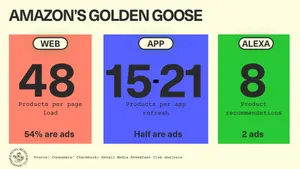

A version of this article was first published to my column at The Drum on August 11, titled 'Why brands with nothing to sell on Amazon are targeting me there'
Which demographic would you place someone in who has been targeted with ads from a retirement community, medical alert bracelets, and banking services?
It’s me, fam. A 39 year old woman, who recently looked up the address of a relative in a retirement community, a medical condition not related to age, who’s saving for the future.
This was just one of the surprising things I found when I learned that any consumer can request to download all the advertising data that Amazon has about them.
While the amount of money I've spent on Amazon over the past 15 years was shocking, the ad targeting data I leafed through was pretty humdrum. My "AdvertiserClicks" file ran to roughly 438 ads, and it was all my usual categories: coffee, camping, activewear. No real surprises there.
But the other file, “AdvertiserAudiences”, got my attention. Pfizer. GEICO. Emirates Airlines. Chase. McDonald's. Westpac, which is an Australian bank. None of these companies sell anything on Amazon. All of them were holding me in advertising audiences — and the file was nearly the same size as the clicks file, just under 400 companies in total.
Until recently I lived in the US, but I holidayed in Europe and moved back to Australia just a few weeks ago, so Amazon has me split across three regional exports. The European one contains a single recorded ad click. It also contains 92 advertiser audiences, all presumably developed during the two days I shopped on Amazon's France marketplace, looking for a gift for an Airbnb host.
This isn't a privacy complaint. Advertising pays for a lot of what I use and I'd rather it were relevant. (I wrote about that here.)
But seeing this list of company names in my own file sent me looking for how far along non-endemic advertising really is.
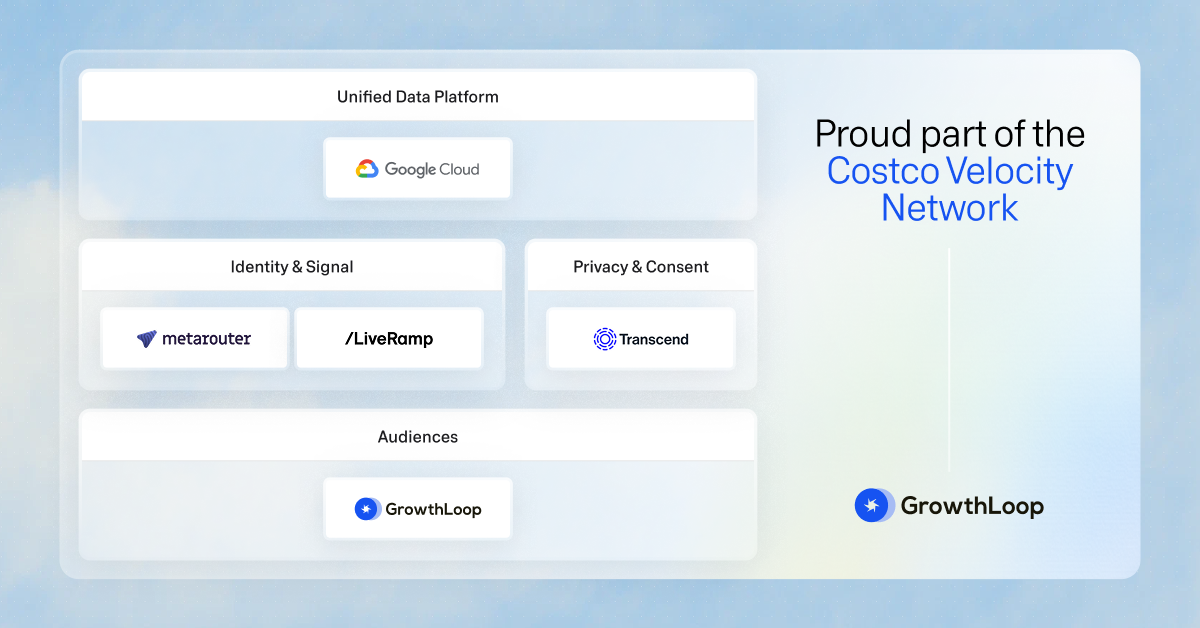
Costco isn’t scaling its RMN with legacy adtech and manual solutions. It’s leaning into a cloud-centric, composable stack.
As part of the Costco Velocity Network, GrowthLoop empowers the retail media team to build audiences directly from the data cloud, enabling faster activation, greater relevance, and better performance — all while maintaining privacy and governance standards.
The result? Exceptional value and experience for Costco members and better ROI for brand advertisers.
Learn why the GrowthLoop Composable Commerce Media solution was the right choice for Costco’s Velocity Network.
Why are non-endemic brands choosing retail media?
Non-endemic has been building as a retail media story for a while.
Amazon does not publish a breakdown of its split between endemic and non-endemic ad revenue. But across the broader ecosystem, US offsite retail media ad spending will reach $17.05 billion in 2026, up 29.5% YoY, EMARKETER forecasts.
Why? EMARKETER senior analyst Sarah Marzano says: "Retailers who have more mature, developed retail media networks are recognizing that they might be reaching a level of saturation among their endemic brands."
The response has been to go and find advertisers who were never going to sell through the retailer in the first place. A very short and non-exhaustive sample of where that has got to so far:
- Earlier this year, Home Depot's Orange Apron Media put more than 20 first-party audiences into a beta with Pinterest Media Network Connect — its third off-site activation environment after The Trade Desk and Yahoo, and the first social platform where brands it doesn't stock can target its shoppers.
- Dick's Sporting Goods reads life stage off GameChanger, its youth sports app — a family's team registration moving from Seattle to Chicago implies a house, an insurance policy and a college fund — and general manager David Young told me in June the business is in "very real and substantive conversations" with financial services partners.
- Last year, Kroger Precision Marketing ran Chevrolet's Equinox EV launch through Yahoo DSP on grocery-basket signals rather than automotive intent.
While attracting non-endemic advertisers is undoubtedly appealing for RMNs, it's likely a pursuit that only the most sophisticated networks can handle. The IAB's "Building a More Competitive Commerce Media Ecosystem" whitepaper, which defines six sustainable business models for the future, suggests that attracting non-endemics is only available to RMNs who are willing to scale through significant investment. This business model is the best fit for networks with "marketplace models, massive first-party data, patience, and the willingness to invest $100M+ over multiple years."
Why now
Ross Walker, director of retail media at Acadia, argues the trigger wasn't the product getting better. "The 'Amazon DSP for non-endemic brands' story has existed for years," he wrote last month, "but it remained mostly a conference-panel talking point rather than a widespread budget shift." A few things recently changed, by his reading:
- Consumer data has become harder to access everywhere else. As cookies went and attribution fragmented, what advertisers buy from Amazon stopped resembling a retail audience and started resembling "one of the world's largest commercially observable consumer-behavior graphs."
- Amazon DSP expanded its reach and efficiency through new Open Internet integrations, particularly across connected TV. This makes it a "one stop shop" for big media budgets rather than a niche buy.
- Better measurement capabilities. Non-endemics can match their own audience data against Amazon's exposure and behavioral signals in Amazon Marketing Cloud, with a recent improvement being able to look back over five years.
This is all a decidedly different proposition from the one retail media was pitched on. Proximity was the argument: advertising bought close to the transaction and measured against it, which is what justified the premium and the budget shift. A non-endemic advertiser has no transaction on the retailer's platform to be close to.
And they might even be less price-sensitive than a consumer-goods brand who's always hunting for the best performing ad unit.
Dr Koen Pauwels is a professor at Northeastern University and was previously a senior ad scientist at Amazon. Writing in his newsletter in June 2025, he offered this take:
"Marketers of high-margin products are willing to pay a lot for ads that don't immediately convert, as they help the consumer along the purchase journey. This was my experience with non-endemic ads at Amazon, for e.g. high-margin vehicles and hospitality services."
In conclusion
This is one person's file over seven weeks, not a dataset. But it is specific. Amazon logged 42 conversion events on me between 19 June and 5 August this year — fires from tags sitting on other companies' websites, not on Amazon. Emirates appeared 18 times. Then Westpac, Citi, finder.com.au, T-Mobile, Marriott, Disney+ and two DTC brands.
The big appeal of retail media is the ultimate closed loop, its proximity to the purchase. And for endemic brands, that's still the killer feature. But as that segment becomes saturated, future growth is coming from advertisers with no shelf presence at all.