"That's cute," I thought when I first saw Sponsored Prompts.
That was Amazon Unboxed last October, where they were announced as a way to nudge shoppers into longer conversations with Alexa for Shopping and monetize the exchange along the way.
They seemed like a fairly simple way for Amazon to both flex the usage of Alexa Shopping and goad shoppers into longer conversations by asking follow-up questions. And, bonus! A seemingly low-lift way to monetize those conversations.
Boy, did I under-estimate the new version of little blue links. Maybe not in terms of immediate ad revenue, but more in terms of how they disrupt what it means to be an ad.
Last week, Andrew Bell just did a massive deep dive into the patent behind Sponsored Prompts which changed my thinking. (Disclosure: Bell is VP of Research at ReFiBuy, a company I advise.)
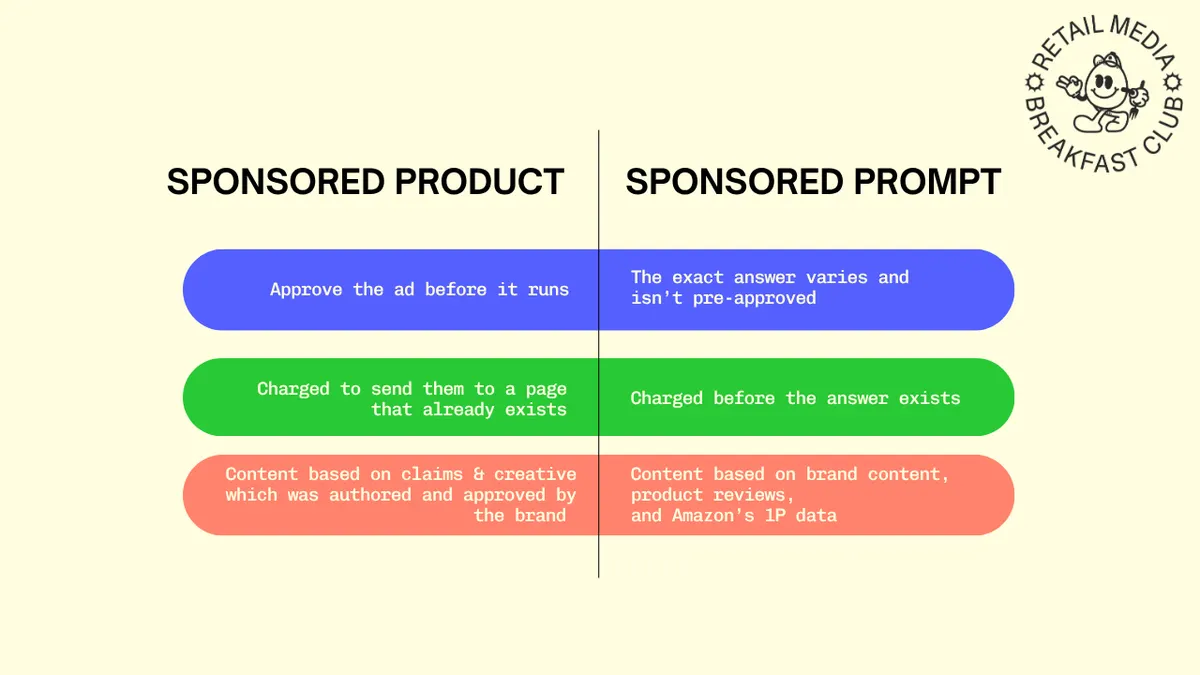
The big reveal is that with a Sponsored Prompt, you are billed for an ad before the ad exists. And that has big implications for brand-side advertisers.
This is part 1 in a 2-part deep-dive series on Amazon Sponsored Prompts. You can read Part 2 here.
You're paying for creative you haven't seen
Here's how a normal sponsored click works: A brand bids, wins, and pays to send a shopper to a page the brand built — a product detail page, a Brand Store.
The brand, or their agency, wrote the copy, got it approved, and knew exactly what the shopper is would see when they arrive.
A Sponsored Prompt inverts that order. The shopper taps a question, the tap gets billed, and then Amazon retrieves evidence and writes the answer — assembled from your detail pages, Brand Store and campaign data, alongside product reviews and other Amazon first-party signals."That raises all kinds of questions about product claims, brand positioning, and understanding which points are resonating with customers.
Are manual processes slowing down your RMN momentum?
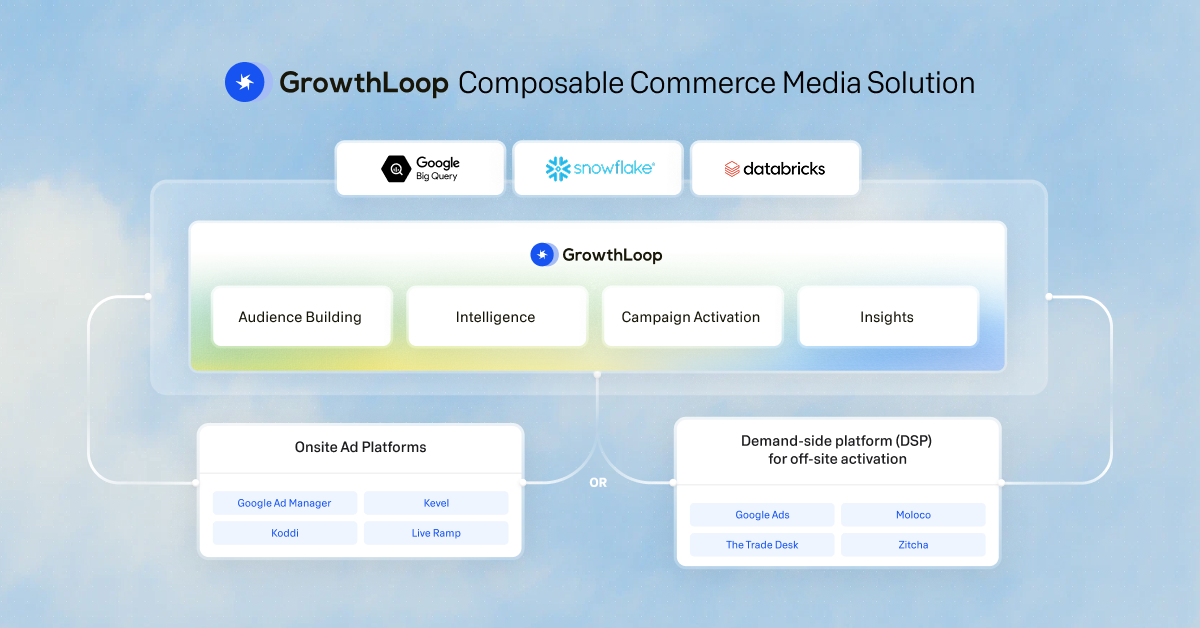
With GrowthLoop’s composable commerce media solution, retail media and ad teams can build and launch precise audiences in minutes, activate across DSPs and ad platforms, and deliver transparent ROI reporting that drives advertiser revenue.
Learn how retail media leaders at Costco, Fanatics, and Gopuff use GrowthLoop to deliver stronger results for their brand partners.
The precedent for dynamic ads
Importantly, the advertiser is billed before any of this content is assembled. Nobody's worked this way before, at least not exactly.
Google has Responsive Search Ads, Dynamic Search Ads, Performance Max — Google has been assembling ad copy on the fly for years. DSA in particular even generates the headline dynamically from the page content and the query. There are two key differences this time.
- The sequence.
In Google's dynamic formats, the ad — headline, description, the whole unit — is assembled before it's shown to you. You see a complete ad, then you decide whether to click, and the click is what bills.
What the patent describes for Sponsored Prompts is the click landing on a question, the click getting billed, and then Amazon going to retrieve evidence and generate the answer. The persuasive content is built after the money changes hands. Google assembles-then-charges. This is charge-then-assembles.
- Who supplies the raw material.
With Google's dynamic copy, it's your stuff being recombined — your headlines, your descriptions, your landing page, assets you wrote and can approve.
In the sponsored prompts system, the answer is built from a wider pool: your detail pages and Brand Store, which you author, plus your review corpus and other Amazon first-party signals, which you don't. So it isn't only your copy being dynamically arranged. Part of the argument is assembled from material you didn't write and can't fully control.
The challenges this creates
Here's the potential challenges to advertisers:
1. Liability for claims you never approved. This is the big one. In every prior format, you could control, or at least see, at the creative before it ran. This manifests as legal and brand risk.
2. The spend shifts from "buying attention" to "controlling what gets said." You're not really buying a placement; you're paying for Amazon to make an argument, and you can't control all the the source material that Amazon is pulling from. Advertising no longer looks like optimizing a bidding strategy, it becomes an operational cost of trying to goose the source material (which may not be possible – but you can bet your tail that scrappy brands with nothing to lose are going to try).
Amazon Ads makes a distinction worth noting: only the prompt question itself is the paid unit. The conversation that follows is, in Amazon's framing, organic Alexa for Shopping content generated from information available on Amazon about the product, and it passes through content moderation. That doesn't change the billing sequence — the click is charged before the answer exists — but it does mean Amazon doesn't treat the answer as advertising creative at all.
Is this form factor actually the enduring one?
This is the big question that rides above all of this, which dictates how seriously brands need to consider where and how they invest and organize themselves.
We are in the early days of ads in AI. For now, they kinda mostly look like the ad units we have lived with for the past 10 years: sponsored product ads, banner ads, video ads, etc.
Sponsored Prompts is the first genuinely new shape we've seen in a while. Whether it's the enduring shape, or just the first draft of one, is an unknown.
Walmart launched sponsored prompts in Sparky a few months back, suggesting the format could become more wide-spread.
But the expansion of this format has overall been quite relaxed, which is its own kind of signal.
In Part 2 of this deep-dive: if the billing sequence is the mechanism, the consequence is that money and labor get reallocated across the whole ad operation — and reviews, of all things, become the most disrupted asset nobody budgeted for.
You can read Andrew Bell's full patent breakdown here.
Correction, September 2,2026: This post originally described the answer generated after a Sponsored Prompt click as assembled "from product reviews and Amazon's first-party signals," and the underlying material as "source material you don't own." That was incomplete: Amazon Ads names a brand's own product detail pages, Brand Store content and campaign data among the inputs, alongside other first-party signals, so part of the source material is brand-authored and part isn't. The relevant passages have been updated, and Amazon's position that only the prompt question is the paid ad unit has been added. The argument of the piece is unchanged.