
This week, OpenAI hired Dave Dugan — formerly VP of global clients and agencies at Meta — as its VP of global ad solutions. If you've spent any time in digital advertising, you know what that kind of hire signals. You don't recruit someone who managed Meta's biggest advertiser relationships to run a small experiment. You recruit them when the testing phase is over and the build phase has begun.
Debra Aho Williamson, who covers AI advertising through her newsletter The AI Ad Economy, framed the hire as a signal that brands and retailers need to take seriously. Having spent 17 years analyzing Meta's ad business at eMarketer, she sees a familiar pattern forming: a massive consumer platform transitioning from experiment to commercial ad infrastructure. "We're at the beginning of an enormous new shift in advertising," she wrote on LinkedIn. "The birth of AI media." For anyone selling products through retail channels, the question is no longer if AI Assistants become an ad surface — it's whether you're ready when they do.
When OpenAI first started testing ads, there was a wave of skepticism. Justified skepticism, honestly — the whole value proposition of an LLM is that the answer isn't bought. That was the premise of a whole Super Bowl ad campaign that competitor Anthropic ran this year. But none of these platforms can run forever without a monetization layer, and advertising is an obvious candidate.
Ads in ChatGPT are still nascent, and it's still early days to see whether users still trust the answers, and what this means for the retailers and brands who are trying to figure out how to show up in these new surfaces.
For the final installment of this expert series, I'm back with Amelia Van Camp, Head of Agentic Commerce at Mirakl [who is sponsoring this series], to unpack what agentic advertising actually looks like — and what retailers and brands should be doing now, before the formats are settled.
Here's our conversation, edited for clarity.
SPONSOR: MIRAKL ADS
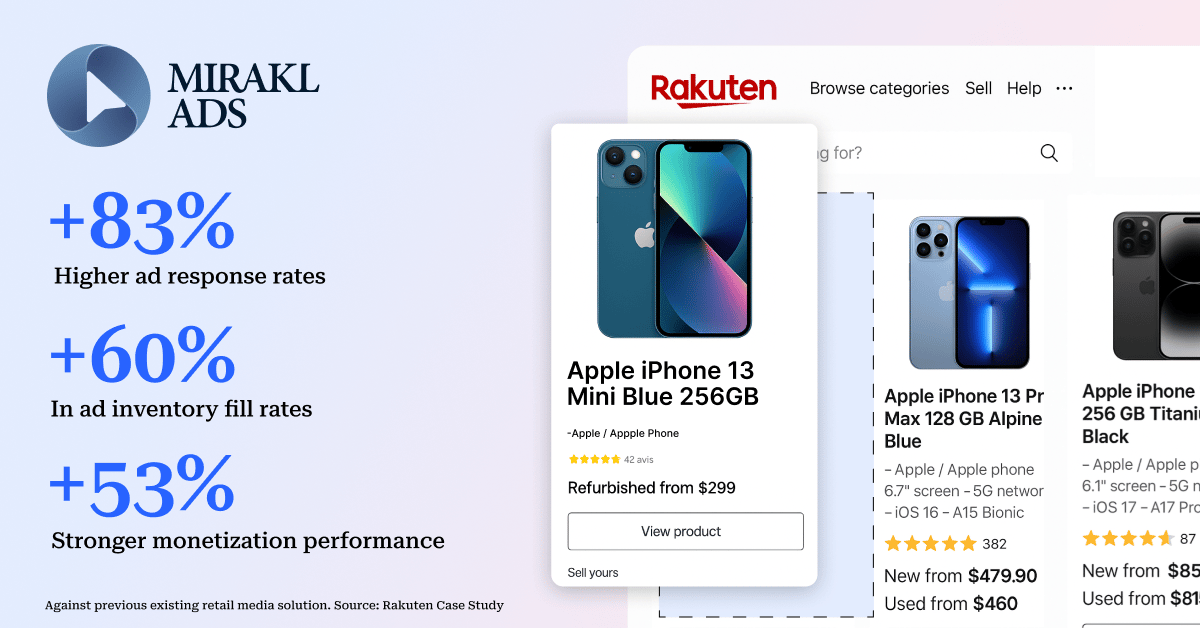
Retailers know that a marketplace model can dramatically boost product assortment, shopper engagement, and total revenue.
But, to get the most out of your marketplace, you need an ad tech solution that can really engage sellers.
Mirakl Ads is powering the future of retail media for leading retailers — to activate both 3P sellers and 1P brands.
Kiri: You mentioned that when other LLMs publicly mocked OpenAI for testing ads, it made you laugh. Why?
Amelia: Because what OpenAI is doing is very intelligent and also not particularly surprising. These are corporations with a monetization strategy behind every avenue they pursue. Advertising is a valuable one. And given how shopping has always worked — both in-store and online — it shouldn't shock anyone that we're starting to see ads show up inside an LLM experience.
I think what OpenAI has done well is set the precedent early: they're not letting ads impact the answer itself. The sponsored placement sits at the bottom of the conversation, separate from the result. That means it's not diluting the trust users have in the LLM. You still believe the answer is real — but there's also a sponsor placement below it.
Kiri: Is there a risk that those ads won't be relevant enough to the conversation the user is having?
Amelia: It's a possibility, but I don't think the LLMs would ignore it. The way they approach everything is relevancy on steroids — relevancy to you as a user, relevancy to the conversation you're having, the context you're providing. I'd expect the same standard inside of advertising. Where it gets interesting is the onus doesn't just sit with the LLM. It also goes back to the advertiser. Who's placing the bid for that sponsored placement? Can they meet that relevancy bar? And if so, how?
This is where some of the concepts we've talked about earlier in this series — GEO, AEO, intent-based attributes — come back into play. If you can bring that level of contextual richness into the advertising space, my hope is that the LLMs will embrace it, because it creates a better experience for everyone: for the platform, for the advertiser, and for the user.
Kiri: So the same product data strategy that helps you get recommended organically also positions you to advertise effectively inside these platforms?
Amelia: Exactly. And I think that's the key insight. It's not piecemeal — this is one thing we do for ads, this is another thing we do for our conversational commerce agent, this is a separate thing for search and discovery. It starts to bring a unified strategy across all of those arenas. Relevancy on steroids isn't just a concept for organic results. It's the standard that advertising on LLMs will have to meet.
Kiri: What practical steps should retailers be taking right now to get ready?
Amelia: First and foremost: data rich wins the race. It always has. That's not a new concept — but it still applies, and it's all connected to trust. How can you make sure LLMs trust you so they populate your products back into the conversation? And how do you ensure that the customer who converts keeps coming back, whether that's on your site or through the LLM?
Start by cutting your data into two layers. The first is your core data set — accurate pricing, stock status, product descriptions, ratings, shipping info. That's been a standard requirement in e-commerce for years. Assess how robust it really is. Are there pricing anomalies? Gaps in the catalog? Get honest about where you stand. Then layer on the metadata that includes intent-based attributes — the contextual, conversational information that helps your products surface in agentic environments. And when you're evaluating vendors in that space, make sure what they're showing you is real. Do they support multiple LLMs? Multiple models? Is it asynchronous? Make sure A plus B actually equals C, so you don't end up with one side of your data that's strong and another that's weak.
Kiri: You describe what Mirakl is building as an orchestration layer. Can you explain what that means in practice?
Amelia: Our history is in multi-merchant order orchestration — managing multiple sets of information handled by different parties. That backbone carries into how we think about agentic commerce. The idea is that you have an environment where core e-commerce capabilities, discoverability, ranking, agentic channel connection — all of that lives inside a single orchestration layer. You can see the full flow, transact the whole way through, and ensure that from end to end you're covered, not just on data but on the process and system that enables you to meet the customer wherever they are, whether it's on an LLM or on your marketplace.
Kiri: Let's talk about brands — specifically CPG brands that sell almost entirely through retailers. How powerless are they in this equation?
Amelia: They're not powerless at all. I actually think they've been given an amplification — a bit of a loudspeaker — inside of agentic commerce. A brand has a standalone reputation that's separate from the retailers it sells through. And that reputation is something the AI agent considers when deciding which products to surface. So it creates an onus for brands to think about how they present themselves to the digital world, full stop.
What does your subreddit conversation look like? What assets do you have on YouTube? What does your Wikipedia page say about you? These are data sources that agents scrape from, and they're outside the control of the retailer — but inside your hemisphere of control. If you're a brand that doesn't have a strong direct-to-consumer site, start thinking about how you can feed information both through the retailer and on your own properties to optimize for your products showing up in the first place.
Kiri: So it's almost a new kind of brand PR?
Amelia: In a way, yes. And the themes are the same ones we've been talking about all series: consistency, data richness, data integrity. Those are your responsibility as a brand. But you can also be asking your retail partners the right questions. Have you done a front-end health assessment to make sure your site is readable to agents? What's your agentic commerce strategy? Have you launched a shopping agent, and if so, how is it determining which products to surface? Work with the organizations you're distributing through to understand their strategy and how you can support it. And again — intent-based attributes. I'll say it until the end of time. This is a key concept not just for retailers, but for brands. It's about how your products surface inside a conversation.
Now What
After four episodes of digging into agentic commerce with Amelia, I am on board with the idea that the advertising layer inside AI Assistants is going to demand the same contextual richness that organic recommendations already require. That's actually a useful simplification: that the retailers and brands who have invested in strong product data and intent-based attributes aren't only optimizing for one channel. They're building the foundation that works across organic results, sponsored placements, and whatever ad formats emerge next.
For brands, especially those that sell primarily through retail partners, this is a moment to take more ownership of how you show up across the surfaces that agents actually scrape — Reddit, YouTube, Wikipedia, your own site. That's not a new idea, but the stakes are higher when the recommendation engine is an LLM that treats every data source as signal.
And for retailers: the question isn't whether to participate in agentic advertising. It's whether your data — and your systems — are ready for a world where relevancy is the price of entry.
Previously in this series, presented by Mirakl Ads: