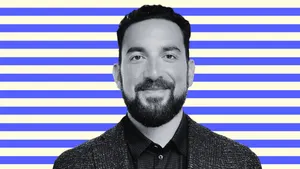
When I sat down with Harvey Ma at Cannes this week, the hotel suite was aggressively air-conditioned, a thrilling contrast to the sky-high temps outside. The climate control meant that Harvey was able to keep on his customary patterned blazer rather than the linen most others are wearing, sweating up and down the Croisette.
But there were a few things Harvey was at pains to clear up, following the announcement that Walmart is pulling its whole global advertising business closer together, including Sam's Club.
I've been following Sam's Club's retail media story for about two years now. I profiled Harvey Ma for Forbes back in early 2025 — the mechanical engineer who texted his boss after his first digital marketing meeting to say he might be in the wrong job. He shared how he takes Walmart's technology for a test drive and re-spec it for the club environment. I wrote about racetracks and carpark activations as "experiential meets performance" bet.
The party line was that Sam's Club as a member-centric retailer was doing it their way.
So when I sat down with Harvey at Cannes this week — days after that announcement, I went in curious about how the maverick story survives contact with the mothership.
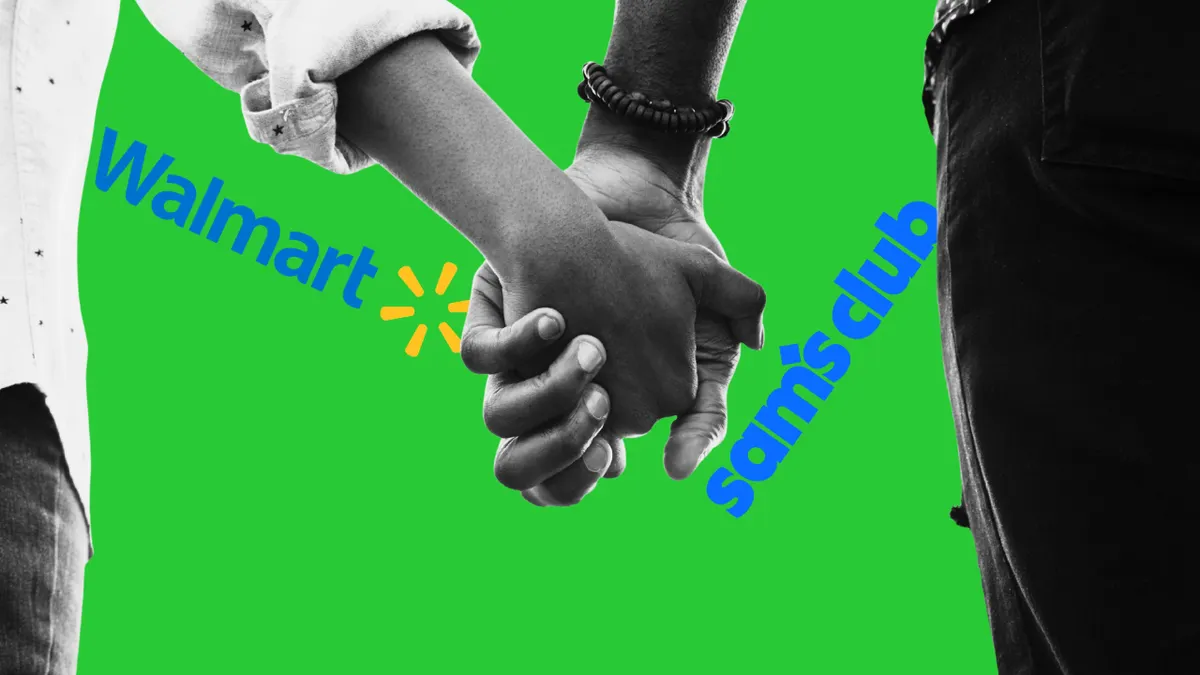
A quick recap of what was announced. On June 22, at Cannes, Walmart set out a new vision for its global advertising business — Walmart Connect U.S., Walmart Connect International, and Sam's Club, all pulled into closer alignment under Seth Dallaire, chief growth officer of Walmart Inc. Shared technology, shared tools, shared platforms. And the headline change for the club: Sam's Club MAP — the Member Access Platform — is now Sam's Club Connect, a name that pulls it under the Walmart Connect umbrella. The official framing is careful: the three networks "will operate separately to serve the unique needs of their markets" while being "increasingly aligned." (Walmart's announcement is here.)
That phrase — operate separately, increasingly aligned — is the whole thing. It's also where the tension lives.
The alignment that already runs deep
Here's the part that's easy to miss in a rebrand announcement: the two banners have been sharing some infrastructure for a while. Sam's Club already shares some of Walmart's tech — borrowing the capability, then adapting it for a club environment that isn't nearly as SKU-intensive as mass. The "keys to the car" arrangement predates the rebrand by years.
What might be new is the direction of travel. It's no longer just Sam's Club borrowing from the parent. Harvey described value moving both ways:
"The measurement suite that we have is obviously incredibly robust, because we have the luxury of being one-to-one member deterministic and longitudinal. Everyone walking into this store has to scan in. So that same methodology can be applied to a Walmart business, just done slightly differently. There is goodness to be shared on how we predict, how we model behavior over the course of time."
And in the other direction — the experiential muscle Sam's Club has been building goes back to Walmart:
"There's also a layer of experience which we can bring back to Walmart. So demos and samples, for example, are a bread-and-butter staple of Sam's Club, or any warehouse model. But that shouldn't be only limited to warehouse. In core retail, experience is just as important. We just happen to have been focused on it with the retail media lens for the past two years."
So far, so synergistic. On the plumbing — the measurement methods, the modeling, the experiential know-how — pulling the banners together makes obvious sense. Build once, share across. Harvey's own word for the upside was efficiency:
"Synergies, I think, are the keyword. And then combining efficiencies, technology, and talent are natural byproducts of that."
That's the business case: two networks under one roof, no longer rebuilding the same tooling separately and trying to Frankenstein it together later.
The part that doesn't merge
Then I asked about the customer overlap — because if the advertiser pitch is connectivity across the two banners, the obvious question is how much the audiences actually have in common. You'd extend a campaign across Walmart and Sam's Club to reach the same people more often, or to reach more people. Either way, you need to know how much the two shopper bases overlap.
Harvey's answer surprised me:
"We don't publicly disclose that number, but what I can tell you is that the demographic that shops mass and the demographic that shops warehouse — the overlap is potentially smaller than you might think. The reason for that is all of the information you'd traditionally think of for a warehouse shopper: think household income, think location. I'll use an example. Many of our warehouses — if you live in the inner city, you are not likely going to haul a 48-pack of water back home on the L [train]. But in the suburbs, you would. In our urban, dense areas for mass, that's an incredibly rich business with customers. So while there is certainly overlap, you might be surprised that it's potentially less than you think, because the behavior is different."
This was interesting to hear. The pitch for pulling the banners together leans on scale and connectivity — reach customers and members wherever they shop. But the mass shopper and the warehouse member are substantially different people, shopping differently, for structural reasons that aren't going away. The 48-pack of water doesn't fit on the L train in Brooklyn. That's not a data gap you can close with a shared tech stack.
Retailers know that a marketplace model can dramatically boost product assortment, shopper engagement, and total revenue. But, to get the most out of your marketplace, you need an ad tech solution that can really engage sellers. Mirakl Ads is powering the future of retail media for leading retailers — to activate both 3P sellers and 1P brands.
And Harvey was insistent that the differences are the point, not a problem to be smoothed over. When I asked what people don't understand well enough about the announcement, this is where he went:
"The biggest one is, this was not done because we are absorbing teams, countries, segments, to become one blob of ads ecosystem. We will still maintain the individuality and represent the preferences that each country, each channel, and each team should be focused on… The combination of a global ad ecosystem does not mean that my new focus is now only going to be on maximizing search. That individual nature of a club that makes it so special to our members, and the individual nature of international that makes it so special across countries — that DNA will remain, even though we are now united under one family."
While the infrastructure should converge — shared measurement, shared modeling, shared experiential playbooks, lower transaction cost for advertisers. And the things that make each banner worth advertising on separately — the distinct shopper, the distinct behavior, the distinct member relationship — have to stay distinct, or the whole proposition flattens into the "one blob" Harvey is at pains to say this isn't.
1 + 1 isn't automatically 5
We talk about retail media consolidation as one path through the commerce media squeeze.
But the Sam's Club Connect rebrand is a useful reminder that even for the biggest retailer in the United States, aligning with a single sibling banner — one it already owns, already shares some technology with, already sits beside under the same corporate growth org — isn't an immediate 1+1=5. The parts that consolidate well are the parts that were never the differentiator. The parts that are the differentiator resist consolidation by design — and the people running them know it, which is why Harvey kept drawing the line around them.
The annually-paid club membership still has to mean something different from a Walmart loyalty card. Otherwise, why have two?