A few weeks ago, Kroger Precision Marketing announced a partnership with Google that lets brands activate Kroger audiences inside YouTube and DV360, with measurement flowing back through a conversion API tied to Kroger sales. On the surface, it's a media story: another offsite channel, another way to close the loop on awareness spend.
But scratching below the surface, it's really a context engine — a system anchored in two decades of loyalty data that knows what shoppers actually buy across both digital and physical aisles — and it's the piece of the stack that Google can't build itself.
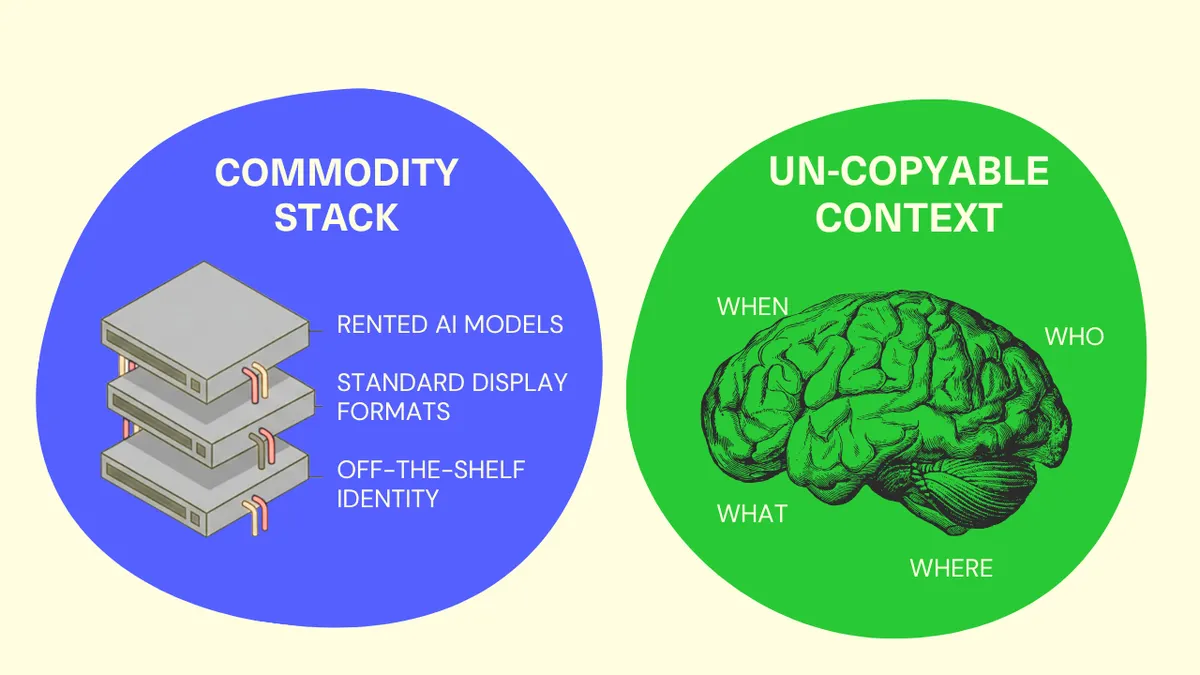
That's the under-discussed shift happening in commerce media right now. There's a lot of capabilities out there that are starting to look the same. But what retailers uniquely own, and what the more sophisticated ones are building around, is context:
- Who the shopper actually is, stitched across devices, channels, and household members
- What they actually buy — not what they click on, not what they add to cart, but what shows up in the receipt
- Where they buy it — online, in store, click-and-collect, all of it tied back to the same person
- How that behavior changes over time — across years of purchases, not a single session
Models can be rented. Identity vendors can be rented. The relationship between a shopper and their transaction history, stitched together reliably over time — that has to live with the retailer.
Last week I sat down with Christine Foster, Group Vice President, Commercial Strategy & Operations at Kroger Precision Marketing, and Jon Flugstad, Chief Commercial Officer at MetaRouter — the data infrastructure partner powering the integration — to talk through what they actually built, and why it matters.
Christine, what makes the foundation underneath this Google integration hard to copy?
Christine: It's built on a shopper loyalty program that's existed for more than 20 years. 95% of all Kroger transactions are connected to that loyalty account. That means the data is verifiable, and there's a lot of behavioral inference that's really critical to marketers — about their audiences, who in a lot of cases are also our customers.
When you talk about being able to copy and paste this, most retailers can't, or don't have that level of confidence in their data sets. I'm not saying their data is bad. But for us, it gives us a lot more confidence in who we are, and why this was a good first step for even YouTube to take with us. And with 80-plus percent of US retail sales still happening in the store, that's a piece digital marketing has missed.
Jon, you've worked across a lot of media networks. What do retailers actually own that nobody else does — and where do most of them get in their own way trying to use it?
Jon: The retailer's biggest strength is they have context over what the shopper does and who they are that no one else has. Models will be out there in AI; there'll probably be commoditization of the various models. Context is unreplicable. It's the thing that the retailer owns that they're now orienting the architecture around, because it's the gold.
But the way retail media got built means a lot of retailers are dealing with this assemblage of components that don't speak to each other. You'd have one platform for onsite sponsored products, another for onsite display, different platforms for offsite activation, one identity partner for onboarding, another for household identification. So you end up doing reconciliation work just to make your data work, let alone make it work in really low latency for the type of sharing you want to use for targeting and outcome-based algorithms.
So even when the data is great, the plumbing has been holding it back.
Jon: That's a lot of what's changed. There are ways to build this where you accomplish similar outcomes but the foundation isn't as durable, and there are ways to build it that are. What I think was true in the case of KPM was they set out to design it in a way that gave them control.
We're deployed within their private cloud, so they have maximal control over data and what's used for any kind of matching. The signals are near real time, with flexibility over how they're routed — even down to brand-level accounts for self-serve. And it's representative of all sales, not just online. For a long period of time in retail media, optimization was around the online sales while in-store remained the lion's share of overall sales. Matching in-store sales in a way that lets you drive and measure outcomes is one of the design principles here.
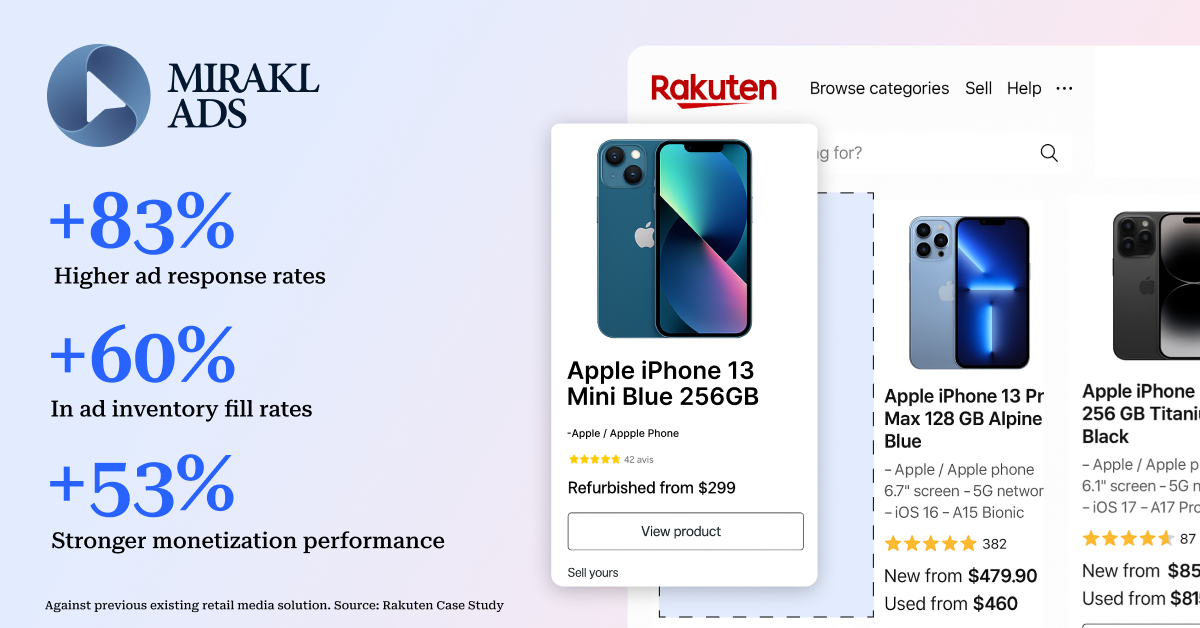
Did you know leading retailer media networks drive 85% of their ads revenue through mid- and long-tail advertisers?
Mirakl Ads provides full funnel ad formats tailored to both 1P and 3P advertisers, leveraging unique AI-capabilities that provide unprecedented levels of relevance and engagement.
Retailers who want to capture ad spend from the long tail of 3P marketplace sellers use Mirakl Ads in their tech stack.
Christine, does that match how you're thinking about it from inside KPM?
Christine: It does. As one of the viewers in the chat put it during the livestream, "architecture has to catch up with the data explosion." Things we've wanted to do haven't always been possible to do, and that's where we're at right now — catching up. It's part of why we're all so tired. But things like this are super exciting for that reason — you can see it happening in real time. We didn't start in managed service with Google. We can launch a partnership with Google straight out of the gate in a very self-service, real-time measurement opportunity for brands.
Jon, you've made the point that self-serve is becoming the default rather than the exception. How does that connect to the context layer we've been talking about?
Jon: I think we're fundamentally shifting from a world that was managed-service native to self-service native, with managed service as the exception going forward. Managed service made sense initially because the target for retail media networks was the top brands that drove the most sales — partners with preexisting merchant relationships, where IO-based conversations linked to JBPs.
But when you get beyond those brands, it doesn't pencil. The team you'd need to serve the medium and longer tail with that level of service, with manual sales motions, with managed-service campaigns where you're doing all the ad ops and planning and buying and measurement — it just doesn't pencil operationally. There's also self-serve and self-serve. There's self-serve in an owned portal — which still has a learning curve for buyers — and there's self-serve in accounts where buyers are already buying. KPM went straight to the second one, which is a powerful move.
Now What
For a while, retail media networks have been converging on the same playbook: similar onsite formats, similar offsite extensions, similar measurement promises. The differentiation between RMNs has been getting harder to articulate. What conversations like this one make clear is that the real differentiation isn't in the formats or the channels. It's in the depth and architectural accessibility of the context layer underneath.
That work is unglamorous. It's loyalty programs that took twenty years to build connection rates worth bragging about. It's untangling the seven different ad servers and identity partners that Roi Iglesias, watching the livestream, summed up in the chat: "another platform is always the answer I see in most retail tables." It's the kind of architectural debt that, as Kara Pierce put it in the chat, requires a full history lesson every time someone new asks why things are done a certain way.
Identity will commoditize. What retailers uniquely own is context — what the shopper does and who they are, stitched across online and in-store, anchored in 20 years of loyalty data. Everything else (architecture, ad servers, partners) is debt being paid down so that context can actually flow.
Thanks to Metarouter who sponsored this event. Watch the full conversation on the LinkedIn livestream here.