

I wrote this week in my column for The Drum about the two big themes from Home Depot's third annual Infronts event: merchant alignment and the push toward self-service. Those are notable and the progress that Orange Apron Media [OAM] has made toward these goals is notable.
But there's something else.
It's all the ways that OAM is leaning into things that other retailers cannot do.
The Pro customer is a media product
Nearly every speaker at the Infronts hammered the pro customer. Pros represent half of Home Depot's sales. OAM has built hundreds of pro audience segments and a localization capability that lets suppliers target by regional building codes and trade specialties — an electrician in South Florida has different product needs than a general contractor in the Pacific Northwest, and OAM can now segment accordingly.
The pro customer isn't a segment Home Depot is trying to acquire. It's a segment they already own at a depth no competitor can match. OAM is treating that depth as a media product rather than just an audience to reach.
Stores are the moat
OAM announced it would scale in-store digital screens to 1,400 stores by mid-year — its largest deployment to date. But the headline number understates the layered media estate Home Depot has been assembling incrementally over several years. There are now paint screens, pro-focused screens, side caps, and — as of this rollout — screens positioned in view of the racetrack, the main walkway at the front of the store where shoppers can see every aisle's end cap. In-store audio runs across more than 7,000 locations.
Each format serves a different moment in the shopping journey.
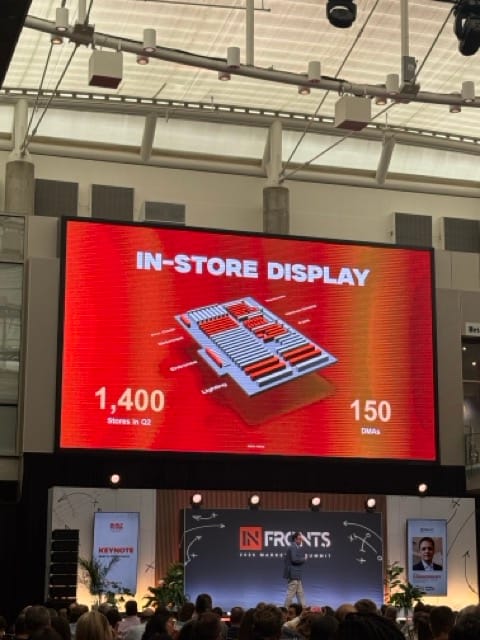
Jordan Broggi, executive vice president of online, shared an example that made this tangible. Paint has the lowest e-commerce conversion rate of any category on HomeDepot.com. By conventional digital metrics, it looks like a poor investment. But when Home Depot measures "enterprise conversion" — factoring in store purchases influenced by online research — paint is consistently the top-performing category.
For every dollar transacting on HomeDepot.com, another three dollars transact in-store influenced by the site.

Mirakl Ads is the ad-tech solution trusted by Rakuten and 50+ global enterprise retailers.
That’s because Mirakl Ads was built with both 3P marketplace sellers and 1P suppliers in mind. Both advertiser audiences demand a seamless advertising journey from onboarding to reporting.
You can offer everything from Sponsored Products to video all in one solution.
That kind of measurement reframes the entire value proposition of digital media investment at Home Depot — the return isn't just what happens on the website.
Connecting media to merchandising data
OAM's integration of its supplier analytics program into Orange Access may have been the most significant announcement of the day. The supplier analytics platform — built on a system called Fusion that's been around since 2016 — gives suppliers rich merchandising data: sell-through rates, category performance, competitive positioning. But it was a separate system, used by merchandising teams, disconnected from the media buying workflow.
Stephanie Cattonar, OAM's senior director of strategy, product and analytics, told me the disconnect became obvious during the proof of concept: some advertisers didn't even know they were subscribers to the analytics program. Those who did had to become experts in two different platforms and manually connect the dots between their ad campaigns and their sales outcomes.
Now that data flows into Orange Access alongside campaign reporting. An advertiser who just promoted seven SKUs can see how those SKUs performed at shelf without leaving the media platform.
This was the feature that Allison Fowler, director of media strategy at Rust-Oleum, told me she was most excited about. "We need to translate our retail media spend and KPIs to tangible sales results," she said. "At the end of the day, that's why we have these spends - to grow sales together in partnership."
The tech stack as differentiator
Cattonar described a hybrid approach: partnering with Vantage, Pentaleap, and Kevel for core infrastructure while building other proprietary solutions in-house. Decisions are made module by module. "Some of these things are so intimate to the way that we run things here at the Home Depot," she told me, "it just makes sense to build it ourselves."
Quirks are a feature, not bug
Home Depot is a category specialist. It doesn't sell groceries, fashion, or general merchandise. Its customers come with high-intent projects, its catalog is curated rather than open, and its store associates have genuine product expertise. For years, that narrower positioning looked like a limitation in a retail media landscape where scale — measured in monthly active users and SKU count — was the primary selling point.
OAM is leaning into these characteristics are features, not bugs. The pro customer, the curated catalog, the 2,000+ stores, the project-based shopping journey — these are assets that can't be replicated by a marketplace with 20 million SKUs or a grocery chain optimizing for weekly replenishment.
Worth considering for every other retailer with a media network: what are you doubling down on? Every retailer has something distinctive – those who figure out their own version of "feature, not bug" have a path forward.
As Allison Fowler of Rust-Oleum told me: OAM operates differently than many retail media networks. "I think they doubled down on what sets them apart."
Read my write-up of the OAM announcements in The Drum, and check out my other profiles of RMNs.