A version of this article first ran in my column for The Drum as 'Chewy’s ad boss thinks the data hoarders have it backwards'. It is reproduced here with permission.
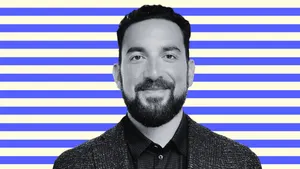
Frank Mulcahy is a Boston guy, and in the world he came up in, that meant defining yourself against New York.
He spent the early 2000s running sales offices in a market that always felt like the smaller sibling to the one down the Acela line — the bigger, louder city whose reps would come up for every industry mixer and try to mug the local agency heads for their time. The Boston response, he tells me, was a posture: we'll do this our way, on the strength of relationships, with a slight chip on the shoulder. He hears an echo of it in retail media today. One company sets the terms for everyone else — the 900-pound gorilla whose playbook the rest of the industry can either copy or quietly resent — and the interesting players are the ones deciding to build something of their own instead.
Mulcahy is the Head of Chewy Ads, the pet retailer's media network, and he is firmly in the build-our-own-way camp. And just like the face-off between Boston and New York, he has strong views about the right way to do retail media.
A POV from the other side of the table
Mulcahy spent nearly two decades in digital ad sales — Lycos, Yahoo, Microsoft, a stretch standing up Apple's iAd business in New England — before he crossed into retail at Wayfair in 2016, where he was recruited to build a retail media network from scratch.
After Wayfair,he spent a stretch at Microsoft's PromoteIQ — selling retail media technology to other networks — before landing at Chewy in 2022. That seat, talking to the top RMNs from the vendor side of the table, is where his core conviction hardened. It was "clear as day," he says, "who got it and who didn't."
What separated them, in his telling, wasn't budget or scale. It was where people came from. Leaders who came up through advertising understood data sharing and transparency as the water the industry swims in. The ones who came up through retail often didn't — and that, he argues, is why so many networks still treat first-party data like something to be held under lock and key.

The rules of retail media are being rewritten. Discovery is shifting. The economics are following. And the retailers and brands defining the next era aren't watching it happen from the sidelines.
Meet the Mirakl team at Cannes Lions, June 22–26, for curated conversations, exclusive events, and 1:1 strategy sessions built for where the industry is headed.
Commerce-first media starts in Cannes.
Is retail media ‘retail’ first, or ‘media’ first?
There are two camps and both sides have a case.
One camp holds that retail media is retail first. The media business and the retail business are inseparable, and the media has no value without the retail strength underneath it — the assortment, the membership, the customer relationship, the reason anyone shows up. Mark Williamson, who runs retail media at Costco, said in a recent Drum interview: "Costco existed before retail media and it would still exist without retail media." Retail media, in his framing, should "accelerate the flywheel that already works." Asked what he's building, his answer was the opposite of empire: "We're not trying to build a media business. We're trying to make the membership more valuable."
Mulcahy's stated ambition is almost a direct rebuttal. He wants Chewy to be "the biggest and most effective pet media company" — not a retailer with an ad business bolted on, but a media business that happens to be borne from a retailer's data. In this view, a network should behave like a media company: share data, adopt standards, treat advertisers as partners rather than captive spenders. His favorite framing of why this is the right read he credits to Brian Monahan, the Albertsons Media Collective leader I profiled last year: retail media is the first time in advertising history that the publisher and the advertiser actually want the same thing.
In television you’re trying to optimize for Gross Rating Points, which measure the total volume of an advertising campaign’s delivery; in social you chase more clicks to feed the algorithm. In retail media, Mulcahy says, the retailer and the advertiser both want to sell more widgets. If the goals are genuinely aligned, hoarding data from the people you're aligned with is self-defeating — and, to him, mostly a tell that someone came up in retail and never internalized how digital advertising actually evolved.
It's worth being precise about who the hoarders actually are, because Williamson isn't one of them. A member-first network that's transparent about being member-first is making a coherent choice about their value proposition, rather than guarding a vault.
The instinct Mulcahy is criticizing is something else, and in conversations across retailers and the solution providers serving them, I hear its real motive: Give an advertiser genuine transparency and they might not like what they find. The incrementality numbers might not flatter. Worse, a brand that truly understands what it's getting from one network can use that knowledge to negotiate harder with every other one, or move the money somewhere it performs better. Opacity protects the retailer from being measured honestly by the people paying. Which is exactly what Mulcahy is needling when he says "the lack of data assumes bad data" — if you were sure your numbers were good, you'd show them.
Mulcahy says that everything happening in retail media now — consolidation, talks of federations, fights over data — happened 15 years ago in digital advertising. "Websites beget portals, beget ad networks, beget programmatic," he says. Retail is running the same sequence, just skipping the ad-network step and jumping straight to programmatic-style buying. He reaches back further, to paid search, which the creative "black shirt" crowd once dismissed as lower-funnel heresy before it became the backbone of integrated campaigns. The implication: the data-protective instinct will look just as dated in hindsight.
Both philosophies have merit, and the divide explains a lot of otherwise puzzling behavior — why networks make different calls on data access, self-serve, and whether they position themselves as "media companies" at all.
The barbell
Mulcahy's data convictions take concrete form in what he calls a barbell strategy, and in the suite Chewy launched at Global Pet Expo in March: three products — Chewy Max, an objective-based AI buying tool; Chewy Marketing Cloud, a pair of data clean rooms; and native incrementality measurement, including iROAS.
One end of the barbell serves the time-poor — the thousands of smaller brands and DTC sellers who, as Mulcahy puts it, face a "paradox of choice" trying to manage campaigns across 25-plus networks and simply can't. For them, Chewy Max takes a budget, products, and a target return, and handles bids, placements, and products across onsite and offsite inventory. The pitch is "here's my goal, go get it."
The other end serves the dozen-odd large multinational CPGs with their own analysts and their own measurement tools, which they'll use no matter what a retailer hands them. For them, Chewy Marketing Cloud offers clean rooms — one to match a brand's own CRM data against Chewy's first-party data for offsite activation, another for custom cross-channel measurement. "If I can just give you all the data you need to make intelligent business decisions, you'll thrive, we'll thrive," Mulcahy says. He's untroubled that sophisticated buyers bring their own stack — he expects it, and built Marketing Cloud to stop pretending otherwise: "I'm going to give you my numbers. You're not going to use them anyways. I know that. Here's all the cash." The protective instinct, in his view, comes from "a place of naivety as to how this industry has worked for 25, 30 years."
Chewy’s public statements say the network is delivering $8 in lifetime-value sales for every $1 invested, that one in two customers who engage with an ad are new to the brand, and that one in three ad clicks results in a sale.
Crucially, the automation is optional, which is a smart design choice. I recently ran a poll of 139 buy-side readers on objective-based, AI-driven buying — the "hand over the keys" pitch retailers keep making.
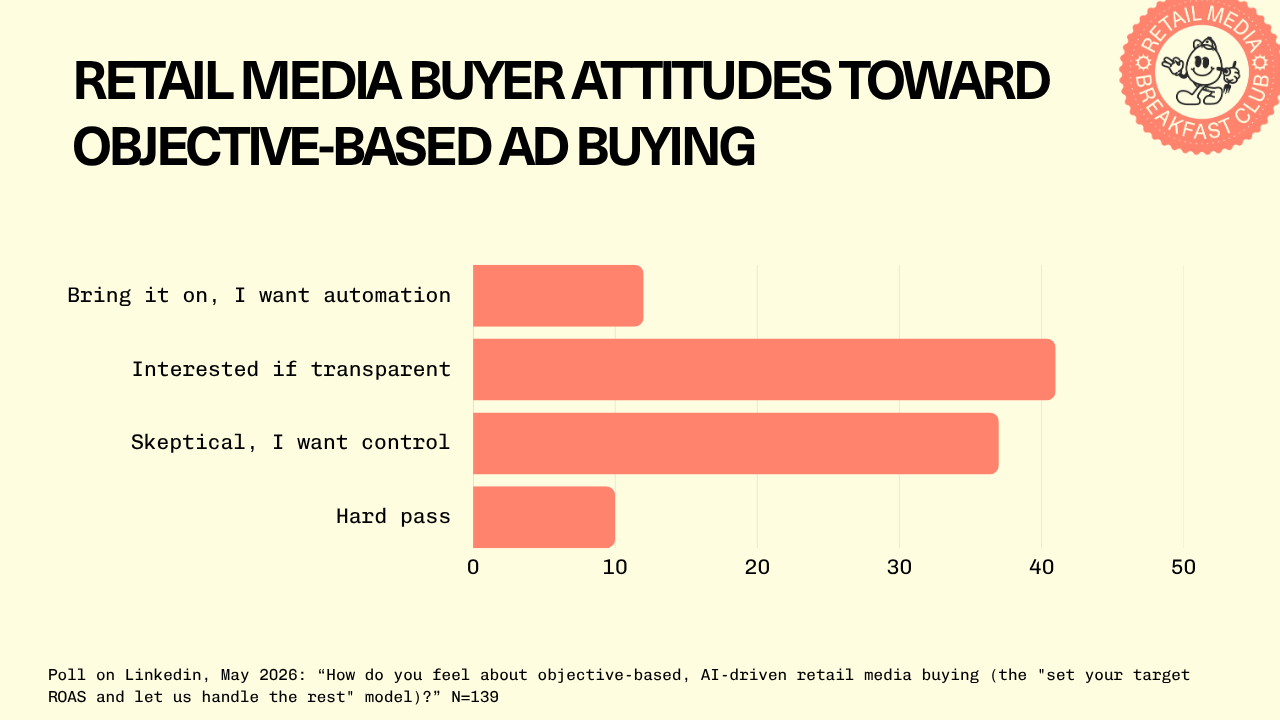
- 12% said bring it on
- 10% were a hard pass
- Most respondents sat in the middle: 78% split between "interested if transparent" and "skeptical, I want control"
The overwhelming middle ground shows the same instinct: show me what's under the hood first. That's the buyer Chewy Max is built for. Mulcahy shares the reflex against black-box automation — the "I don't want P-Max" resistance among sophisticated buyers. "You're not wrong. I agree." So the tool sits alongside the manual levers rather than replacing them, and the transparency extends to reporting both lifetime-value ROAS and direct ROAS rather than the flattering one. The test he's watching is whether the media buyers stay, and he says they are: activation goals exceeded, early signs of stickiness rather than test-and-abandon.
What this adds up to
The identity question — retailer that runs media, or media company born from a retailer — is the one you can argue about over a drink. The harder one, and the one the barbell is actually built to answer, is whether you'll let advertisers see what they're buying.
That's where Mulcahy's strategy stops being a philosophy and becomes a wager. The clean rooms, the optional automation, iROAS and direct ROAS reported side by side instead of only the flattering number — none of it works unless the underlying performance can survive being looked at. Sharing data is a bet: that Chewy's numbers hold up, and that a brand who can measure honestly will spend more, not less.
My poll suggests it's the right bet. This is a crowd that wants to see what's under the hood first.
The retailers still treating first-party data like a vault are, in effect, betting their numbers can't take the scrutiny — and telling their best customers exactly that. Mulcahy is betting the opposite. We'll find out who's right when the buyers either stay or walk. So far, he says, they're staying.