
A version of this piece was first published to my column at The Drum on October 12, 2026, as Should retail media get back to what it does best? It is reproduced here with permission, and with some new insights from the retail media community as shared on LinkedIn.
Somewhere along the way, retail media stopped being about retail.
With a mandate to grow ad revenue weighing heavily on their shoulders, retail media network (RMN) leaders have spent the last few years conjuring up increasingly glittery ad slots, media partnerships and targeting options, all in a bid to win dollars that would previously have gone to national media. Best Buy Ads launched connected TV, a creator program and a TikTok Shop last month. Walgreens is putting screens into 1,200 stores. Walmart Connect and Omnicom brought Meta into their partnership to match Walmart purchase data with Instagram creators.
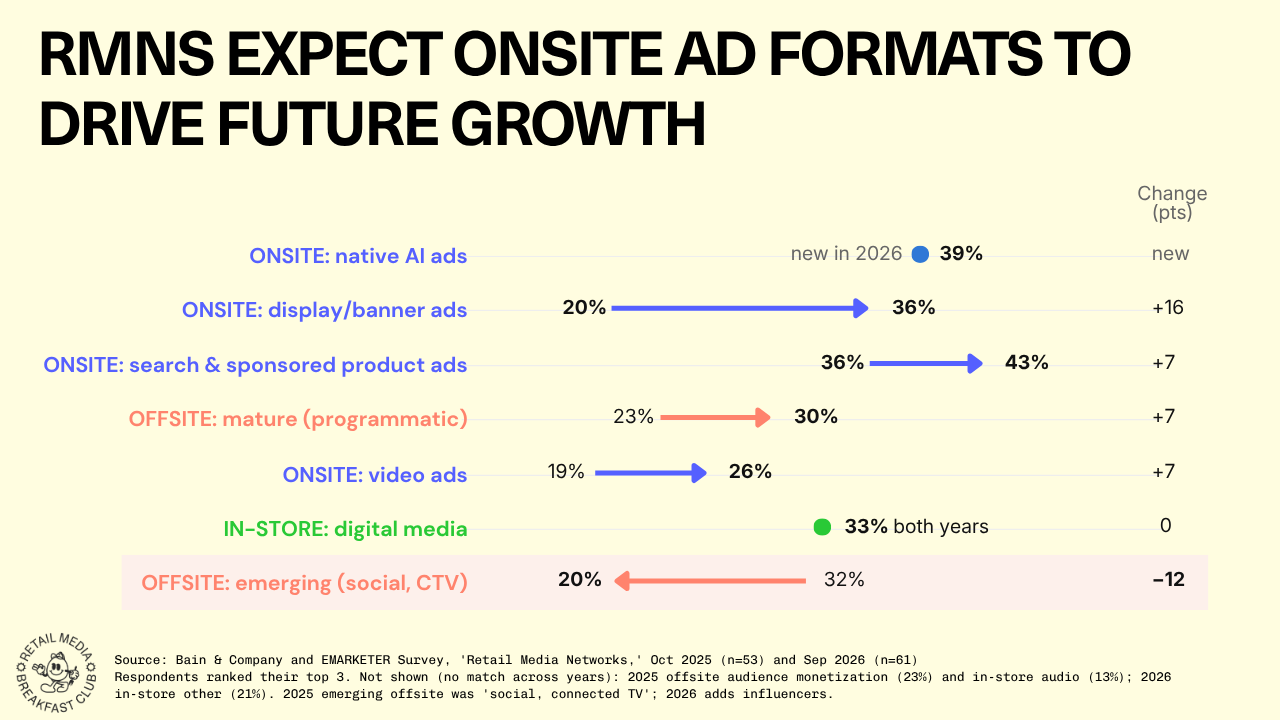
But new research from EMARKETER and Bain & Company shows that senior retail media leaders believe that their future actually lies closer to home, in the ad format that got us started: the humble onsite product ad.
The survey of 61 US retail media network leaders, conducted in July, asked which ad formats they expect to drive the most revenue growth over the next year. In last year's version, the top three spanned onsite, in-store and offsite. This year, all three are onsite: search and sponsored product ads ranked first, followed by native AI ads and display and banner ads.
Networks still have plenty of appetite for growth. They expect about 23% revenue growth this year, though nearly a third (31%) expect to come in under plan. The retreat is about where that growth will come from, and there are good reasons for it.
(RELATED: I wrote about the 2025 edition of this research in The Secret Hopes & Dreams of RMN Leaders)
Onsite is where the margin is
Sarah Marzano, principal analyst at EMARKETER, put herself in a retailer's shoes when describing the logic to me. On their own websites and apps, "we have the most control. We make the highest margins. We have the fewest third parties to answer to."
The survey shows the same shift in what networks have prioritized over the past year. Expanding and enhancing onsite ads jumped four places in the ranking, to 38%.
The margin gap is large. In January I wrote in my Drum column that onsite advertising generates profit margins of around 70-80% for US retailers, compared with roughly 40% for offsite.
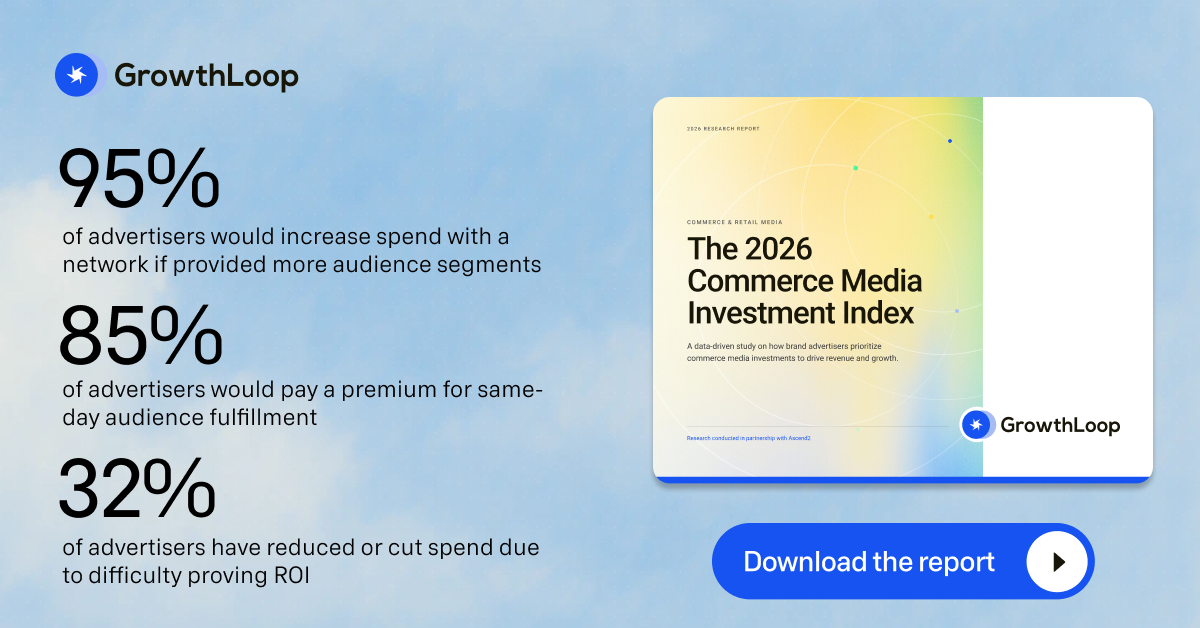
85% of advertisers plan to increase spend with media networks in the next year. So, how do you get a bigger share of those budgets?
New research from GrowthLoop & Ascend2 reveals that activation speed and audience options are decisive factors in where advertisers place their dollars.
- 86% would reduce spend or leave a network if their audience fulfillment is too slow
- 85% would pay a premium for same-day fulfillment
- 32% have reduced or left a media network because of difficulty proving ROI
For more insights into what brand advertisers are looking for in media network partners, download The 2026 Commerce Media Investment Index.
Now, before my hate-mail inbox overflows: I know there is a wide range within each of these categories, depending on the technology and resourcing involved.
The gap between them comes from all the handoffs. Selling offsite media involves partnerships with the publishers where the ad appears (CTV, social, the open web) and the technology partners needed to buy, run and measure those placements. Each of them takes a cut.
There is also the question of who's paying. Offsite means going after national brand budgets, and that has proven to be a harder internal and commercial sell than many networks expected.
Katharine McKee, an ecommerce and omnichannel consultant, explained why in a LinkedIn comment after this column first ran. At large brands, she wrote, the RMN relationship usually sits with the ecommerce or sales team, and those teams don't buy TV, brand placements or anything that isn't at least mid-funnel. "Their budgets are very strongly tied to ROAS and won't be budging." The brand money that offsite was built to win sits with a different team.
Onsite inventory can be sold to the people already buying from you.
Questioning the hype
EMARKETER's separate research on retail media and social, by Marzano and Max Willens, puts numbers on how hard that sell is. Retail media spending on social will be about $1.3bn in the US this year, under 2% of retail media spend. "The basic infrastructure is largely in place; advertiser demand is the missing piece," the report concludes.
Advertisers told EMARKETER that buying social through a retailer costs more and adds complexity, and some had tested it against buying direct and found the extra cost outweighed the benefit. Marzano told me that RMNs are "going to have to do a lot more than simply build the connectivity between the two platforms."
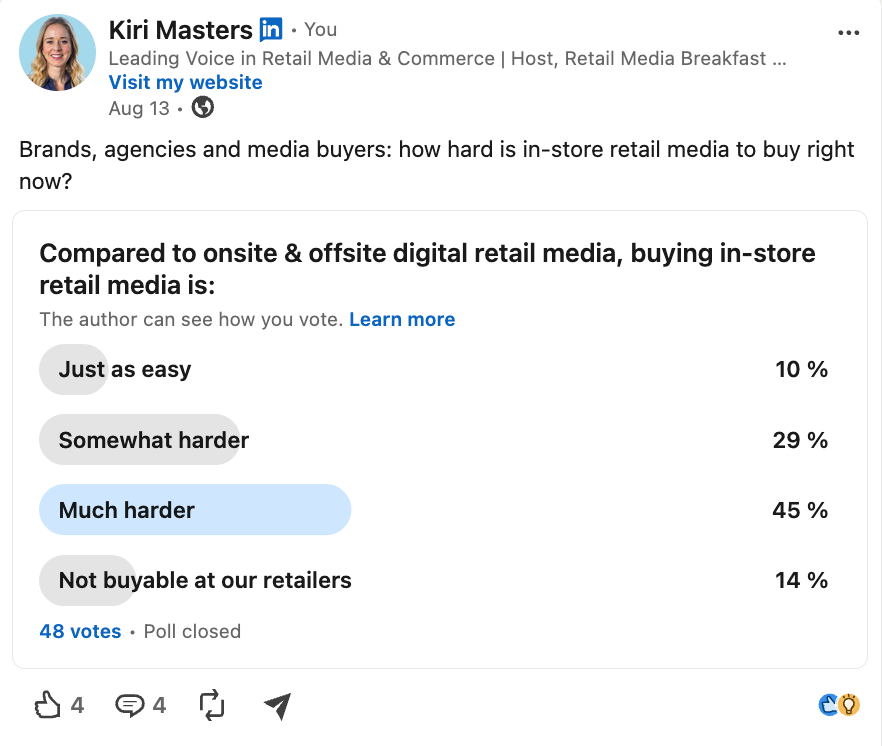
In-store media has been hailed for years as the next big wave of media spending, but advertiser interest is still muted. In a quick LinkedIn poll I ran, most respondents said in-store retail media is harder to buy than onsite or offsite.
The RMNs seem to have reached a similar conclusion. Emerging offsite formats, including social, CTV and influencers, fell from third place to last in the growth ranking.
This is harder than it looks
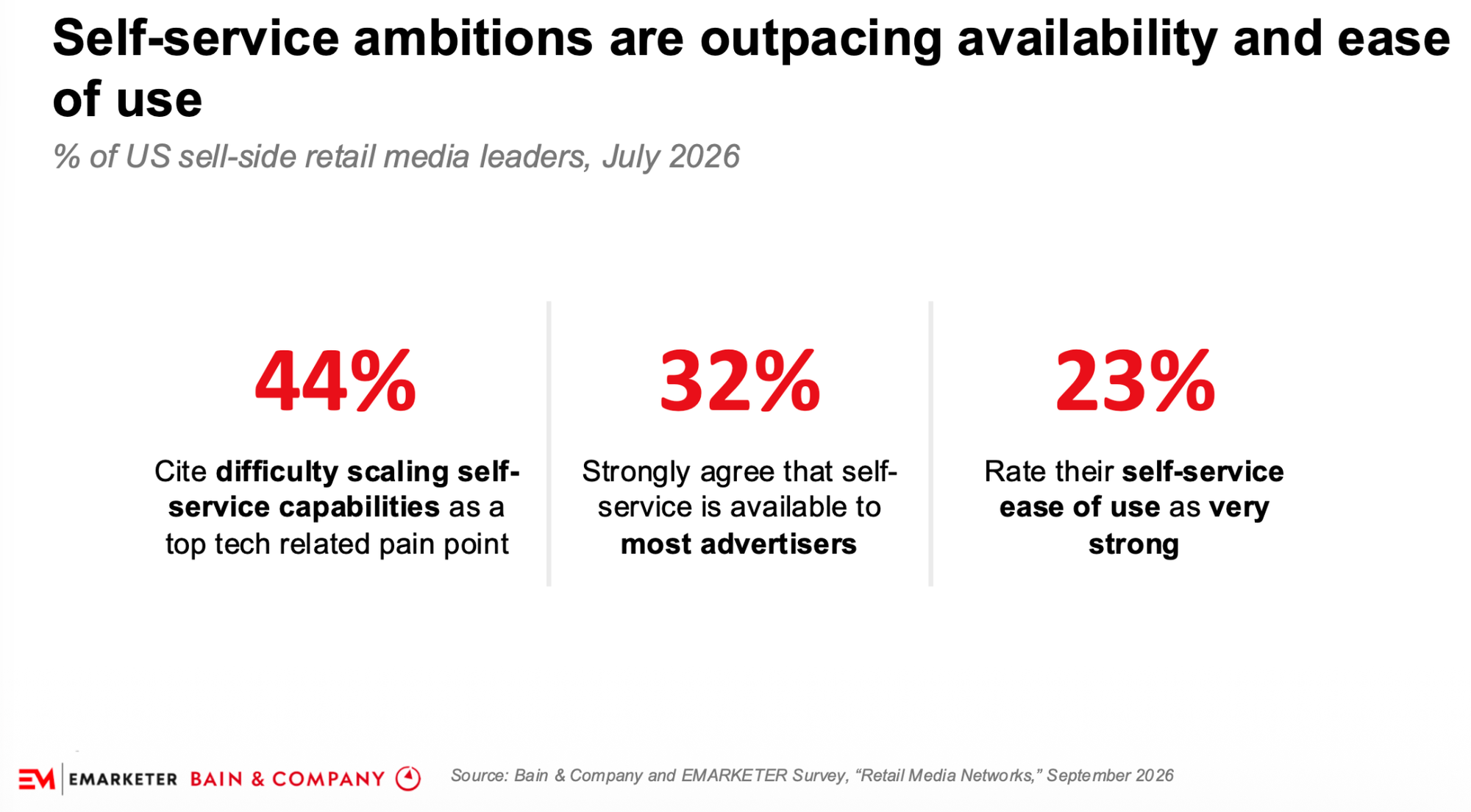
Networks are also changing who they sell to. Growing the long-tail advertiser base was their top focus over the past year (49%, up seven places), and driving self-service adoption rose five places. That points away from the national brand budgets offsite was meant to unlock. But only 23% rate their self-service ease of use as very strong.
Confidence in the business case is slipping too. Just 31% of leaders strongly agree their retail media revenue is incremental to existing supplier spend, down 14 points on last year.
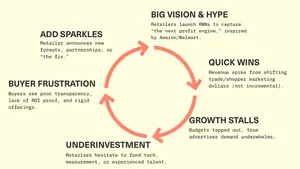
"There's just a fair amount of RMNs who are figuring out that this is going to be harder than they thought it would be," Marzano told me. She pointed to talent shortages in technology, measurement and sales, and to a self-fulfilling prophecy: networks without the expertise can't win "leadership buy-in to fund those things," and fall further behind.
That's the retail media doom loop I've written about. One network leader told me their request to replace an ad server that couldn't read retail traffic patterns was denied, so they now correct its forecasts by hand every week or two.
Two kinds of network
A few networks have the resourcing and executive backing for big bets. Best Buy is one: its ads showcase last month barely mentioned the sponsored product ad, and Lisa Valentino, its chief ads and media officer, reports directly to the chief executive.
For most other networks, retail media is a side quest. And for those, the retreat to onsite is the rational move.
The big risk
The trouble is that onsite is where retail media is most exposed. As I've argued before, when discovery moves into AI assistants, shoppers reach the retailer's site already decided, and the search results page where sponsored products live gets thinner. Meta's Muse AI agent can now shop and check out for users. In the survey, 44% of leaders named AI platforms bypassing retailer-owned purchase journeys as a top disruption.
So the retreat makes sense, but the format can't stay a sponsored listing on a search page. The survey hints networks know it: native AI ads ranked second, and 34% say they're building a shopping assistant with monetization in mind. Earlier this year I wrote that Amazon was the only retailer with a monetized AI chat assistant.
What Next
Most of the response when I shared this column on LinkedIn was agreement, including from Michael Krans, who runs Macy’s Media Network. John Greca, a digital commerce and retail media consultant and former head of retail media at Carrefour Belgium, saw a different problem with the retreat. He argued that leaning on onsite, where the money is easiest, may be one reason the easy double-digit growth is ending. “There is a difference between doing what works now vs. going where growth is next,” he wrote. In his view, offsite is where retailers and brands can work toward shared goals, such as bringing new shoppers to the retailer and growing a brand’s share once they arrive, using the retailer’s closed-loop sales data.
Either path asks a lot of the buyer. Doing onsite better means selling brands on new formats like native AI ads. John’s version of offsite needs brand money from outside the ROAS-bound ecommerce budgets that Katharine McKee described.
As Sarah Marzano put it: “You have to really get advertisers to buy differently... and it turns out that’s hard.”
Further reading:
 Kiri Masters