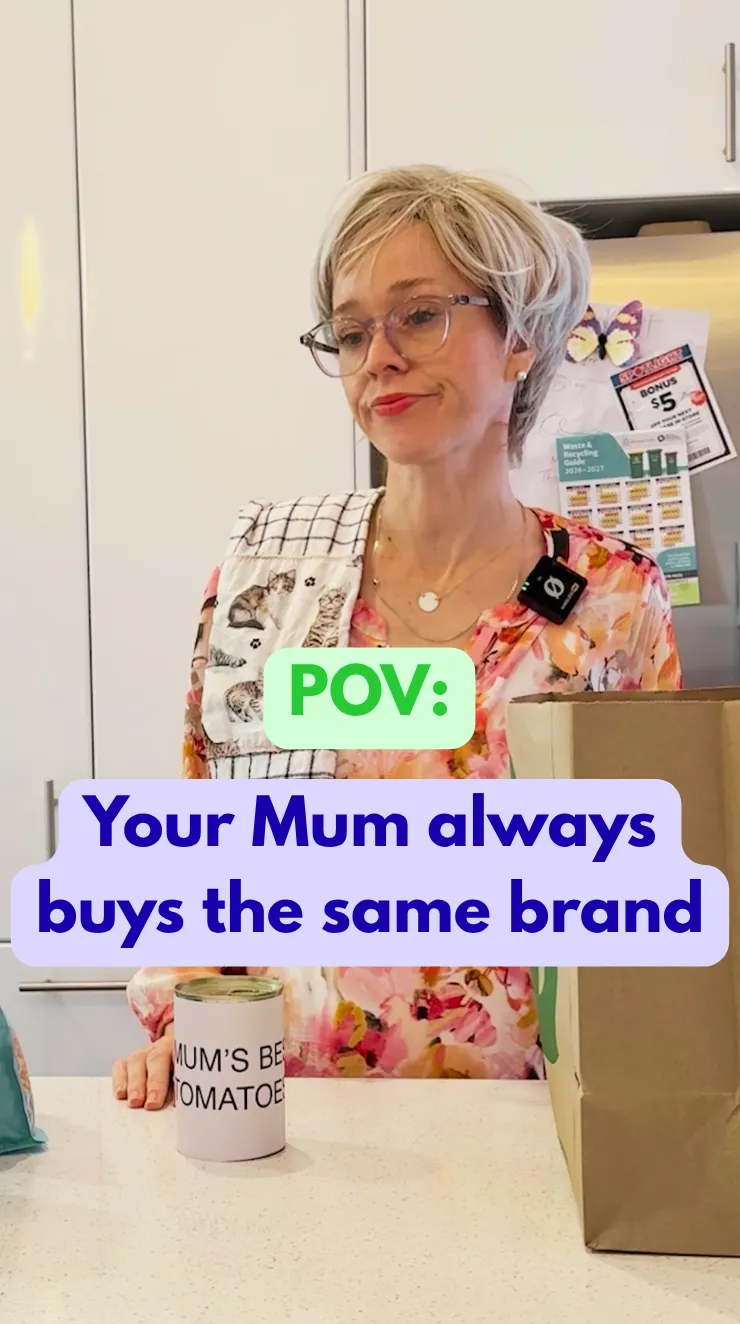
"Mum" has her go-to brands. She always has. When her son asks why, the explanation doesn't seem entirely relevant.... but it makes sense to her!
Her son points out that the store brand is cheaper. Mum is not moved.
Mum would also make a perfectly normal survey respondent.
In research I co-authored with Bazaarvoice, What's a Brand worth when AI does the shopping?,we asked shoppers why they stick with a brand they buy repeatedly. The top answer was performance: 45% said they stay because the product performs better than competitors. Only 8% chose habit, the "household name I've used for years" option.
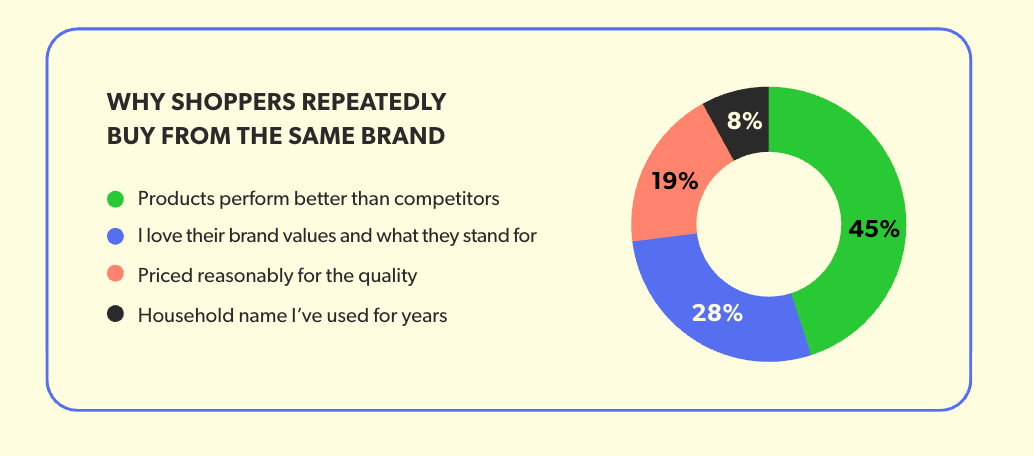
I believe that they believe it. And performance surely matters: a product that stops delivering won't get bought a second time. But it’s usually not what made you choose it in the first place.
Truly optimizing every purchase — finding, reading and weighing objective information about performance in every category — would turn a 30-minute grocery run into a day-long event. And that assumes objective information exists in the first place. So we take shortcuts: habits, recognizable brands, whatever's sitting at eye level. That's before we count impulse buys and the upsell at checkout.
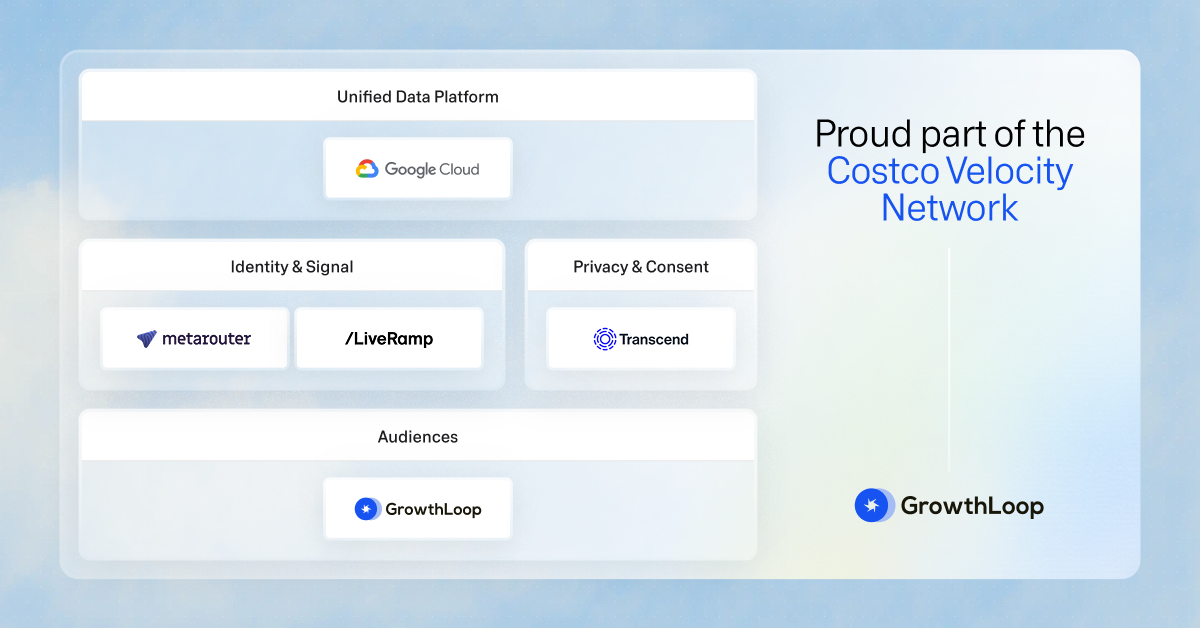
Costco isn’t scaling its RMN with legacy adtech and manual solutions. It’s leaning into a cloud-centric, composable stack.
As part of the Costco Velocity Network, GrowthLoop empowers the retail media team to build audiences directly from the data cloud, enabling faster activation, greater relevance, and better performance — all while maintaining privacy and governance standards.
The result? Exceptional value and experience for Costco members and better ROI for brand advertisers.
Learn why the GrowthLoop Composable Commerce Media solution was the right choice for Costco’s Velocity Network.
Most of the decision happens before the shopping does
WPP Media and Oxford University's Saïd Business School put numbers on those shortcuts in How Humans Decide, published in October 2025. It draws on a decade of WPP's purchase-journey studies: 1.2 million journeys across more than 200 categories in 47 countries.
The paper splits the journey into two stages. In the priming stage, people aren't shopping, but they're picking up experiences of brands and categories as they go about their lives, and those experiences build a bias toward some brands over others. The active stage starts when a need or want kicks in. It can last seconds or months, depending on the category.
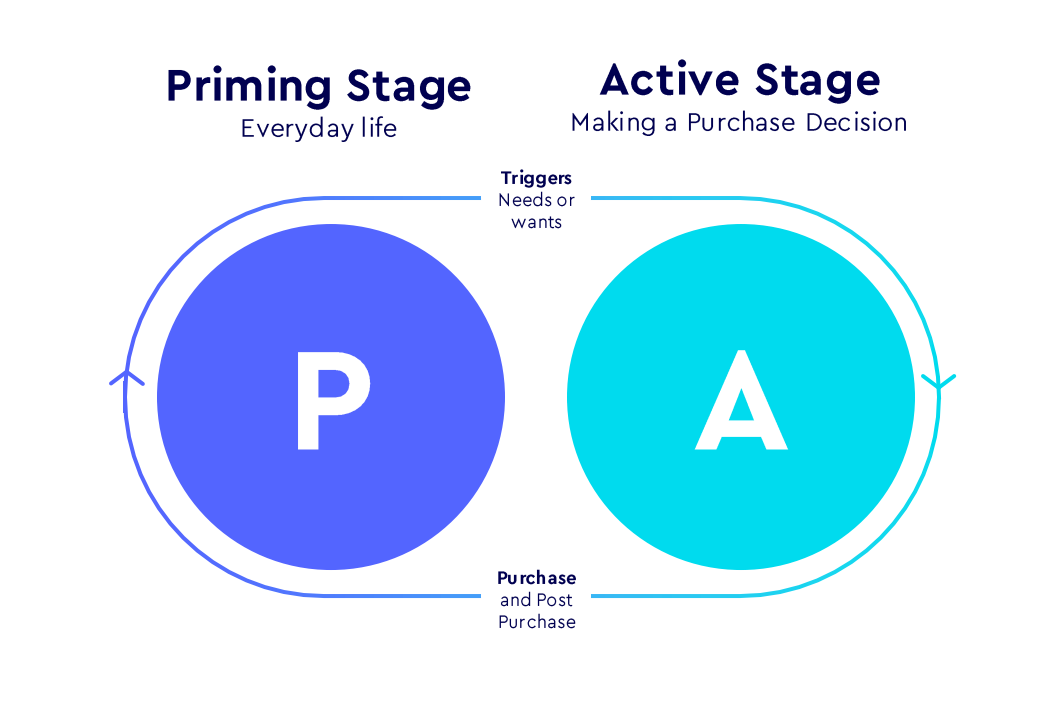
Most of the work happens in the first stage. According to the paper, most shoppers already know which brands they'll consider before they start, typically consider fewer than three, and usually end up with the one they were already biased toward. WPP puts that at 84% of purchases.
The obvious worry for brands is that AI assistants undo all of this. A shopper asks for the best option, the assistant answers with attributes and specs, and the brand gets reduced to a spec sheet.
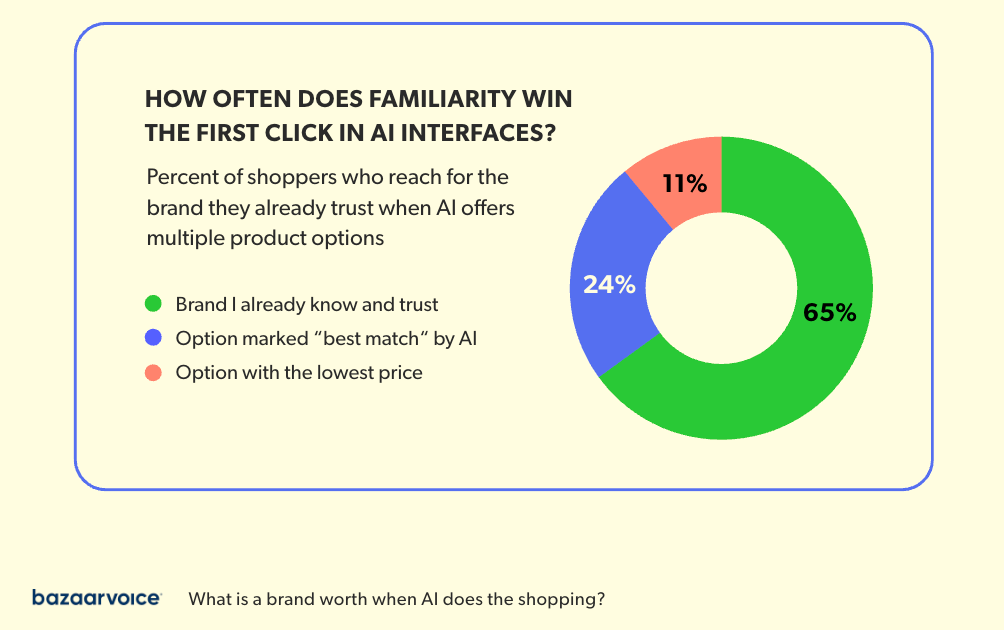
In our Bazaarvoice data, when AI presented shoppers with product recommendations, 65% clicked first on the brand they already knew and trusted. 24% clicked whatever the AI marked as the "best match," and 11% clicked on price alone. So the same shoppers who told us they stay loyal for performance mostly passed over the option the AI said suited them best, and went for the name they knew. (The report breaks this down by category)
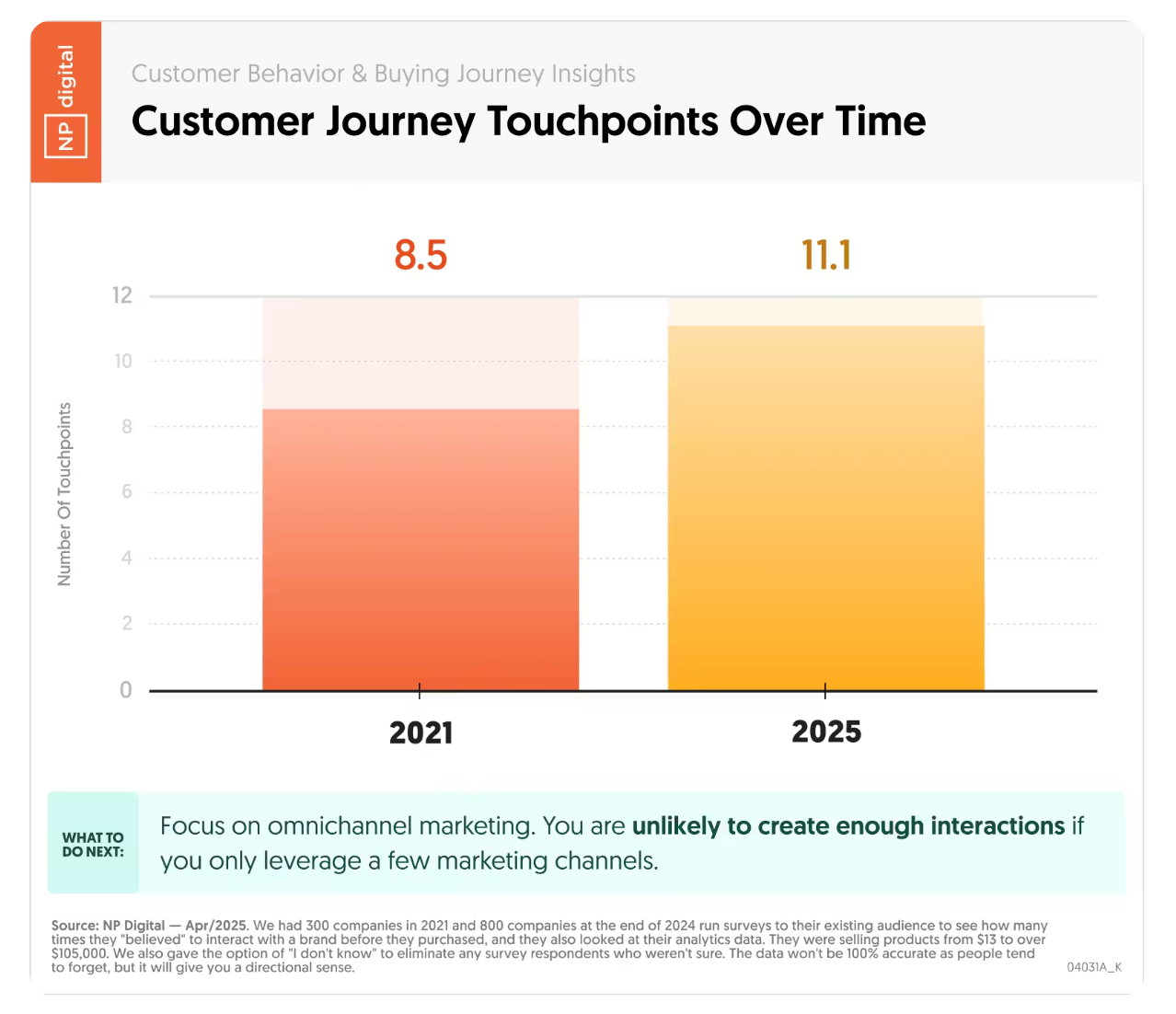
Brands shouldn't read that as permission to coast, because the priming stage is getting more crowded. NP Digital's research, which combines the touchpoints consumers recalled with analytics data, found shoppers needed an average of 8.5 touchpoints before purchase in 2021, and 11.1 in 2025.
Kantar's Media Reactions 2026 study, based on around 23,000 interviews across 33 markets, found 32% of consumers now use social media to browse or shop for products. Kantar's warning to marketers is that "The path to purchase now runs through channels you may not be measuring as commerce."
The retailer's problem is the "active" stage
If priming decides which brand, the retailer's question is where the shopper goes to act on it. That's moving too.
Google says the average search in AI Mode, its conversational search experience, is 3X as long as a traditional search query, and that people are asking it longer, more conversational questions.
I've been arguing for more than a year [Why Agentic Shopping Poses an Existential Threat to Retail Media, Part 1, Aug 2025] that the core retail media ad unit — the sponsored product ad on a retailer's search results page — is exposed to this. If the active stage moves into a third-party assistant, the search results page where that ad lives gets skipped.
RMN leaders see the same risk. In EMARKETER and Bain & Company's September 2026 survey of 61 US sell-side retail media leaders, 44% named AI platforms disintermediating retailer-owned purchase journeys as one of the most disruptive forces they expect over the next one to three years. Only agentic AI disrupting media buying ranked higher, at 46%.
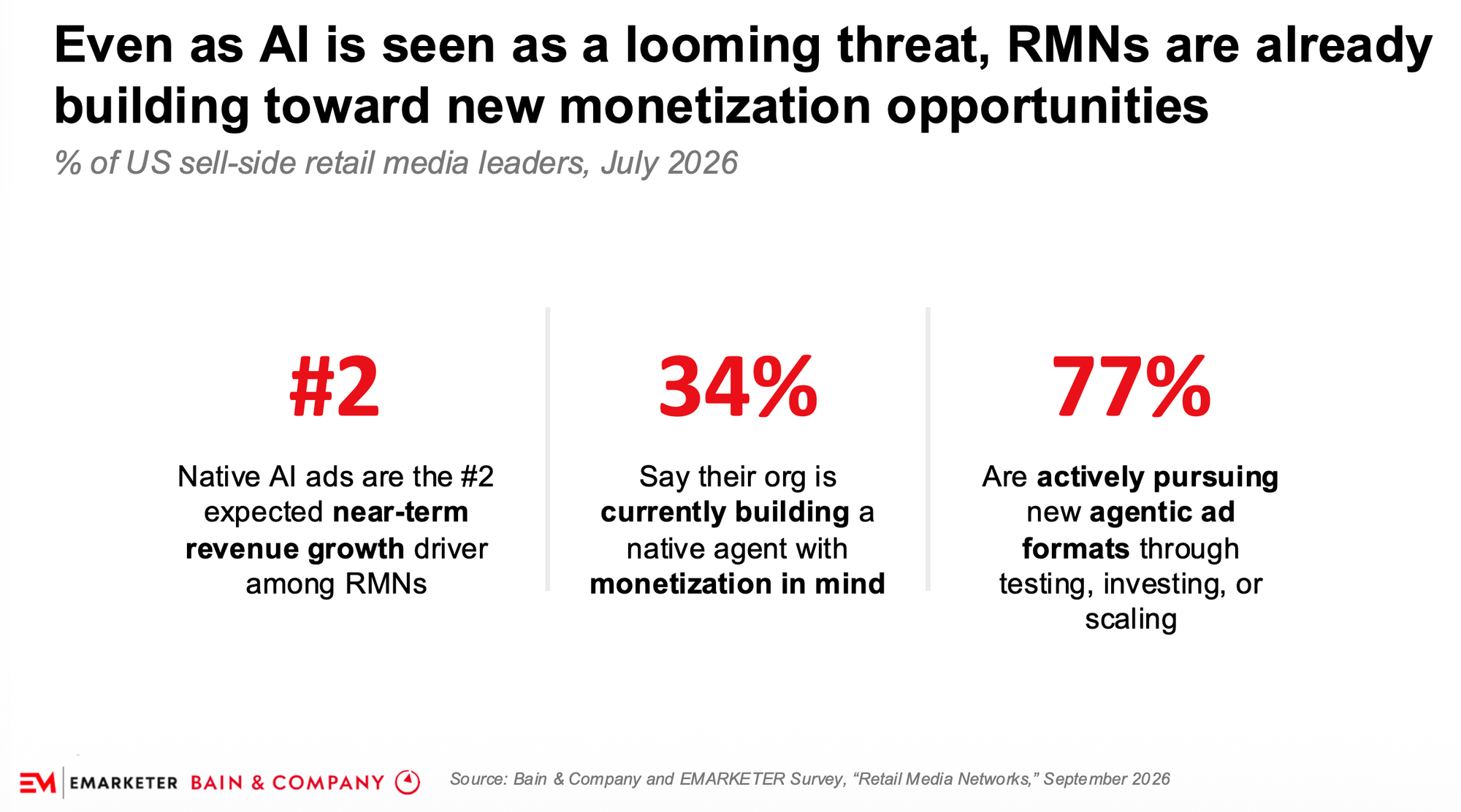
Their response is to build their own version. Onsite native AI ads ranked as the second-biggest expected source of revenue growth in the next 12 months (39%), behind onsite search ads and sponsored product ads (43%). A third (34%) said their organization is currently building a native agent with monetization in mind, and 77% said they're testing, investing in or scaling new agentic ad formats.
I wrote yesterday about RMN leaders pulling their growth bets back onsite, this is part of what that looks like: they count their own assistants as onsite.
That bet pays off only if shoppers do their asking inside the retailer's assistant rather than someone else's. Kantar found 17% of consumers would trust an AI assistant to shop for them in the future. That's a minority, and it's a stated intention — the same kind of answer this piece opened by doubting. It also doesn't tell us whose assistant they have in mind.
If Mum let an AI agent do her shopping, she’d still end up with her go-to brand, just like most of the shoppers in our survey. For retailers, the worry is that she’s asking ChatGPT and not them.
Coming up: In my column for The Drum this week, I look at what happens when shoppers bring those conversational habits to retailer sites and apps — many of which, according to recent Forrester analysis, can't handle them yet.
Research mentions:
- Bazaarvoice, What Is a Brand Worth When AI Does the Shopping? | [September 2026. I co-authored this research. Based on Bazaarvoice's Brand Equity Survey of more than 3,600 shoppers in the US, EMEA and Australia.
- WPP Media, How Humans Decide | October 2025. Produced with Oxford University's Saïd Business School. Based on WPP Media's database of Momentum purchase-journey studies, covering a decade of research into 1.2 million consumer journeys across more than 200 categories in 47 countries.
- NP Digital, customer journey touchpoints | April 2025. Survey of 300 companies in 2021 and 800 companies in 2024.
- Kantar, Media Reactions 2026 | 2026. Consumer survey based on around 23,000 interviews in 33 markets.
- EMARKETER and Bain & Company, Retail Media's Growth Is Outpacing Confidence in What Comes Next | September 2026. Survey of 61 US sell-side retail media leaders, conducted July 2026.