
I’ve been a fan of Next In Media with Mike Shields for a long time. The podcast is great, as is Mike's Substack.
So I fan-girled out when Mike asked me to come onto the podcast to talk about ChatGPT ads and where AI shopping may (and may not) be headed.
The conventional wisdom says consumers will hate ads in their AI assistants. That inserting commercial content into ChatGPT or Gemini will erode the trust that makes these tools valuable. Mike pushed me on this—are we sure this is going to be as powerful as we think?
Honestly? I'm not sure. But I'm more optimistic than most. Or at least, I’m more optimistic than Mike!
SPONSOR: MIRAKL ADS
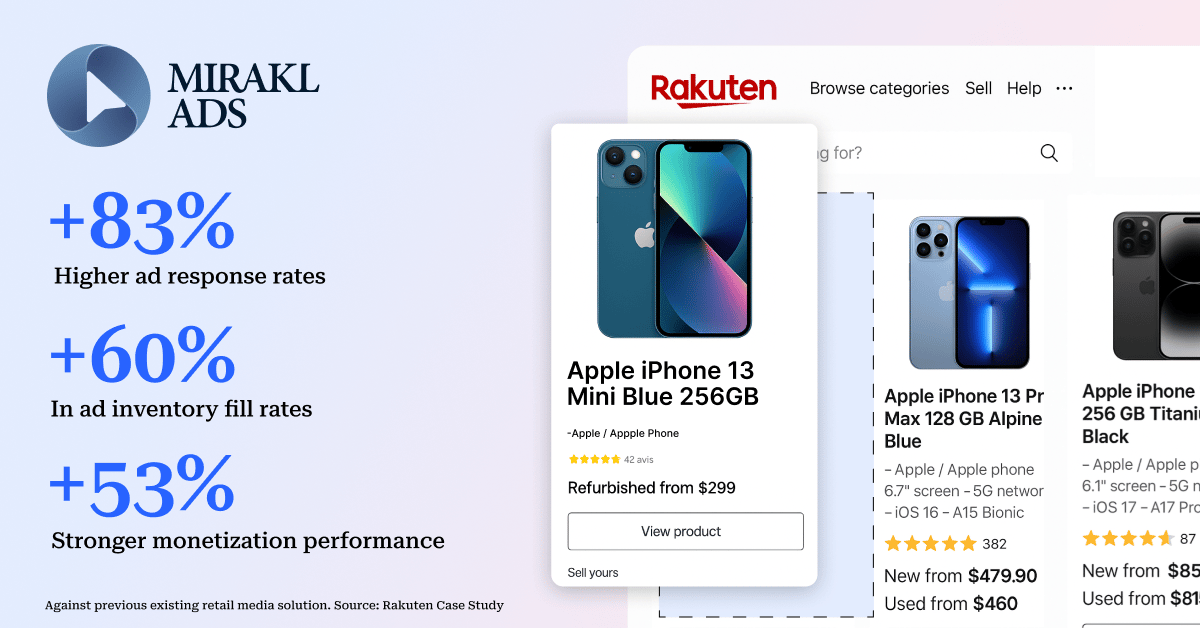
Did you know leading retailer media networks drive 85% of their ads revenue through mid- and long-tail advertisers?
Mirakl Ads provides full funnel ad formats tailored to both 1P and 3P advertisers, leveraging unique AI-capabilities that provide unprecedented levels of relevance and engagement.
Retailers who want to capture ad spend from the long tail of 3P marketplace sellers use Mirakl Ads in their tech stack.
The Case for LLM Ads Actually Being… Good?
Here's the thing about ads: they're annoying when they're irrelevant. A lot of people actually love the ads on Instagram because they're super relevant. You see something and think, "I didn't know I wanted that, but now I do." That can feel genuinely additive.
Now think about the context LLMs have on us. We're not just sharing recipe requests. We're sharing our hopes, fears, marital counseling questions. People are literally having therapy sessions with these things. That's a depth of understanding no advertising platform has ever had access to.
And we shouldn't limit our thinking to what ads look like right now. With AI going multimodal—voice, video, try-ons—the ad unit could be completely different. Imagine getting a notification that one of your favorite apparel brands just dropped a new line, with a visual showing how it would look on you. That's not an interruption. That's actually useful.
The big question is whether these platforms take that direction or just try to copy what's been done before. If they're smart, they'll build something new.
I wrote more on this topic in this piece: Maybe Ads in AI Don't Have To Suck?
The "Free Product" Reality
Mike and I talked about whether people will tolerate ads in these tools. My take: we've made this bargain everywhere else.
It's free. We've come to accept, for better or worse, that when something is free, we are the product. People won't pay for Facebook or Google, and they may not love the ads, but if the utility is there, they keep using it.
Heck, people pay for Amazon Prime and Walmart+ and still see a ton of ads. Copilot has been running ads in chat since day one and they're still going. The utility outweighs the friction.
The Risk Nobody's Talking About
Here's where I actually threw a question back to Mike to get his take on something that I’ve been noodling on.
If LLMs accumulate all this rich intent data and figure out how to monetize it, what does that mean for retailers who've been building their offsite media businesses on exactly that same data?
Think about it. Retailers have spent years building the pipes to activate their shopper data across CTV, social, and the open web. That offsite business was supposed to be the next growth engine as onsite inventory gets saturated. It's not as high-margin as onsite, but it's incremental revenue they're counting on.
But if ChatGPT knows I'm a mom in suburban Atlanta searching for high protein lunchbox snacks, and they decide to build an offsite advertising business instead of cluttering the chat experience, suddenly retailers aren't the only game in town with that data.
Right now, Walmart has that search data and can use it to help a protein brand retarget me on Disney+. But ChatGPT has that same information. The premium CPMs retailers command for that audience data could face some serious competition.
We haven't seen any LLMs talk about pursuing offsite media yet. If I were running monetization at an LLM, offsite is a path I'd seriously consider—you get to monetize without degrading the core chat experience.
What's Actually Resilient
Mike asked whether AI shopping taking off through chat experiences could hurt retail media in general. Short answer: yes, but not uniformly.
Two-thirds of retail media revenue streams are potentially impacted by AI-enabled commerce. Onsite sponsored products face disruption as discovery shifts to AI interfaces. Offsite media faces competition from LLMs who have similar (or richer) intent data.
But in-store retail media? That's actually pretty resilient to AI-enabled shopping disruption. When someone's physically walking through a store, the screens and displays and end caps still matter. There's a good reason to be excited about that channel, even as the digital side gets more complicated.
I’ve gone deeper on this topic in some past pieces:
While We Debate What's 'Really' Agentic, Retail Media's Foundation Is Already Shifting
The 3 Ways Agentic Commerce Could Destroy Retail Media
Now What
The proof will be in the pudding on whether LLM ads actually work. We're in the infrastructure stage right now—the experience is honestly inferior compared to what we're used to. But trust gets built in small steps. My first purchase on eBay at 13 years old felt risky. I paid ‘Cash On Delivery’ (remember that?). Now I buy everything online without thinking twice.
If there's a deal brokered between retailers and AI platforms, the real question is: what's the benefit for the consumer? Maybe it's a small price to pay for convenience. Maybe there's a financial reward for engaging with certain advertisers. There are many possibilities, and the platforms that figure out how to bring consumers into the economics will win.
For retailers, this is a wake-up call. The easy money is gone. Retailers will need to find more collaborative ways of working with brands against shared goals—because the competitive landscape just got a lot more complicated.
You can listen to my full conversation with Mike Shields on the Next In Media podcast or read it on his Substack.
THIS WEEK

With ~83% of US retail sales still happening in physical stores, in-store retail media is finally getting the attention it deserves—and the infrastructure to match. US in-store retail media ad spend is projected to reach $1.07B by 2029 as the channel becomes more buyable, more measurable, and more like DOOH with retail data layered on top.
But there's a bifurcation happening in execution. On one side: scalable, programmatic placements—digital screens at checkout, entrance zones, endcaps, in-store audio—that brands can now buy and manage with increasing ease. On the other: experiential activations that go beyond efficiency to create something memorable and brand-building.
In this LIVE session, I'll sit down again with Jordan Witmer (Salt XC) to explore both sides of the opportunity.
We'll discuss:
* What's working now: Real examples of in-store activations from Salt's experiential and shopper work—showing the range of what brands are doing in retail environments
* Scalable vs. experiential: Where growth is concentrating, and when brands should push beyond programmatic placements into bigger swings
* Bringing social content in-store: How brands can translate their influencer-driven creative into physical retail environments
* The resilience factor: Why in-store retail media may be uniquely insulated from some of the disruption facing onsite and offsite channels (including agentic commerce)
We'll take live Q&A—bring your questions!