
Recently I was standing in the bolts aisle at Bunnings, Australia's answer to Home Depot, dictating like a madwoman to ChatGPT how I needed a new bolt for my at-home studio setup. At the end of ChatGPT's description of the right type of bolt I'd need was an ad from Bunnings, ever so helpfully letting me know that I could buy bolts at Bunnings!
So the ad found me in the AI assistant, as the Bunnings media buyers probably hoped it would, in a seemingly relevant conversation about hardware.
But I'm not going to buy a $1.50 bolt online, and wait days to have it delivered. I wanted to buy one right there in the store. My ideal pathway to get there would be for my assistant, which already knows the details of my project, to ask Bunnings' systems one question: is the one I need here, or do I need to order it?
That's AI shopping as most people will meet it for a while yet. It starts in a general assistant, and ends in a store. But many retail ad businesses are still built around the search box.
85% of advertisers plan to increase spend with media networks in the next year. So, how do you get a bigger share of those budgets?
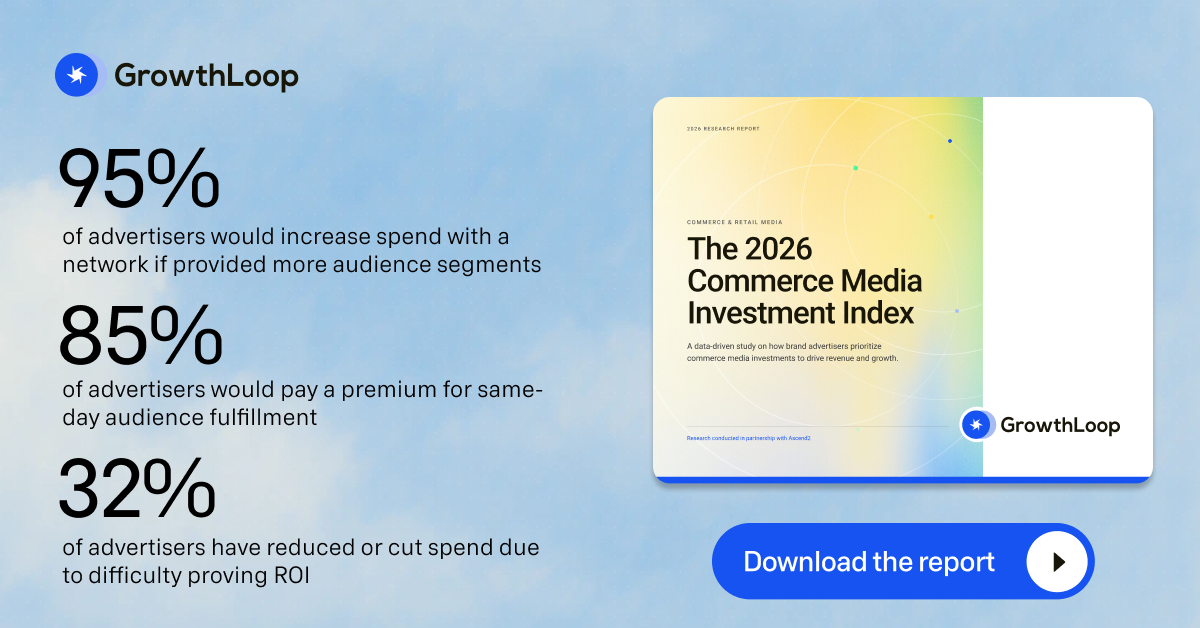
New research from GrowthLoop & Ascend2 reveals that activation speed and audience options are decisive factors in where advertisers place their dollars.
- 86% would reduce spend or leave a network if their audience fulfillment is too slow
- 85% would pay a premium for same-day fulfillment
- 32% have reduced or left a media network because of difficulty proving ROI
For more insights into what brand advertisers are looking for in media network partners, download The 2026 Commerce Media Investment Index.
A playbook borrowed from Amazon
That aisle was on my mind re-watching a conversation The Drum published this week, which was recorded in September after the AdClub of New York's Commerce Media Exchange. Me, Gordon Young from The Drum and Marc Walkin of QSIC debated the concept of a retail media playbook.
Marc argued the industry has spent years following an Amazon-inspired model, even though most retailers run very different businesses.
I agree, and the reason is ultimately a good one – most retailers depend far less on their ad business than Amazon does. You could argue that Amazon's core retail business would be far less viable as a going concern without its media revenue. For almost every other retailer, media is margin-rich, but it's a side quest. Take the media business away and they're still a solvent retailer. Their main job is moving boxes, and they won't change how they serve shoppers to squeeze out a bit more ad margin.
Someone who built a retail media network across independently owned locations told me recently what that looks like up close. Every store operator, long used to a certain level of independence, had to be signed up for the new in-store media program one by one. The network paid for the in-store screens and offered owners a financial incentive to have them setup. That's because some wily operators were already "monetizing their store surfaces" in various tax-effective ways.
None of that is in the Amazon playbook.
Finding what's holy instead
The alternative is an idea I set out in my Drum profile of Gopuff's Michael Peroutka this week: finding what's holy, the moat that keeps customers coming back, which the ad business should exploit and never damage. For Gopuff, that meant partnering with Instacart on its onsite ad tech. It's working with a company it competes with in some ways, so it could focus on and protect what actually makes it different.
In the era of AI-enabled commerce, what's holy includes the things ChatGPT can't know: what you bought last week, what's in stock at my local store, which store pickup slots are open.
Stock on the shelf is exactly what Bunnings knows and ChatGPT doesn't. The ad I got served told me the one thing I already knew.
Shoppers don't follow the playbook either
In the The Drum conversation I said shoppers today are bouncing around to different channels, using different sources to validate and decide." Kantar's latest Media Reactions study, which I watched on a webinar this week, puts numbers on that. Globally, a third of consumers already use AI assistants to research brands and products, but only 24% trust the brand recommendations those assistants give them. So they check somewhere else.
That foots with the research I coauthored with Bazaarvoice, which also tracked where consumers go to validate those suggestions. After deciding to potentially buy an AI-recommended product, 68% go to the brand’s website to look further. 65% check social media. 58% visit a retailer’s website.
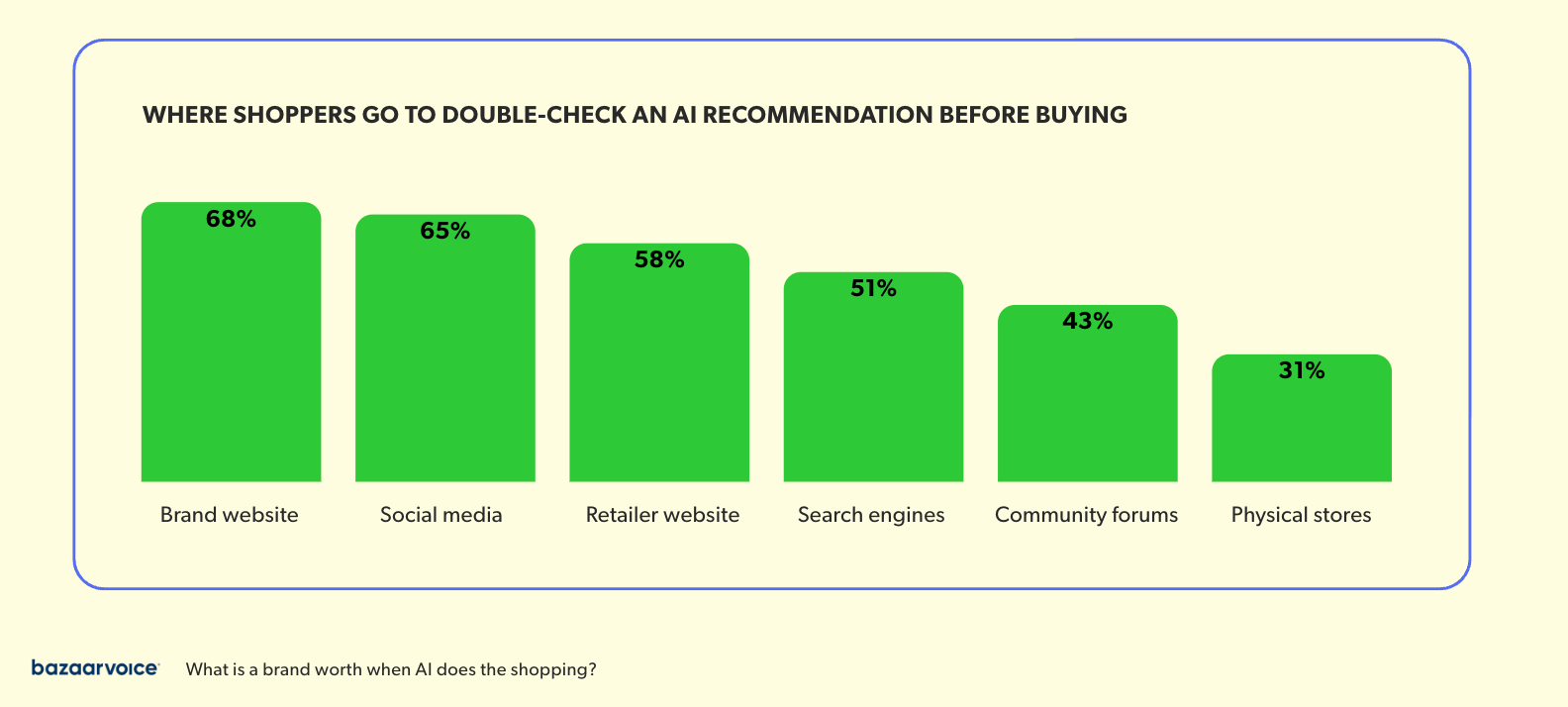
A media playbook built around a retailer's search results page wasn't designed for a shopper who starts in ChatGPT, finds an influencer's tutorial, checks reviews, and buys in an aisle.
Which brings me back to Bunnings.
Bunnings has an AI assistant. But – and I'm sorry to admit this because I know the folks at Bunnings are loyal readers – I never even considered using it. ChatGPT had all my project knowledge and context and the ability for me to verbally dictate my rambling question into it. I didn't have the time or patience to demo a new AI tool right there in the store. I didn't have the confidence, based somewhat unfairly on sub-par interactions with other retailer assistants, it could tell me what I needed to know.
The most useful thing Bunnings could have told me that day was which bolts were on the shelf in front of me. That's what's holy for a hardware store with a massive physical footprint, and it's the part that Amazon's playbook could never replicate.