
Arming the Rebels is a four-part series with Anthony Rotio, co-founder and co-CEO of GrowthLoop, for every retail media network that's fighting for their share. The series is brought to you courtesy of GrowthLoop.
"If only we could get rid of this pesky member thing that kind of gets in the way."
That's Mark Williamson, who runs Costco's retail media business, on Flywheel's Commerce Collective podcast last year, talking about the wondrous, $5bn media business Costco could build if only members didn't come first. "But what business are we in? We're in the business of selling memberships."
Costco's membership is what I call what's holy: the thing that keeps customers coming back, which a retailer's ad business should make use of and never, ever damage. Every network that can't match Amazon or Walmart on size needs to know its own version.
Audience data is where what's holy becomes something a brand can buy. So for the first episode of this series, I asked Anthony Rotio, cofounder and co-CEO of Growthloop, how much of the customer relationship a retailer should let brands use. GrowthLoop sells the tools retail media networks use to build audiences for advertisers, so he sees where retailers draw that line.
This interview has been edited for length and clarity. You can listen to the full interview on the podcast feed or watch on YouTube.
The Tension Is The Clue
Kiri: There's an inherent tension between what a retailer needs to hold onto to stay special, and metering out access to brands that want to reach that same customer. How does that resonate with you?
Anthony: Typically we think about a business's value as its products and services. In retail media, we also think about the customer relationship. What's holy is their relationship with those customers, like you mentioned with Costco. And when you're selling access to audiences, the product becomes this audience data.
It's great that the company gets dollars for selling access to the audiences, but if you do it at the expense of the customer relationship, things can go downhill very quickly. You need to ask yourself, "Am I doing this in a way that's respecting the customer relationship and going to add value for them as well?"
Kiri: A brand-side media buyer commented on one of my measurement posts that if the audience is the same one they can already buy elsewhere, it's hard to justify a separate budget line. When you start working with a new retailer, what are the early wins you look for?
Anthony: There's demand from the buy side on speed and responsiveness, and a need on the sell side for time to first dollar. So the first value folks typically get is being able to build audiences quickly and make them available quickly. Gopuff built 600 audiences in the first hour after they were live with GrowthLoop, with agents building some of these audiences programmatically versus managed services responding to briefs by hand.
I used to work at AB InBev, and NASCAR was one of the partners I managed. We were begging for access to NASCAR audience data 10, 12 years ago, and the tooling just wasn't there to say who might be interested in buying a Budweiser because they're buying certain food items that have a high propensity to buy a Budweiser.
If you can connect those dots across the retail experience, you can do things other retail media networks can't. Maybe they're bigger, but they're not able to tie those insights together. If I as a brand say, "I want to target folks who may be ready to buy a beer at the next NASCAR race because of their purchase history or fan history with NASCAR," then suddenly you have an edge. And then it is something you can go justify to a CFO.
Kiri: GrowthLoop's marketing team pulled out some of the more surprising segments retailers can build: Super Bowl fans with an elderly parent, late-night urgency shoppers, cats moving from adult to senior. Why do advertisers want access to a broad range of audience segments?
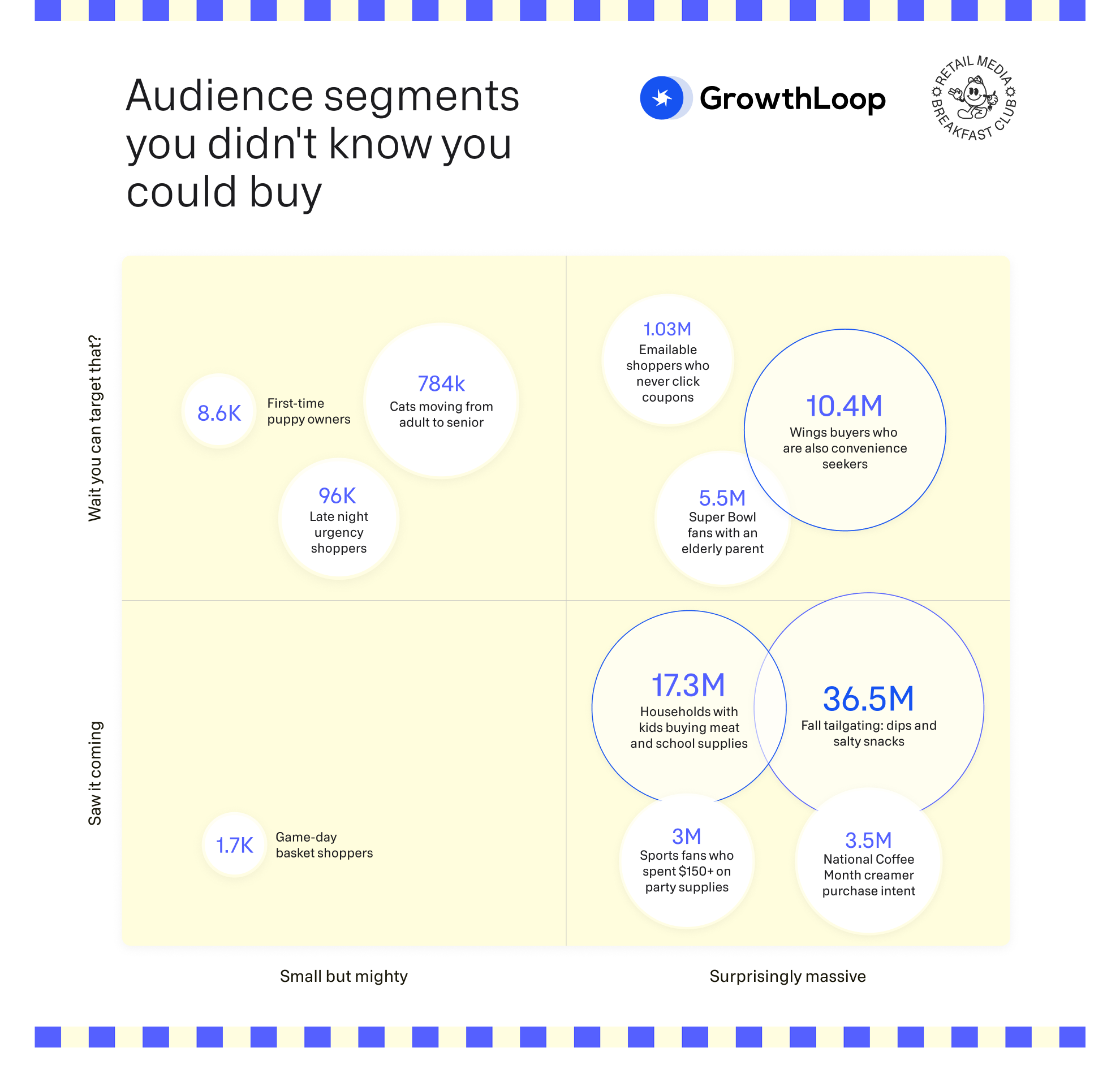
Anthony: If you're buying an onboarding tool or an all-in-one suite where only some of the data is loaded into it, you may not know that [a customer's] cat is moving from adult to senior, or that the Super Bowl fan is taking another action. There's all this contextual data that you may be missing.
That was our bet when we started on the lifecycle marketing side almost a decade ago. Folks were investing in bringing all this rich data into their data warehouse, so what if we built a system that plugged directly into there? A few years later, that also turned out to be a great place to serve media networks. You get contextual data that may not even be that valuable to [the retailer's] own marketing, but may be really valuable to the consumer goods companies buying audience access through the network.
Where the line gets drawn
I asked Anthony for an example of a retailer refusing to use some of its data in order to preserve their customer relationship. He described a set of rules one GrowthLoop customer built into the self-serve tool its advertisers use to build audiences:
- Advertisers can't narrow an audience down to 100 or 10 people, because at that size they could start working out who's in it.
- They don't get to see the level of detail the retailer uses for its own marketing.
With these safeguards in place, the retailer knew they were providing brand partners with everything they needed, and nothing they didn't. "Each organization has a different understanding of what's holy to them, and we want to enable them to keep those rules in place," Anthony said.
The segments that make a media buyer sit up are the ones that combine data from very different places, like the Super Bowl fan with an elderly parent from GrowthLoop's list.
GrowthLoop's recent research suggests a distinctive audience gets a network into the conversation without winning the budget on its own. 34% of advertisers rank the relevance of a retailer's customer base among the factors that most influence which networks they choose. Pricing and fees (47%) and audience targeting capabilities (46%) both rank higher. That's where speed comes in, and we'll get to that later in this series.
Next in the 'Arming the Rebels' series: Martech before media. Why the first job for many new retail media leaders is fixing the marketing team's customer data.