This piece was originally published to my column at The Drum on January 29, 2026 as While everyone debates agentic shopping, Amazon’s Rufus is racking up sales
New research from Sensor Tower, analyzing over 100,000 real Amazon shopping sessions during the 2025 holiday season, shows AI-assisted shopping isn't a novelty anymore—it's becoming a default consumer behavior. On Black Friday, Rufus-assisted sessions captured approximately 40% of total sessions but drove roughly 66% of purchases. Sessions involving the assistant converted at 3.5 times the rate of non-Rufus sessions—a gap that held steady across October, November, and December.
Most striking: nearly all incremental holiday growth on Amazon came from AI-assisted shopping. Rufus sessions rose approximately 90% from October 1 through Black Friday week, while non-Rufus sessions grew just 8%.
This data matters because Amazon has been making bold claims about Rufus that the industry struggled to verify. On the company's Q3 2025 earnings call, CEO Andy Jassy reported that Rufus had reached 250 million active customers, with monthly users up 140% year-over-year and interactions up 210%. Customers who used Rufus during a shopping trip were 60% more likely to complete a purchase, he said. And the headline number: Rufus was on track to deliver over $10 billion in incremental annualized sales.
The claims got people talking, mostly because nobody could figure out what the numbers actually meant. What defines a Rufus "user"? Does "sales" mean Amazon's net revenue or gross merchandise value? What baseline are we comparing against? Without answers, many industry observers filed the numbers away as corporate PR and moved on. Sensor Tower's independent research picks up where those questions left off—and suggests Jassy's claims, while imprecise, may have directionally undersold what's actually happening.
SPONSOR: MIRAKL ADS
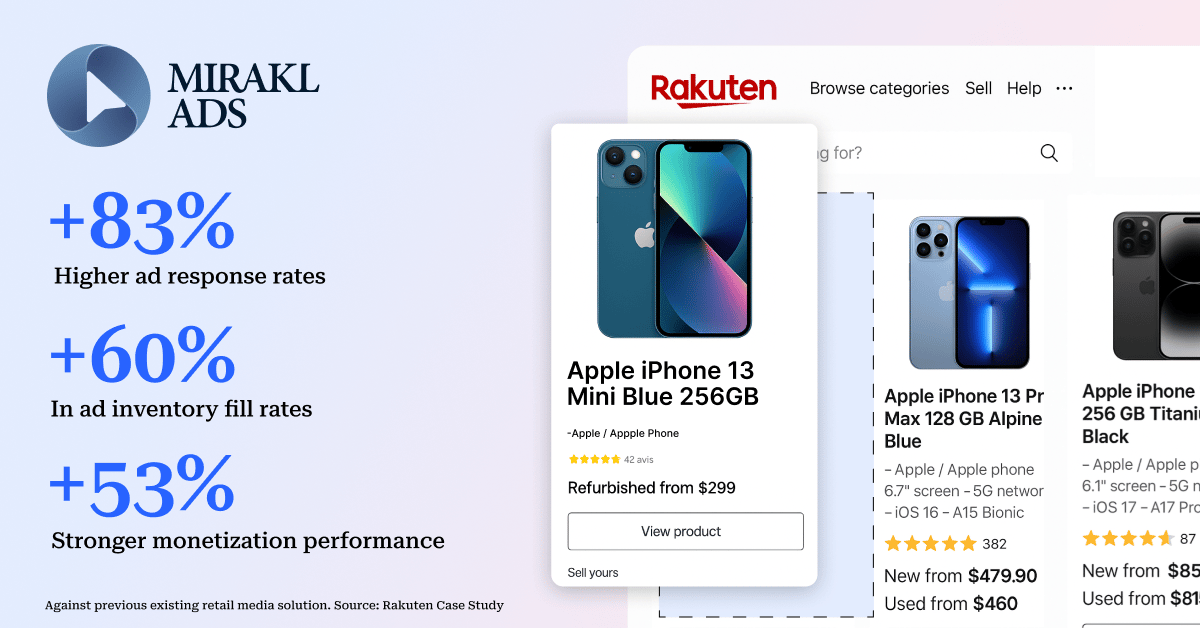
Did you know leading retailer media networks drive 85% of their ads revenue through mid- and long-tail advertisers?
Mirakl Ads provides full funnel ad formats tailored to both 1P and 3P advertisers, leveraging unique AI-capabilities that provide unprecedented levels of relevance and engagement.
Retailers who want to capture ad spend from the long tail of 3P marketplace sellers use Mirakl Ads in their tech stack.
What Amazon Got Right
In a more recent interview with The Information, Jassy doubled down on Rufus as Amazon's answer to third-party AI shopping agents. Physical retail still has advantages in discovery, he acknowledged—the ability to walk in, ask questions, refine those questions, have somebody point you to different things. Jassy argued that Rufus addresses this gap within the digital experience.
On competitors like OpenAI building shopping capabilities, he was diplomatic but pointed: many third-party agents don't have your buying history, your preferences, or accurate information about pricing and products.
He's not wrong, as it pertains to on-site shopping assistants. But notice what Amazon did not do with Rufus: add recipe planning, lifestyle content, or other features of questionable relevance to the core shopping mission. Amazon recognizes that people come to their platform to shop. The assistant stays focused on that job.
This restraint sets Rufus apart compared to some other retailer AI experiments I've observed. Instead of making assistants genuinely useful alternatives to search, unnecessary features get bolted on. The result is bloated tools that don't actually help shoppers accomplish their primary goal. Amazon avoided that trap by keeping Rufus tightly scoped to what shoppers actually need: finding products, comparing options, answering questions, building confidence to purchase.

The Funnel Insight That Matters
Beyond headline conversion numbers, Sensor Tower identified ten distinct shopper behavior patterns that reveal when and why shoppers invoke the assistant.
For example:
Search Assistant (~28% of sessions, ~35% conversion) — Most common pattern. Shopper does multiple searches, can't find the right product, turns to Rufus to get unstuck.
Cart Reconsiderer (~7% of sessions, ~50% conversion) — Shopper has items in cart, hesitates, invokes Rufus to overcome objections and confirm fit. Late-funnel rescue.

The insight here is that AI-enabled shopping is not one funnel. The "Early Decider" asks Rufus a quick question at the start, gets confidence, and converts at 85%. The "Research Conversationalist" engages deeply throughout 150-minute sessions of heavy product comparison, converting at 54%.
Retailers who get this right will design for these patterns, not just adding a chatbot and hoping for the best. ‘Search Assistant’ type behavior needs different support than ‘Cart Reconsiderers’.
A Necessary Caveat
Before anyone cites "3.5x conversion lift" as proof that AI assistants cause purchases, some methodological caution is warranted.
Rufus usage could correlate with higher intent rather than cause higher conversion. Heavy Amazon shoppers—those most likely to convert regardless—may also be most likely to use Rufus. The research defines "Rufus sessions" as any session with even brief interaction, which could inflate gaps. And the methodology relies on modeled panel data that may be revised.
This data shows AI-assisted journeys are tightly linked to high conversion and likely improve outcomes for at least some shopper segments. Consider it a strong directional signal, not a causal proof point.
The Next KPI To Watch
If Rufus is genuinely improving product understanding and purchase confidence—not just accelerating decisions shoppers would have made anyway—we should see evidence in post-purchase outcomes. Lower return rates. Fewer cancellations. Fewer exchanges. Especially in high-research categories where the assistant guides complex decisions.
This is the measurement that will prove whether AI actually makes shopping better - or faster. Retailers and brands should start demanding this data split: AI-assisted versus non-assisted post-purchase outcomes. Until we see that analysis, conversion lift remains an incomplete picture.
What This Means for Retail Media
If assistants become primary decision aids, the monetizable unit shifts from search result placement to inclusion in the assistant's answers. Amazon has already introduced sponsored ad units within Rufus, and I'll be reporting soon on how those early placements are performing for brand advertisers.
But that's a topic for a future column. The more immediate point is this: we don't need fully autonomous shopping agents to see meaningful disruption. Rufus isn't making purchases on anyone's behalf. It's not a true "agent" in the technical sense. But it's already reshaping how a significant share of Amazon shopping sessions unfold—and capturing a disproportionate share of actual purchases.
The disruption starts at question-answering, comparison, and confidence-building. It starts when shoppers invoke an assistant to get unstuck, validate a choice, or navigate complex research. It starts well before anyone hands their wallet to an algorithm.
Amazon can afford to play the long game. Other retailers watching these numbers should recognize they don't have that luxury. Everyone's waiting for the agentic future. Don’t miss what's already changed.
COMING UP

Retail media networks have exhausted the "easy money" of trade and shopper marketing budgets. Now they're knocking on the door of brand marketing—but the playbook that got them here won't get them there.
In this LIVE session, I'll sit down again with Jordan Witmer (Salt XC) we're going to breaking down what brands need to be asking about when retailers come calling on that alluring brand marketing budget.
If you haven't joined one of our live sessions yet, its kind of like a live podcast where we take audience comments and questions in stride. Join us live on Feb 19 as we hash this topic out.
Jordan brings an especially informative POV to this topic since prior to leading retail media at Salt, he was brand-side at Kenvue, Hershey and Stanley Black & Decker.
Sign up to join live or be notified of the replay!