Last week I was on a panel at Mirakl's annual customer summit in New York, when the moderator opened with a World Cup analogy. Most of the room had already qualified, he said — they had marketplaces up and running. But qualifying and winning the tournament are different things.
I reached for a sports metaphor too, but because I can't fake being a sports fan even if my life was on the line, I got my own sports analogy wrong on stage. But history belongs to those who write it, so let me fix it here.
I said that having a marketplace was like getting everyone into the stadium, and the next step was selling them popcorn and drinks. But concessions aren't where the money is. What (upon further research) actually makes a sports franchise valuable is the media rights and the sponsorships, the money a franchise commands because it reliably draws an audience. You spend years building a team worth watching. The enterprise value is in what you can sell to the crowd.
That's the better analogy for a marketplace. The assortment is the team — the reason anyone shows up. Advertising is the media-rights. But some retailers who've built a healthy marketplace, a roster people actually come for, haven't started selling against the audience at all.
One flywheel, not two
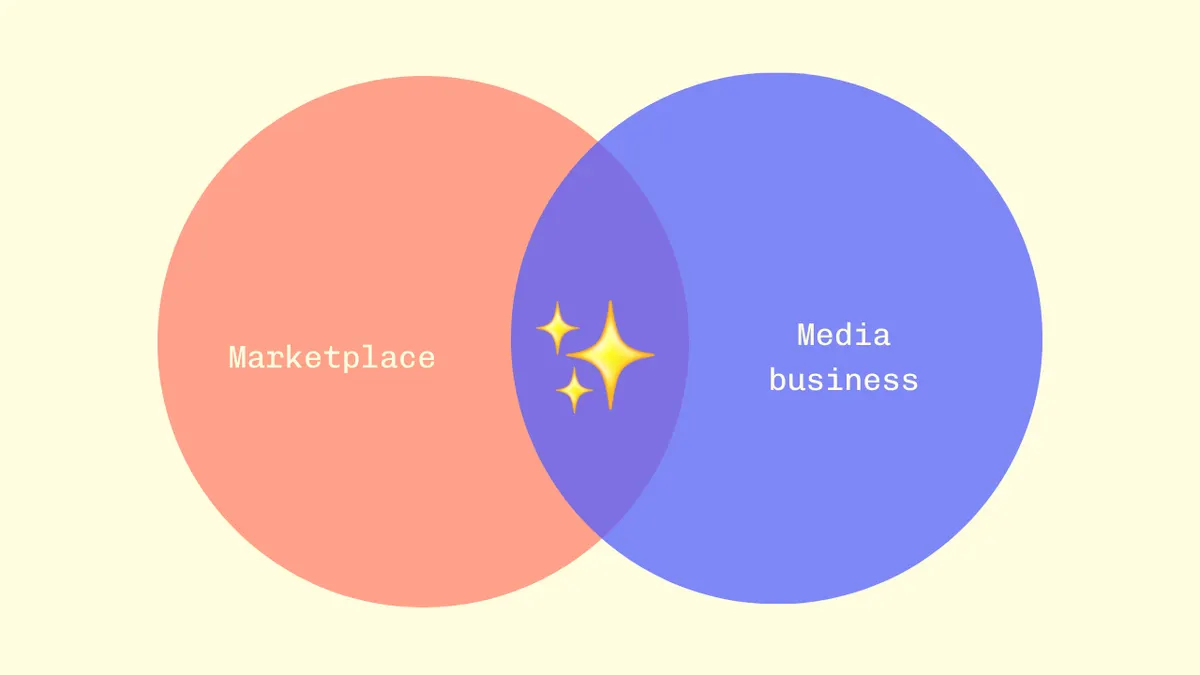
A marketplace and a retail media network aren't two businesses you run side by side. They're one flywheel.
A healthy marketplace is constantly adding sellers. Those sellers compete for the same shoppers, and on a marketplace, the way you stack the odds in your favor is visibility — which is to say, advertising. More sellers means more competition for visibility, which means more ad demand, which means more revenue to reinvest in the experience, which attracts more sellers. The marketplace is the engine. The ads that sellers buy is a phenomenal way to monetize the competition the engine creates.
Advertising is the exhaust of a healthy marketplace.
I've written before about the retail media doom loop — the trap where retailers stand up a network by repackaging finite trade dollars, ride the early spike, then stall when that money runs dry and they can't justify the next round of investment. Marketplace ad dollars are one way out. They're net-new — motivated sellers who need visibility to survive, spending money your merchant team isn't already fighting over.

The rules of retail media are being rewritten. Discovery is shifting. The economics are following. And the retailers and brands defining the next era aren't watching it happen from the sidelines.
Meet the Mirakl team at Cannes Lions, June 22–26, for curated conversations, exclusive events, and 1:1 strategy sessions built for where the industry is headed.
Commerce-first media starts in Cannes.
Lowe's understood the assignment
At the event, Mirakl cofounder Adrien Nussenbaum interviewed Michael McCluskey, Lowe's VP of Marketplace, alongside Latoya Townes, the Stanley Black & Decker leader who ran Black & Decker's launch on Lowe's Marketplace.
Lowe's uses its marketplace to do things that are hard to pull off in a physical store. Items like above-ground pools, infra-red saunas, and oversized seasonal items. All the long-tail stuff that a big-box footprint can't hold. It lets them say yes to customers instead of no.
It lets them move fast: when a "porch goose" trend took off , the goose became a top seller. Lowe's more than doubled their SKU count inside roughly a year, thousands of sellers, still invite-only to protect brand trust. And a real chunk of marketplace customers are new to Lowe's.
But Lowe's they deliberately did not launch ads in year one. Retail media came in year two, in beta through Mirakl Ads. McCluskey's framing was that the decision actually got pulled forward because the sellers themselves were asking for it, with budget already allocated.
That's the flywheel turning on. You don't have to manufacture demand for the ad business. If the marketplace is healthy, the sellers show up asking where they can buy ads. I said as much on my own panel: Lowe's launches a marketplace, and immediately the sellers are asking where the ad inventory is. They know that to beat the incumbents to the top of search, they have to pay their way up.
Townes made the seller side of this concrete. Black & Decker has about as much brand awareness as a tool brand can have. They still want retail media — not to build awareness, but to surface their extended marketplace assortment to customers who don't yet know it exists. That's a high-awareness brand that's still eager to run ads in order to maintain findability.
A tale of two retailers
The reason Lowe's stuck with me is that some other private conversations I had that week were with retailers running only half of the playbook.
One runs a genuinely good marketplace and hasn't layered ads on top yet. The demand is sitting right there — their sellers are competing for visibility whether or not anyone's charging for it. But they're not capturing any of that upside.
Another retailer I chatted with had the opposite problem: a thriving retail media business, and a leader who wants to add a marketplace precisely because they can see the net-new ad dollars and the more interesting assortment on the other side. But the internal view at their company is that marketplaces look risky.
And marketplaces are risky if you do them badly — counterfeit, quality control, brand safety, the customer who has a bad third-party experience and blames you, not the seller. Lowe's, and many other retailers, have stayed invite-only for that reason.
But the prize is there for the effort. A Forrester study commissioned by Mirakl (December 2024, 160 retailers across North America and EMEA) found that mid- and long-tail advertisers account for about 28% of retailer ad revenue on average. But top-performing networks actually derive 85% of their ad revenue from the mid-long tail.
Escape velocity
I'll leave you with the wrinkle that Dan Brenner, a Partner at Bain & Company, raised on our panel.
Say you do it right. You build the marketplace, you switch on the ad engine, you tap the long tail, you hit something like escape velocity. There's a version of the next few years where a chunk of those hard-won ad dollars gets disintermediated anyway — where AI shopping agents assemble baskets without ever passing through the search results and category pages that retail media monetizes. I've spent more than my share of wordcount in this newsletter arguing that point.
But this is where format evolution steps in. Retailer chatbots can bear some ad load. Not the same volume as a search result homepage, but presumably more relevant results that brands would be willing to pay more for. And there are other ad formats that are resilient to AI-assisted shopping journeys. (Read more here and here)
So this isn't a finish line. But it is a better starting position. The retailers who get the marketplace and the media business spinning as one flywheel will be in far better shape to adapt to whatever comes next than the ones still running a network on fumes from the trade budget.
Disclosure: Mirakl Ad sponsors this newsletter.