
A version of this article originally ran in my column for The Drum on Spetember 24, 2026 as 'Best Buy Ads’ showcase moves on from the sponsored product ad. I've reworked it for RMBC to look at the trend behind Best Buy's showcase, including how Best Buy's pitch has changed since last year and what other retailers are doing.
Patrick Albano and I spoke on related panels at an Ad Club of New York event in September, making similar arguments about brand building in commerce media.
During my session I asked the room for a show of hands: how many people were actually using the brand-building parts of commerce media in their media plans? A couple dozen hands went up agreeing that it was possible for retail media to drive brand awareness, but more than half of those hands went down when it came to putting that belief into action.
About a week later, ahead of Best Buy Ads' annual showcase event, I spoke with Albano, who is Chief Revenue Officer at Best Buy Ads. We talked about how brands do want brand-building capabilities from retail media, but the follow-through from the people holding the budgets isn't there yet. "I think it's just something that will take a little time to change, but the mechanics of the offer, the opportunities are there," he said.
At the showcase itself, the sponsored product ad barely came up, except as one of the channels the new multi-touch attribution tool will track. That stood out because Best Buy was one of the first US retailers to ship sponsored product ads, back in 2011. The retailer that helped get the format started now puts its energy somewhere else.
Last year's pitch vs this year's
I wrote up some themes from 2025's showcase, "We Got Next," in this same newsletter last year. A quick comparison:
2025
- One of the big ideas was a platform pitch. Lisa Valentino, who leads Best Buy Ads, told me the company was "all in" on building shared customer data sets with other retailers
- Store takeovers, sports partnerships and offsite expansion
- A large new studio facility
2026
- CTV across Insignia televisions, through an expanded Fire TV agreement with Amazon
- A relaunched creator program that brings in Blue Shirt store staff
- The production studio opened up to more brands
- A TikTok Shop arriving in late October
- Attribution for every advertiser and upgraded incrementality testing
The emphasis moved, but in both years the headline items didn't have much to do with the search results page. Onsite performance ads still run and still earn, but by putting these big bets on the stage, we can see what they aspire to be.
Are manual processes slowing down your RMN momentum?
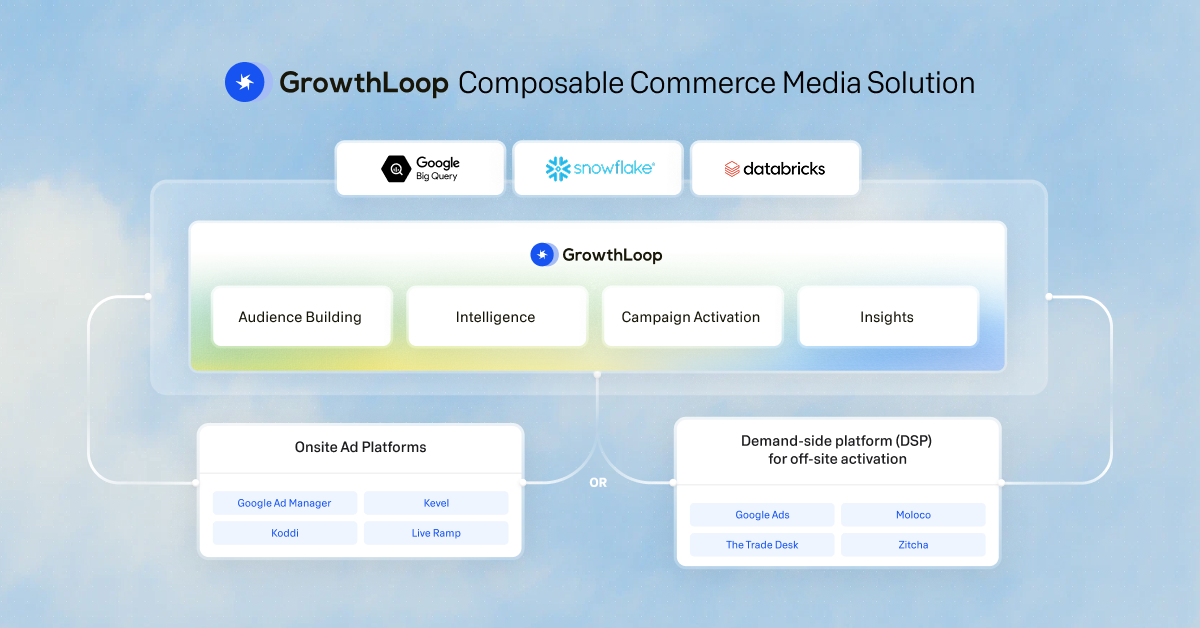
With GrowthLoop’s composable commerce media solution, retail media and ad teams can build and launch precise audiences in minutes, activate across DSPs and ad platforms, and deliver transparent ROI reporting that drives advertiser revenue.
Learn how retail media leaders at Costco, Fanatics, and Gopuff use GrowthLoop to deliver stronger results for their brand partners.
Why the growth has moved
Two reasons come to mind:
Budgets. Onsite performance ads like sponsored products make up most of US retail media spend, although Amazon and Walmart likely blow that balance out a bit. Best Buy has run its ad auction for 15 years and has a scaled third-party marketplace, whose sellers rely on performance ads and rarely buy CTV. I'm not sure Best Buy has maxed out sponsored products, but the ways to grow that line are limited:
- raise prices
- bring in more advertisers
- get existing advertisers to spend more over time
As those narrow, growth has to come from national brand budgets, which is where many retailers have been looking for the past couple of years.
AI. This is my read, but Albano described a change that fits it. "You're seeing more people start with LLMs and go directly to Best Buy. So that means the funnel is condensing."
If the research happens in a chat assistant and the visit lands straight on a product page, fewer shoppers use the search bar, and the results page where most sponsored product inventory sits gets fewer eyeballs. [LINK: earlier agentic commerce pieces] A TV spot during live sports, a creator video or an event in a store doesn't depend on that page, and an assistant can't skip it.
Best Buy has been more proactive than most retailers in integrating with AI assistants. It was an early mover in putting its catalogue into ChatGPT, and was one of the first retailers to launch ads there. The new products look like belt and suspenders in case the path to Best Buy changes.
Best Buy isn't the only one
The largest networks are heading the same way by different routes:
- Walmart completed its $2.3bn acquisition of Vizio in December 2024. Ryan Mayward, US general manager of Walmart Connect, said in September: "As those capabilities mature, our advertising business opportunity size will be much bigger than that which is enabled by the retail business."
- Albertsons Media Collective launched a "BOGO for retail media" last year, matching brands' ad buys with its own enterprise marketing spend. Brian Monahan, who leads the business, told me the goal is crossing "the chasm from shopper and trade budgets to brand budgets."
Sponsored products still pay most of the bills here, to be sure. But the trend is about where they expect the next dollar of growth.
What Best Buy's own research shows
Best Buy commissioned Circana to run a marketing mix model across two years of sales, four categories and $2.3bn in media, against the largest national media platforms. Best Buy Ads:
- returned ROAS 17% better than the national media average
- made up 17% of spend but 35% of measured media contribution to sales
- generated 9.9% of the brand equity measured (using YouGov data)
- drove nearly 16% of media-driven sales at competing retailers
Best Buy presents this as evidence that retail media builds brand. Read it the other way and it explains why Best Buy needed something new: its existing mix is very good at converting demand and middling at creating it.
The competitor halo is the more unusual disclosure. Brands have long known it happens, but retailers have little incentive to measure sales at other retailers. Publishing it is a pitch to the national brand budget, which counts sales wherever they happen.
Albano noted the study finished before the new products launched. "So I suspect that in the next wave of this, we'll see an even better result from that."
Media that looks like the retailer
Retail media gets criticised for being one-note, which came up in last week's episode on the Ipsos research which bemoaned retail media as a creative wasteland. That's fair when a retailer runs the same playbook as everyone else and buyers compare networks on performance metrics alone.
But Best Buy is selling what makes it unusual: its pull with sports and gaming culture, the trust shoppers place in Blue Shirt staff, and a store footprint that is growing again (its latest annual report plans the first net increase in US stores in more than a decade).
The networks with something distinctive to sell will have an easier time moving beyond sponsored products than the ones whose main asset is search traffic.
Still waiting on the buy side
Back to that show of hands. Best Buy and some of its peers are building routes to brand budgets. Let's see how it bears out.